Travel Guide · Travel Guides · Updated August 2026
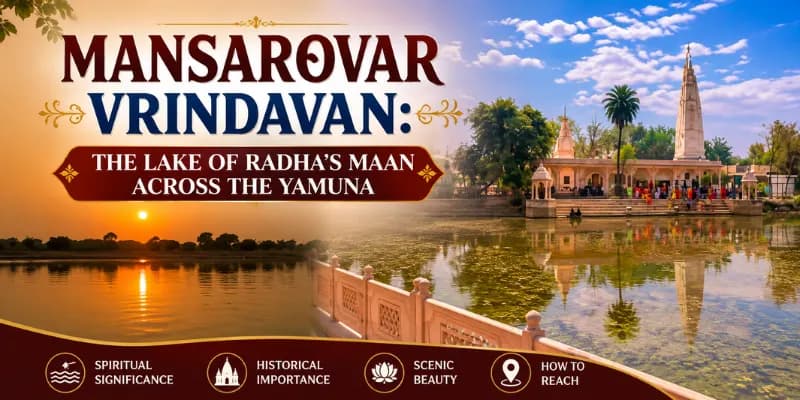
Mansarovar Vrindavan: The Lake of Radha's Maan Across the Yamuna
By Gurudutt, Experience My India·20 August 2026
Quick Answer
Quick Enquiry
Key facts at a glance
Detail | Information |
What it is | A forest lake near Vrindavan of Radha's maan-leela |
Name meaning | Maan, loving pique; sarovar, lake; the lake of maan |
Where | Across the Yamuna, opposite Vrindavan, in a solitary forest |
Revered as | Formed from Radha's tears in her maan; where Krishna pleased her |
On the bank | A temple of Radharani, with a painting of the maan-leela |
Also | A rare wetland grove and bird sanctuary of about five acres |
Scripture | The pastime is sung in Jayadeva's Gita Govinda |
Entry | Free; open through the day |
Mansarovar Vrindavan: an overview
Across the Yamuna from the busy lanes of Vrindavan, in a solitary grove of pilu, kadamba and tamaal trees alive with peacocks and birdsong, lies one of the most tender and least-visited of all the sacred waters of Braj: Mansarovar, the Maan Sarovar of Shri Radha. Its name joins maan, the loving and transcendental pique of the beloved and sarovar, a lake; for by the cherished tradition of Braj this is the very lake formed from Radha's tears, shed in the exalted mood of maan and the place where Krishna came to please her. It is a peaceful forest lake and bird sanctuary, with a temple of Radharani on its bank. This guide gives the full story, what the tradition tells, a note on the name, what to see, the timings and how to reach; and if you are planning a mathura vrindavan tour package with Experience My India, this hidden lake of divine love is a place the seeking heart will treasure.
Why visit Mansarovar:
To behold the hidden lake revered as formed from Radha's tears of loving maan
For one of the most tender leela-sthalis of Braj, sung in the Gita Govinda
A solitary forest lake and bird sanctuary, deeply peaceful, away from all crowds
The temple of Radharani on the bank, with its painting of the maan-leela
A rare, contemplative darshan for those who seek the quieter Braj
From the ground (Gurudutt): Maan Sarovar is one of my most treasured places to bring devotees who want the hidden, contemplative Braj. It is across the river, reached traditionally by boat from Keshi Ghat and a walk through the forest, so few come and that is its blessing: you will often have the lake, the birds and the silence to yourself. I always explain first that Radha's maan is not a worldly sulk but the highest, sweetest mood of divine love and that the Lord placing his head at her feet is his supreme tenderness. Go with a guide, for it is solitary and unsigned and go with a soft heart. We hold all of this with the deepest reverence. See our Mathura Vrindavan tour Package or message WhatsApp +91 7302265809.
The story of Maan Sarovar: Radha's maan-leela
By the cherished tradition of Braj, the story of Maan Sarovar unfolds like this and is recounted here with reverence:
During the rasa-leela by the Yamuna, Shri Radharani entered the exalted and transcendental mood of maan, the loving pique that is itself a height of divine love.
In that mood she quietly left the circle of the rasa dance and crossed the Yamuna to this solitary forest, far from the others.
Feeling the pang of separation from Krishna, she wept and the stream of her tears is said to have formed this very lake, the sarovar.
Krishna, the supreme relisher of loving mellows, searched for her and found her here in the grove.
To please her, he placed his flute and his own head at her lotus feet, admitting his fault and vowing never to grieve her so again.
And so, pleased, Radha's maan melted; from that day the lake has been called Maan Sarovar, the lake of maan.
This is the divine and transcendent love-play of Shri Radha and Krishna, never a worldly quarrel or a mundane matter; the maan of Radha is revered as among the sweetest of all the moods of love. We present it as the cherished belief and tradition of Braj, held with faith and recounted with reverence.
What the tradition tells
Sung in the Gita Govinda. This pastime, of Krishna placing his head at Radha's feet and praying for her grace, is beautifully sung by Jayadeva Goswami in his Gita Govinda, cherished across the devotional world.
The painting in the old temple. On the bank of the lake, an old temple worships a painting of this very scene, of Krishna at Radha's feet and a marble temple holds the vigraha of Shri Radharani.
Where Shiva became a gopi. By the tradition, it was here that Lord Shiva bathed to take the form of a gopi, that he might enter and behold the rasa-leela of the Divine Couple, a story dear to the devotees of Braj.
The baithak of Vallabhacharya. A baithak, a seat, of Shri Vallabhacharya is honoured at Maan Sarovar, for the great acharya of the Pushtimarg sat and discoursed on the leelas here.
We recount these as the cherished tradition of Braj, held with faith and reverence.
Mansarovar or Maan Sarovar? A note on the name
A word to clear two common confusions, for the name is shared by more than one place:
Not the Kailash Mansarovar. This Mansarovar is the Maan Sarovar of Radha near Vrindavan, in Braj; it is quite distinct from the famous Lake Manasarovar beside Mount Kailash in the Himalayas, with which the name is often confused.
Not the Maan Mandir at Barsana. It is also distinct from the Maan Mandir or Maan Garh, at Barsana, another site of Radha's maan on a hill; both remember the maan of Radha, but they are different places, one a hilltop temple at Barsana, this a forest lake across the Yamuna from Vrindavan.
So when pilgrims speak of Mansarovar in Vrindavan, they mean this hidden forest lake of Radha's maan-leela; the maan mandir barsana is its namesake at Barsana. We note this simply for clarity.
Mansarovar at a glance
Detail | Information |
Type | A forest lake and leela-sthali of Radha's maan |
Where | On the Yamuna, opposite Vrindavan, in a solitary grove |
Revered for | Radha's maan-leela and Krishna's pleasing of her |
On the bank | A temple and vigraha of Shri Radharani; a painting of the leela |
Nature | A wetland grove and bird sanctuary of about five acres |
Trees and birds | Pilu, kadamba and tamaal; peacocks, cuckoos, swans and deer |
Best for | Quiet, contemplative darshan away from the crowds |
In one line: Mansarovar is the hidden forest lake across the Yamuna from Vrindavan, revered as formed from Radha's tears of loving maan and as the place where Krishna pleased her.
What to see at Mansarovar
The lake itself. A big, deep lake of cold, pure water, set in a serene forest grove, revered as formed from Radha's tears; simply to sit by it in the birdsong is the heart of a visit.
The temple of Radharani. On the bank stands a temple, in part of white marble, with the vigraha of Shri Radharani and an old shrine worshipping the painting of Krishna at Radha's feet.
The bird sanctuary and forest. A rare wetland grove of about five acres, with pilu, kadamba and tamaal trees and peacocks, cuckoos, swans, deer and other creatures, a place of deep natural peace.
The Vallabhacharya baithak. The honoured seat of Shri Vallabhacharya, where the acharya of the Pushtimarg discoursed on the leelas of Radha and Krishna.
The other sacred waters of Braj are gathered in our braj kunds and sarovars guide and the Pushtimarg seats in our baithakji of mahaprabhu in braj guide. We recount these as the cherished tradition of Braj, with reverence.
Timings, entry and the best time to visit
Detail | Information |
Lake and temple | Open through the day; visit any daylight hour |
Entry fee | Free |
Best season | October to March and each Purnima |
Special day | Sharad Purnima, the night of the rasa-leela |
Best time of day | Early morning, for the birds and the calm |
Time needed | A quiet hour or more, for the lake and the temple |
Maan Sarovar, being a forest lake with a temple on its bank, may be visited freely through the day; there is no entry fee. Devotees especially come on the Purnima and the cool months of October to March are the loveliest. Because it is solitary and unsigned, allow time and go with a guide. The general hours of the region's temples are set out in our mathura vrindavan temple timings guide.
How to reach Mansarovar
Mansarovar lies across the Yamuna, opposite Vrindavan; the ways to reach it are given below.
From | Route | How to travel |
Vrindavan (Keshi Ghat) | Boat across, then a walk through the grove | The traditional way, by boat and on foot |
Vrindavan (by road) | Around by the river bridge | Car or auto, a longer way round |
Mathura | About 15 to 20 km by road | Car, taxi or bus |
Mathura Junction (railhead) | About 15 to 20 km | Train, then road |
Delhi airport | About 150 km | Flight, then road |
In short, by each way:
By boat and on foot (the traditional way): take a boat from Keshi Ghat in Vrindavan across the Yamuna, then walk through the forest to the lake; it is the loveliest approach, though solitary, so go with a guide.
By road: a car or auto can reach the area by a longer route around the river bridge; the last stretch is quiet and unsigned, so local guidance helps.
Arriving in Vrindavan: Mathura Junction, about 15 to 20 km away, is the nearest railhead and Delhi the nearest airport; those coming by rail can see our tundla to vrindavan distance guide for the last leg.
The ghats of Vrindavan, including Keshi Ghat, are covered in our braj yamuna ghats and leela sites guide and getting around Braj in our how to commute in vrindavan guide.
Places to visit near Mansarovar
Mansarovar is reached from Vrindavan, so the great sites of the town are the natural companions to a visit; the nearby places at a glance:
Place | Distance | What it is |
Keshi Ghat | The crossing point | The great ghat of Vrindavan on the Yamuna |
Banke Bihari | In Vrindavan town | The beloved heart of Vrindavan |
Prem Mandir | In Vrindavan | The great marble temple of divine love |
ISKCON temple | In Vrindavan | The Krishna-Balaram temple |
Bhandirvan | Across the Yamuna | The forest of the Bhandir banyan |
In Vrindavan itself are the beloved banke bihari temple, the magnificent prem mandir vrindavan and the iskcon temple vrindavan; Mathura and the birthplace at the shri krishna janmabhoomi temple are a short drive on. So Maan Sarovar is best woven into a Vrindavan visit. We hold these as the tradition of Braj, with reverence.
Tips for your visit and how to plan
Go with a guide; Maan Sarovar is solitary and unsigned and the forest approach is easy to miss.
Come in the cool early morning for the birds and the deepest calm of the grove.
Understand that Radha's maan is transcendent divine love, not a worldly sulk; visit with reverence.
Take the boat from Keshi Ghat if the river allows; it is the loveliest approach.
Entry is free; carry water and a little cash for any free-will offering and beware of touts.
Pair it with a Vrindavan darshan day of Banke Bihari, Prem Mandir and the ghats.
Our mathura vrindavan tour itinerary helps you shape a Vrindavan day that can include this hidden lake.
We arrange guided Vrindavan tours that can include Maan Sarovar and the hidden leela-sites across the Yamuna, with pick-up from Mathura or Vrindavan, a comfortable vehicle, the boat crossing where possible and a knowledgeable Braj-born guide to tell the maan-leela on the spot. A shared day tour starts from around ₹1,499 per person, with darshan free at the temples; our vrindavan tour package covers Vrindavan in a day, our mathura vrindavan tour the twin cities and the braj 84 kos yatra the whole circuit. Message me on WhatsApp at +91-7302265809 to plan your visit to Mansarovar.
Related guides
Meet Gurudutt — Your Mathura Vrindavan Guide
Not just a tour operator — Gurudutt was born and raised in Braj Bhoomi. He has spent over a decade personally guiding pilgrims through the sacred lanes of Mathura & Vrindavan.
Founder – Experience My India
Gurudutt
Founder · Experience My India