The seat, not an idol - how a Baithak is worshipped
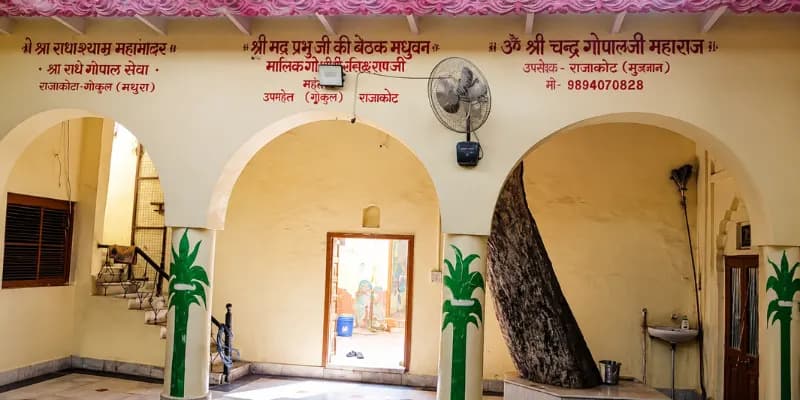
Here is what makes a Baithak unlike almost any other Hindu shrine. A Baithak holds no idol (murti) for worship. Instead, it is the seat itself - the gaddi where Mahaprabhu sat - that is revered, often with his footprints (charan), his manuscripts and his image. Devotees perform seva to the seat, invoking Mahaprabhu's living presence.
The offerings, too, are distinctive: not the elaborate meals of a temple, but water, mishri (sugar crystals) and milk sweets - a custom rooted in Mahaprabhu's own rule that, during his pilgrimages, he cooked and ate by his own hand after offering to his travelling deity. The seats observe the seven darshan periods of the Vaishnava havelis and their histories are preserved in the Pushtimarg's Varta Sahitya (chronicle literature), the details famously recorded by Gokulnathji, a grandson of Mahaprabhu.
Gokul - where Pushtimarg was born
Of all the Braj Baithaks, Gokul is supreme - for it is here that the Pushtimarg itself was born. When Mahaprabhu came to Gokul, by the tradition Krishna appeared to him as Shrinathji and revealed the Brahma Sambandha - the mantra of self-dedication to Krishna by which a soul enters the path of grace. The next morning he initiated his dearest disciple, Damodardas Harsani, as the first Vaishnava of the Pushtimarg. So Gokul is to the Vallabh Sampradaya what no other place can be: its very cradle.
Gokul holds the founding seats:
Govind Ghat - Mahaprabhu's first seat, beneath a chhonkar (sami) tree on the bank of the Yamuna, where he performed his first seven-day Bhagavata recitation (saptah).
Thakurani Ghat - where, tradition says, the Yamuna appeared to him as a beautiful maiden to point out the ghat and where he composed the beloved Yamunashtak, the eight-verse hymn to the river-goddess. A temple of Yamuna and Shrinathji stands here.
(A born-Brajwasi notes honestly: Gokul and old Mahavan are essentially one ancient place and the present Gokul village is a later settlement - never confuse the two Gokuls.) See our Gokul guide.
Mathura - Vishram Ghat & the boy who sang the Yamunashtak
At Mathura, the Baithak stands by the holy Vishram Ghat on the Yamuna. There is a tender story here: it is said that Vallabhacharya first beheld Vishram Ghat as a boy of about thirteen, arriving by boat - and, overcome, spontaneously sang the Yamunashtak in praise of the river-goddess. (Tradition also remembers that Vallabhacharya, together with Keshav Bhatt Kashmiri of the Nimbarka sect, had the oppressive restrictions on Vishram Ghat lifted by the force of their devotion.)
Nearby is Soor Kuti, where the great blind poet Surdas is said to have received initiation from Vallabhacharya - for Surdas became one of the Ashtachhap, the eight poet-singers of the Pushtimarg whose songs adorned the seva of Shrinathji. See the Yamuna ghats guide for Vishram Ghat.
Govardhan & its seats
Govardhan is the second great heart of Pushtimarg in Braj - for it is here that Shrinathji manifested, the deity who became the sampradaya's supreme form. Around the holy hill lie several Baithaks: at Govardhan itself; at Anyor, the village by Shri Giriraj's Mukharvind (the "lotus-mouth" of the hill); at Sundershila, facing the Mukharvind; at Chandrasarovar (Parasoli), the moon-lake of the Raas; and by Radhakund, the most sacred of kunds.
To walk these seats is to trace Mahaprabhu's own devotion to Giriraj. See our guides to Govardhan Hill and the Govardhan temples & Mukharvind. (An honest word: Shrinathji himself is no longer on Govardhan - the deity was carried to Nathdwara, in Rajasthan, during Aurangzeb's reign, where he resides today.)
Vrindavan - the Bansi Vat seat
In Vrindavan, Mahaprabhu's Baithak stands at Bansi Vat (Vamsi Vat) - the sacred tree where, in the leela, Krishna's flute called the gopis to the Raas. Here Mahaprabhu sat in this most charged of leela-spots, by the Yamuna, expounding the Bhagavata in the very grove of the divine dance. (Bansi Vat is covered among the Yamuna ghats and leela-sites.) It is a seat where the Pushtimargi feels the nearness of both Mahaprabhu and the Raas-leela he adored.
Vallabhacharya in Braj
Shri Vallabhacharya was born in 1479 at Champaranya (in present Chhattisgarh), into a line of Telugu Vaidiki Brahmins of the Vishnuswami tradition. He propounded the philosophy of Shuddhadvaita ("pure non-dualism") and founded Pushtimarg, the path of grace (pushti) - teaching that the householder, no less than the ascetic, may attain Krishna through loving service (seva) and his grace.
He had a special love for Braj, staying four months of every year in Vraja and his very kirtans dwell on the baby Krishna and his childhood pranks - the leela of Gokul. He wrote the Anubhashya, the Subodhini (his Bhagavata commentary), the sixteen Shodasha Granthas, the Yamunashtak and the Madhurashtakam. He is revered as an incarnation of Agni (Vaishvanara, the fire-face of Krishna). At fifty-two, he took samadhi in the Ganga at Hanuman Ghat in Kashi. His two sons were Gopinath and Vitthalnath (Gusainji), who would carry the sampradaya forward. (See our saints & samadhis guide.)
The seats of Gusainji & the descendants
The Baithak tradition did not end with Mahaprabhu. His son Vitthalnath Gusainji - who organised the sampradaya's seva, the seven swarups and the Ashtachhap poets - established 28 Baithaks of his own and Mahaprabhu's seven grandsons a further 30, so that 142 seats in all are revered. Many of Gusainji's seats stand at the very places of Mahaprabhu's, deepening the holiness.
It was Gusainji, too, who is credited with securing Gokul for the sampradaya and his line - the Vallabhkul Goswamis - who tend the seats and the great havelis to this day. So when you visit a Braj Baithak, you stand in a living tradition five centuries deep, from Mahaprabhu through Gusainji to the Goswamis of today.
An honest note
A born-Brajwasi owes you precision where it exists and honesty where it doesn't:
The canonical numbering of the 84 Baithaks varies between traditional lists, so I name the Braj seats rather than assigning each a fixed number - different sources count them differently.
Shrinathji is no longer in Braj - the deity was carried to Nathdwara (Rajasthan) during Aurangzeb's reign, where he resides today; Govardhan is his manifestation-place, not his present home.
The date of the Brahma Sambandha at Gokul is given variously (around 1492-94); revere the event and don't fix a single year as certain.
Don't confuse the two Gokuls - old Mahavan-Gokul and the present riverside settlement; and distinguish Mahaprabhu's 84 seats from Gusainji's 28 and the grandsons' 30.
This is the Pushtimarg dimension of Braj told straight.
For the Pushtimargi pilgrim - visiting the Braj Baithaks
A practical word for those touring the Baithaks:
Begin at Gokul - Govind Ghat and Thakurani Ghat, the founding seats, are the heart of a Braj Baithak yatra.
Then Mathura (Vishram Ghat), Govardhan (with Anyor, Chandrasarovar, Radhakund) and Vrindavan (Bansi Vat).
Observe the seva customs - the seat-worship, the mishri-and-milk offerings; follow the Mukhiyaji's guidance at each Baithak.
A guide who knows the Pushtimarg seats - and the Varta stories behind them - makes the yatra immeasurably richer; many seats are quiet and easily missed without one.
Festivals of the tradition
Festival | What's special | When |
Annakut / Govardhan Puja | Pushtimarg's great festival - the mountain of food to Giriraj/Shrinathji | Kartik Shukla Pratipada (after Diwali) |
Krishna Janmashtami / Nandotsav | The Lord's birth and Nand's joy; the heart of the seva | Bhadrapada |
Pavitra Ekadashi | Associated with the Brahma Sambandha at Gokul | Shravana |
Vallabhacharya Jayanti | Mahaprabhu's appearance day | Vaishakha Krishna Ekadashi |
Annakut (Govardhan Puja) is especially dear to the Pushtimarg, recalling Krishna's lifting of Govardhan and the offering of the Annakut to Shrinathji.
Temples to combine
The Braj Baithaks weave through the dham's holiest sites:
Gokul - the founding seats and the Gokulnath temple
Govardhan Hill & Govardhan temples / Mukharvind - Shrinathji's hill, Anyor, Jatipura
Vishram Ghat & the Yamuna leela-sites - the Mathura and Bansi Vat seats
Braj's saints, samadhis & ashrams - Vallabhacharya, Surdas and the Ashtachhap
The Divya Desams of Braj - the Sri Vaishnava tradition's seats in Braj
Browse all at the Famous Temples of Mathura Vrindavan hub.
Author's tips from Gurudutt - what only a local knows
Gokul is the cradle - Govind Ghat and Thakurani Ghat are where Pushtimarg was born; begin your Baithak yatra there.
The seat is the deity - come understanding there is no idol; you revere the gaddi where Mahaprabhu sat.
Carry the Varta in your heart - knowing each seat's story (from the chronicle literature) transforms the visit; a good guide tells them.
Shrinathji is at Nathdwara now - Govardhan is his manifestation-place, not his present home; know the difference.
Annakut at Govardhan is the great day - the Pushtimarg's festival of the food-mountain to Giriraj.
The Gujarati and Marwari families who come to me for a Baithak yatra often weep at Govind Ghat in Gokul - and rightly. This little seat under the old tree, by the Yamuna, is where their whole path was born; where Shri Mahaprabhu sat, where the Lord gave him the Brahma Sambandha. There is no grand idol here, no golden spire - just the seat, the manuscripts, a little mishri offered with love. But for a Pushtimargi, no Banke Bihari, no Prem Mandir, can match it. This is the cradle of their grace. To bring them here is one of the sweetest duties of my work. - Gurudutt