The Six Goswamis
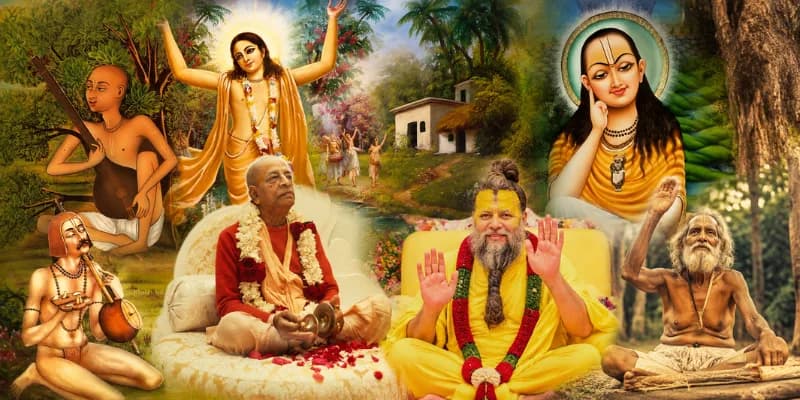
The Six Goswamis of Vrindavan are the scholar-saints sent by Chaitanya to recover the lost leela-sites and write the theology of Gaudiya devotion. They are:
Rupa Goswami - the foremost; author of the great works of rasa-theology; his seat is Radha Damodar, his bhajan-sthali Ter Kadamba.
Sanatana Goswami - Rupa's elder brother; the senior teacher; honoured at Mudia Purnima.
Raghunath Das Goswami - the saint of renunciation, who lived and left his body at Radha Kund.
Raghunath Bhatta Goswami - devoted to the recitation of the Bhagavata.
Gopal Bhatta Goswami - for whom Radha Raman self-manifested from a shaligram.
Jiva Goswami - the great philosopher, nephew of Rupa and Sanatana, also of Radha Damodar.
Their samadhis ring Vrindavan - and the samadhis of Rupa and Raghunath Das ring Radha Kund, where they spent their last years. To offer obeisance at them is core to Gaudiya pilgrimage; without the Goswamis, there is no Vrindavan as we know it.
Swami Haridas
Swami Haridas (16th c.) is the great musician-saint of Braj - founder of the Haridasi tradition, and, in tradition, the guru of Tansen, the legendary court-musician. His deity is Banke Bihari, who, in the living belief, self-manifested to Haridas at Nidhivan out of his devotional song.
Haridas is the fountainhead of Braj's samaj-gayan - the antiphonal devotional singing that still pours through the temples and groves, often through the night. To honour him at Nidhivan, his bhajan-sthali and at Banke Bihari, the deity he gave Braj, is to touch the very source of its music and its most beloved Lord.
The founding acharyas
Braj's living traditions flow from their founder-saints (acharyas):
Chaitanya Mahaprabhu (1486-1534) - the ecstatic Bengali saint, held by Gaudiyas to be Radha and Krishna combined, whose visits re-energised Braj; honoured at Imli Tala, where he sat absorbed in Radha's love.
Vallabhacharya (1479-1531) - founder of the Pushtimarg (the path of grace); his baithaks (the seats where he taught) form their own pilgrimage across Braj.
Hith Harivansh (16th c.) - founder of the Radhavallabh tradition, the most Radha-supreme of all; honoured at Radha Vallabh temple.
Nimbarka - founder of the Nimbarka tradition (the oldest of the four Vaishnava sampradayas by tradition), with seats around Vrindavan and Govardhan.
These four streams - Pushtimarg, Gaudiya, Radhavallabh, Haridasi, with Nimbarka the eldest - give Braj its many doors of devotion.
The poet-saints - Surdas, Raskhan, Meera
Braj's saints are not only philosophers but poets and their verses are the living soundtrack of the temples - not museum pieces, but sung daily still.
Surdas - the blind master of the Ashtachhap (the "eight seals," the eight poets of the Pushtimarg); associated with Chandra Sarovar.
Raskhan - the Muslim devotee whose Krishna-verse Braj still sings with love; his samadhi is near Gokul.
Meera - the Rajput princess-saint, whose Krishna-longing binds her to Braj.
To hear their pads (devotional songs) in a Braj temple is to hear the saints still speaking - the poetry of divine love, centuries old and utterly alive.
Srila Prabhupada
A.C. Bhaktivedanta Swami Prabhupada (1896-1977) is, in the manual's honest words, the reason Braj is now a global pilgrimage. The founder of ISKCON, he carried the Gaudiya tradition and the holy names to the whole world, bringing millions to Krishna and to Braj.
His samadhi is at the Krishna-Balaram Mandir in Vrindavan - the ISKCON temple - a place of immaculate kirtan and deep devotion, drawing pilgrims (many of them from across the world) to honour the saint who opened Braj to all humanity. For the foreign or ISKCON devotee especially, his samadhi is a central darshan.
Premananda Maharaj - a living saint
Among the living saints, Premananda (Premanand Govind Sharan) Maharaj draws the largest contemporary crowds in Vrindavan, standing in the Radhavallabh tradition. His ashram is Shri Hit Radha Keli Kunj (on the Parikrama Marg, in the Varah Ghat / Raman Reti area).
He is best known for an early-morning padyatra (a walking procession, often around 3:45-6 a.m.) followed by pravachan (discourse). Some honest, practical points the manual stresses: darshan is free, organised by token/booking and the ashram does not solicit donations online. Because it is structured and the timing shifts, confirm the day's arrangements before going. A guide who can place him - and gently manage the enormous, disciplined crowds - is a real help.
Devraha Baba & Neem Karoli Baba
Two beloved ascetics of recent memory:
Devraha Baba - the long-lived ascetic who lived on a raised machan (platform) by the Yamuna, blessing devotees with a touch of his foot; he passed in 1990 and is still deeply revered.
Neem Karoli Baba (Maharaj-ji) - the beloved guru of Ram Dass and many Westerners, who left his body in Vrindavan in 1973; his samadhi-ashram here draws a distinct, often Western, following.
Their seats are places of quiet, powerful blessing, each with its own devoted circle.
Other seats - Pagal Baba, Nimbarka & more
A few more seats and shrines tied to saints and traditions:
Pagal Baba Mandir - a tall, multi-storey Vrindavan temple raised by the devotee known as Pagal Baba ("the mad one," in the sweet sense of one mad for God); a popular modern darshan.
The Nimbarka seats - ashrams and the Nimbarka peeth around Vrindavan and Govardhan, of the oldest Vaishnava sampradaya.
Jagadguru Kripalu Maharaj (1922-2013) - founder of the trust behind Prem Mandir; a major modern preacher.
The Vaishno Devi replica - a popular modern cave-shrine attraction in Vrindavan, recreating the Vaishno Devi pilgrimage.
These round out Braj's landscape of saints and their seats, old and new.
What a samadhi means
A word on the samadhi itself, for it is often misunderstood. In the Vaishnava tradition, a great saint is not cremated like an ordinary person but placed in samadhi - buried in a seated, meditative posture - because the saint is held to be eternally present and absorbed in the Lord, not dead but in eternal meditation.
So a samadhi is not a grave but a living seat - a place where the saint remains, blessing those who come with devotion. To bow at the Goswami samadhis or at Prabhupada's, is not to mourn but to seek the living grace of one who is, in the tradition, fully present there. This is why Gaudiya pilgrims always offer obeisance at the samadhis.
Honest notes on visiting the living saints
A few honest pointers, as the manual insists:
Darshan of the great living saints is free and often organised by token or booking; the genuine ashrams (like Premananda Maharaj's) do not solicit donations online - be wary of anyone who claims otherwise in their name.
The crowds are enormous but disciplined - keep the elderly and children out of any crush, follow the ashram's system and don't push.
Approach with respect, not as spectacle - these are living devotional gatherings, not shows; the influencer-reel wave has changed the crowds, but the right spirit is reverence.
Temples to combine nearby
The saints' seats thread Vrindavan's temples:
Krishna-Balaram Mandir (ISKCON) - Prabhupada's samadhi
Nidhivan & Banke Bihari - Swami Haridas
Radha Damodar & Radha Raman - the Goswamis
Prem Mandir - Kripalu Maharaj
Browse all at the Famous Temples of Mathura Vrindavan hub.
Author's tips from Gurudutt - what only a local knows
Thank the Goswamis - without them there is no Vrindavan; bow at their samadhis, ringing the town and Radha Kund.
A samadhi is a living seat, not a grave - come to seek the saint's grace, not to mourn.
Honour Prabhupada at the Krishna-Balaram Mandir - the saint who made Braj global.
Hear the poets sung - Surdas, Meera, Raskhan are the living soundtrack of the temples.
People come to Braj for the deities and forget the saints - but it was the saints who found the deities for us. Rupa Goswami with his books, Haridas with his song, Prabhupada with his ship to the West. Bow at their samadhis and understand: these are not graves. The saint is still sitting there, still absorbed in Radha and Krishna, still blessing every head that bends. Braj is their gift. Say thank you. - Gurudutt