Why Radha Damodar matters in my Braj
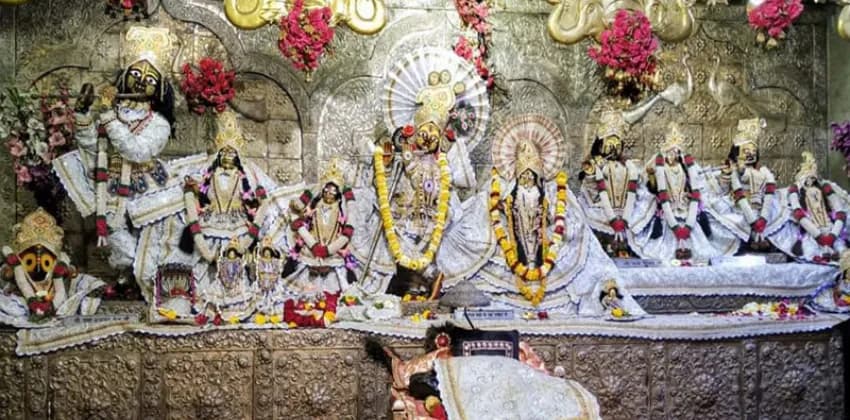
Of all the temples in old Vrindavan, Radha Damodar is the one I take a thoughtful pilgrim to when they want not spectacle but depth. This is the seat of Rupa Goswami - the great scholar-saint whose writings are the very foundation of Gaudiya devotion - and it holds a treasure that has moved me since I was a boy: a stone from Govardhan, marked with Krishna's footprint, which the old and the weak may circle to receive the full blessing of the Govardhan parikrama they cannot walk. Where other temples dazzle, Radha Damodar steadies the heart. Come here to sit, to circle the shila and to bow at the samadhis of the saints who gave Braj back to us. Radhe Radhe.
Rupa Goswami & the Six Goswamis
Radha Damodar is the seat of Rupa Goswami, the foremost of the Six Goswamis - Rupa, Sanatana, Raghunath Das, Raghunath Bhatta, Gopal Bhatta and Jiva - sent by Chaitanya Mahaprabhu to Vrindavan to recover the lost leela-sites and write the theology of the Gaudiya tradition.
Rupa Goswami was the great architect of that theology - his works on the science of bhakti-rasa (the relishing of divine love) remain the bedrock of Gaudiya Vaishnavism. He is also the saint who recovered the Govind Dev deity (see Govind Dev Ji). To stand at Radha Damodar is to stand at the scholarly, devotional heart of the whole bhakti revival that re-monumentalised Braj.
The Govardhan shila - parikrama for the infirm
Here is the treasure that makes Radha Damodar unique. The temple holds a Govardhan shila - a sacred stone from the hill - bearing Krishna's footprint. Tradition holds that circling this shila equals a full parikrama of Govardhan Hill - so the elderly, the unwell and anyone who cannot walk the hill's 21 km may come here and "do Govardhan parikrama" by circumambulating the stone.
I cannot tell you how many frail pilgrims I have brought here with tears of relief - those who feared they would never complete the great parikrama and who found that Krishna's grace had placed it within their reach in a quiet Vrindavan lane. The hill, after all, does not count blisters; it counts love. (For the hill itself, see Govardhan.)
The deity & the name Damodar
The deity is Radha Damodar - Radha with Krishna in his form as Damodar. "Damodar" means "bound at the belly," recalling the tender Gokul leela in which mother Yashoda tied her butter-stealing child to a wooden mortar with a rope. It is a name of intimacy and a mother's love.
This gives the temple a special resonance in the holy month of Kartik - the Damodar month - when all Vrindavan offers lamps and sings the Damodar-leela. The deity's very name makes Radha Damodar a heart of that devotion.
The Goswami samadhis & Ter Kadamba
In the Gaudiya tradition, you offer obeisance to the Goswamis' samadhis - the memorial shrines of the great saints, which ring Vrindavan. Radha Damodar is one of the principal places to do so, associated with the samadhi and bhajan of Rupa Goswami and the saints of his line. Tradition also closely links the temple with the later Goswamis and the writing of the tradition's sacred history here; confirm the specific shrines locally.
Nearby stands Ter Kadamba - Rupa Goswami's bhajan-sthali, the place of his meditation and song. Together they make this corner of Vrindavan the contemplative heart of Gaudiya devotion - a place for stillness, study and the chanting of the holy names.
Darshan timings, entry & photography
Radha Damodar opens for morning and evening darshan, served in the Gaudiya way with kirtan - the congregational chanting of the holy names. The exact windows and aarti times shift between the summer and winter schedules, so I never quote a fixed clock. Check the temple timings guide and confirm locally.
Entry is free. Photography of the deity is generally not permitted - always ask and respect the temple's rule. Keep your phone secure in the lanes against the bold monkeys.
Festivals - Kartik, Gaura Purnima & more
Festival | What's special | When (verify the year) |
Kartik / Damodar month | The deity's own month - lamp-offering (Deepdaan) and the Damodar-leela; the whole town glows | Kartik |
Gaura Purnima | The appearance of Chaitanya Mahaprabhu, founder of the Gaudiya tradition | Phalguna Purnima |
Rupa Goswami's disappearance | Honouring the temple's founding saint | (verify the year) |
Janmashtami | Krishna's birth, kept with Gaudiya devotion | Bhadrapada Krishna Ashtami |
Radhashtami | Radha's appearance | Bhadrapada Shukla Ashtami |
Of these, Kartik is especially Radha Damodar's own - the Damodar month, when the temple of Damodar is at the heart of Vrindavan's lamp-lit devotion. Festival dates are tithi-based and move yearly, so verify the current year's date.
How to reach Radha Damodar
Radha Damodar sits in Vrindavan's old lanes, in the Seva Kunj area near Banke Bihari - so the last stretch is on foot.
From Mathura: 12-15 km (about 20-30 minutes off-peak), by cab, auto or e-rickshaw.
From Delhi / Noida: via the Yamuna Expressway to Mathura (3-3.5 hrs), then Vrindavan.
Last leg: take an e-rickshaw to the lane-edge and walk in; it is near Banke Bihari, Radha Raman and Nidhivan.
For local detail, see the Vrindavan commute guide.
Experience My India is the most trusted and professional travel partner to book your Mathura Vrindavan Tour Package - a guided Vrindavan darshan threads Radha Damodar with the old-lane temples and explains the Goswami heritage and the Govardhan shila.
Best time to visit + crowd, safety & accessibility
Early on a quiet, non-festival morning is ideal - Radha Damodar is generally calm and contemplative, far gentler than Banke Bihari nearby, so a settled darshan and an unhurried circling of the shila are realistic on an ordinary day.
The approach is through narrow old lanes on foot, so elderly pilgrims should come at opening and watch their footing - though, fittingly, this is precisely the temple where the infirm can complete Govardhan parikrama at the shila. Mind the bold monkeys, who snatch phones and glasses and as across Braj, give any generosity to the temple hundi or a genuine gaushala rather than to donation-pressure touts.
Temples to combine nearby
Radha Damodar sits in the old-Vrindavan cluster - combine it on foot with the lane-temples:
Banke Bihari Temple - Vrindavan's most beloved darshan, nearby
Radha Raman Temple - the self-manifested Gaudiya deity, never moved
Radha Vallabh Temple - the most Radha-supreme temple
Govind Dev Ji - the deity recovered by Rupa Goswami
ISKCON Krishna-Balaram Mandir - the modern Gaudiya hub
Browse all at the Famous Temples of Mathura Vrindavan hub.
Food & prasad nearby
The old lanes around Radha Damodar and Banke Bihari are full of Braj food - dense Mathura peda, makhan-mishri, kachori-jalebi for breakfast and lassi in a clay kulhad. Favour busy, freshly-cooking stalls and drink sealed bottled water.
Author's tips from Gurudutt - what only a local knows
The Govardhan shila is the reason to come - if you or an elder with you, cannot walk the hill's parikrama, circle the footprint-stone here and receive its full blessing.
Come for stillness, not spectacle - this is the scholarly, contemplative heart of Gaudiya Vrindavan, a place to sit and chant.
Bow at the Goswami samadhis - Rupa Goswami and the saints who recovered Braj's leela-sites and wrote its theology.
Kartik (the Damodar month) is its own season - the temple of Damodar amid the lamp-lit devotion of the whole town.
Pair it with the old-lane temples - Banke Bihari, Radha Raman, Nidhivan - all a short walk away.
Banke Bihari will overwhelm you; Radha Damodar will quiet you. Sit a while by Rupa Goswami's seat, circle the stone that holds Govardhan in a footprint and you will understand why the scholars chose this lane. - Gurudutt