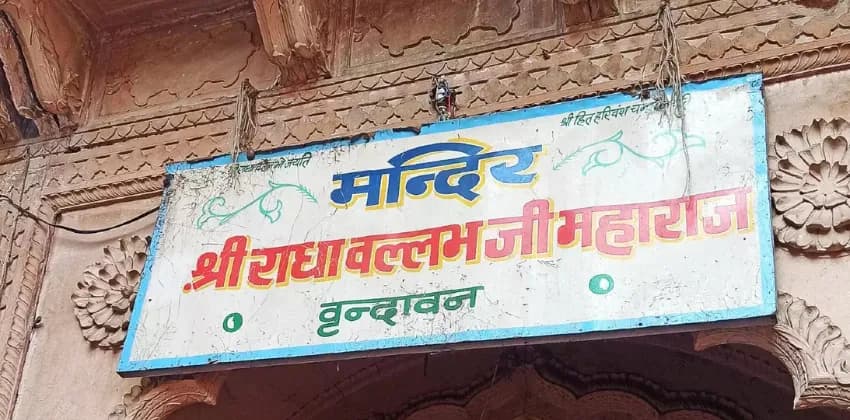
Why is the Radha Vallabh Temple famous?
Radha Vallabh Temple is famous because it worships Krishna as Radha Vallabh, the beloved of Radha, yet keeps no statue of Radha in the sanctum. Instead, a crown is placed beside the deity to signify her presence, a form of worship unique to the Radha Vallabh Sampradaya founded by Hith Harivansh Mahaprabhu.
For pilgrims, that single idea changes how you stand before the deity. You are not looking at a Radha Krishna pair. You are looking at Krishna, with the crown holding the place of Radha, in a tradition that treats Radha herself as the supreme object of devotion. This is the heart of what the sect calls ras bhakti, the devotion of divine love. It is also why locals repeat the line Shri Radha Vallabh darshan durlabh, meaning the true darshan of Radha Vallabh is rare and earned.
The temple is one of the historic seven Thakur temples of Vrindavan, and it draws a steady stream of devotees rather than the heavy tourist crush of some larger shrines. If you want a temple where the atmosphere still feels devotional and close, this is one of the best in Vrindavan.
Where is the Radha Vallabh Temple in Vrindavan?
The Radha Vallabh Temple sits in the old temple quarter of Vrindavan, at Radha Vallabh Ghera off 80 Feet Road, near Gotam Nagar, in Mathura district, Uttar Pradesh, close to the Bankey Bihari Temple. Its coordinates are 27.5812 N, 77.6920 E.
That location is the practical gift of visiting here. The same old-Vrindavan lane network holds Banke Bihari, Seva Kunj and Nidhivan, so several of Vrindavan's most loved sites can be done on foot in a single visit. The inner lanes are narrow and larger vehicles cannot reach the gate, so ask your driver to stop near 80 Feet Road and walk the last stretch in. It is faster than trying to navigate the congestion, especially on weekends and festival days.
To reach Vrindavan, Mathura Junction is the nearest major railhead, and Vrindavan is well connected by road from Mathura, Agra and Delhi. If you are coming from Agra for the day, give yourself the full morning so the temple lanes are not rushed.
What makes the Radha Vallabh Temple architecture special?
The Radha Vallabh Temple is built in red sandstone with thick, fortress-like walls, a rarity among Vrindavan temples of its era because that stone normally went only to royal construction. The old temple is pierced in stages and reflects a Mughal-era permission that few religious buildings ever received.
Standing inside, the appeal is not scale so much as age and texture. This is a working shrine that has held continuous worship for centuries, and the red stone, the thick walls and the restrained decoration give it a very different feel from the brighter, later temples nearby. It rewards a slow, quiet visit.
Is there an entry fee at the Radha Vallabh Temple?
No. Entry and darshan at the Radha Vallabh Temple are completely free, with no tickets and no VIP queue. Donations are voluntary, and the temple runs on an open-access system for all devotees during darshan hours.
Practically, that means the only thing you are managing is time and crowd flow, not cost. Photography and mobile phones are not allowed inside the sanctum, so plan to keep your phone away and simply take the darshan in. Keep your footwear with a minder near the entrance and travel light through the lanes.
Which festivals are celebrated at the Radha Vallabh Temple?
The Radha Vallabh Temple's signature festival is Hitotsav, an eleven-day celebration of the founder Hith Harivansh Mahaprabhu, alongside a nine-day Radhashtami marking Radha's birth. Janmashtami, Vyahlu Utsav (the divine wedding, known locally as Byahovala or Manoratha), Holi, Diwali, Sharad Purnima, Jhulan Utsav, Phool Bangla, Sanjhi Utsav and Patotsava fill out the temple's year.
If you can plan around one of these, do. The Phool Bangla floral decorations and the festival darshans transform the sanctum, and Radhashtami in particular is when the temple is at its most vivid. These are also the busiest days, so arrive early and keep your group close in the lanes.
How does Radha Vallabh compare with the temples next to it?
Radha Vallabh sits in the same old-Vrindavan lane network as Banke Bihari, Seva Kunj and Nidhivan, so doing them together on foot is the smartest way to visit. The natural pairing is Banke Bihari, which is only minutes away and has a completely different mood.
Temple | Deity worshipped as | What sets it apart | Visitor mood |
Radha Vallabh | Krishna as Radha Vallabh, a crown for Radha | No Radha idol; Sampradaya tradition | Quiet, devotional, historic |
Banke Bihari | Krishna as Banke Bihari | Jhanki curtain darshan, no bells or conches | Lively, high footfall |
There is a real historical link worth using on the walk. Before the temple was built, Shri Radha Vallabh ji was virajman at Seva Kunj, so pairing Radha Vallabh with Seva Kunj follows the deity's own story, and Nidhivan, the grove wrapped in the Radha Krishna legend and closed after dusk, is a short walk on. Our honest take: start early at Radha Vallabh while it is calm, take in Seva Kunj and Nidhivan, and finish at Banke Bihari as the energy builds. Doing it in that order keeps you ahead of the crowds instead of fighting them.
A guide's honest note
I have walked visitors through this lane many times, and the mistake people make is treating Radha Vallabh as a quick photo stop on the way to Bankey Bihari. It is the opposite. Come here first, before the crowds thicken, stand for a few minutes, and let the crown for Radha idea actually land. That is the moment guests remember.
Not for you if you want a big, bustling, festival-scale spectacle every single day. On an ordinary morning this is a still, old, devotional temple, and that quietness is the point. If you are after grandeur and buzz, pair it with Bankey Bihari and you get both in one walk.
One practical warning: the lanes are tight, phone-snatching and slippers-minding are real, and photography inside the sanctum is restricted. Travel light, leave heavy bags behind, and keep your footwear with a minder near the entrance.
Plan your visit
- Want a guided Vrindavan darshan? Book the 1 Day Vrindavan Darshan package from Rs 1,499, an AC car, a Braj-born guide and darshan timed to the crowds.
- Want it done for you? Message your dates on WhatsApp, or call +91 73006 20809, for a private plan and a fixed quote.
- Planning the wider trip? Browse all Mathura Vrindavan tour packages, check the temple timings hub, or open the Mathura Vrindavan temples guide.