Why Seva Kunj matters in my Braj
Most pilgrims rush from the great deities and never pause in the quieter groves - and so they miss one of Vrindavan's tenderest truths. Seva Kunj teaches it in its very name: that the highest love is service. In the tradition, this is the grove where Krishna, the Lord of all, lovingly served Radha - and that image, of the divine serving the beloved, sits at the heart of Braj's understanding of prema. It is also, with its sister grove Nidhivan, a place of the most fiercely-held living belief in all of Braj. I bring pilgrims here to slow down and feel that tenderness. Radhe Radhe.
The grove of seva - love as service
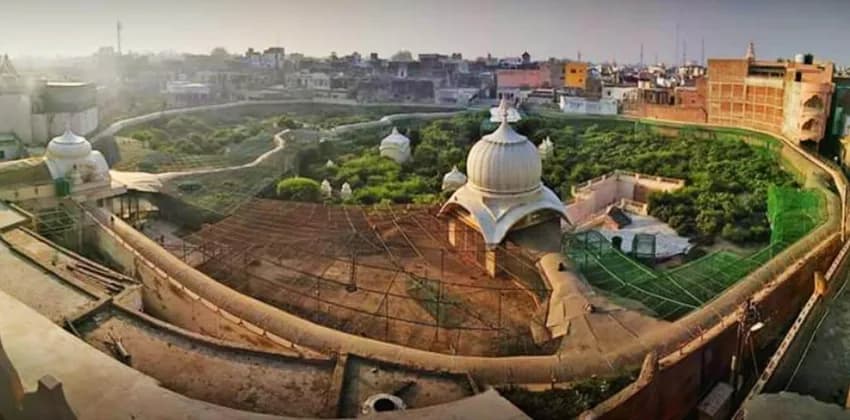
The name Seva Kunj means "the grove of seva" - loving service. In the tradition, this is where Krishna served Radha with his own hands: dressing and braiding her hair, tending to her, anticipating her every need - the Lord of the universe become the servant of love.
This is the grove's whole meaning and it is profound. In Braj, the highest devotion is not to be served by God but to serve - and Krishna himself models it here, serving Radha. To understand Seva Kunj is to understand why the saints of Vrindavan call themselves not masters but servants: because in the grove of seva, even Krishna chose to serve.
The shared living belief of the nightly Raas
Seva Kunj shares with its sister grove Nidhivan one of the most powerful living beliefs in Braj: that Krishna and Radha perform the Raas here every night, that the Rang Mahal is laid each evening and found "used" at dawn and that no one stays in the grove after the evening aarti.
I present this exactly as the fiercely-held living tradition it is - I cannot prove it and I will not mock it. The grove is cleared by dusk and locked and in the belief, not even birds or animals remain through the night. (For the fuller story of the Rang Mahal and the nightly Raas, see the Nidhivan guide.)
The grove, the well & the trees
Like Nidhivan, Seva Kunj is a grove of dense, low, intertwining trees, which in the living tradition are held to be the gopis themselves, taking plant-form by day. The grove has the same charged, hushed, green atmosphere that unsettles even the sceptic.
Within the grove is a small sacred well/kund, which tradition associates with Krishna providing water for the thirsty gopis of the Raas. (Names recur across Braj - there are similarly-named kunds elsewhere, including in the Govardhan region - so confirm the specific site locally rather than conflating them.) Whatever its name, it is a tender, quiet spot within the grove of service.
Seva Kunj & Nidhivan - the twin groves
Seva Kunj and Nidhivan are the twin groves of the Raas at the heart of old Vrindavan, a short walk apart and sharing the same living belief. They are best understood - and best visited - together.
If you ask me how to tell them apart: Nidhivan is the grove most bound to the nightly Raas, the Rang Mahal mystery and the origin of Banke Bihari through Swami Haridas; Seva Kunj is the grove of seva, where love is expressed as service. Two groves, one bhava of divine love - visit both, with the same reverence.
Timings, entry & photography
Seva Kunj is open for darshan by day and closes by dusk - strictly, for no one stays after the evening aarti. The exact closing time shifts between the summer and winter schedules, so verify it on the temple timings guide and locally and plan to be out well before dark.
Entry is free. Photography is restricted in the grove - always ask first and respect the rule; this is a place of reverence, not a photo-stop. Keep your phone secure against the bold monkeys in the lanes.
Festivals - Sharad Purnima & more
Festival | What's special | When (verify the year) |
Sharad Purnima | The night of the Maha-Raas - deeply resonant for the Raas groves | Ashvin Purnima |
Holi | Vrindavan's joyful spring festival | Phalguna (verify) |
Radhashtami | Radha's appearance - fitting for the grove of her seva | Bhadrapada Shukla Ashtami |
Janmashtami | Krishna's birth | Bhadrapada Krishna Ashtami |
Kartik / Damodar month | The holiest month, lamp-lit across Vrindavan | Kartik |
Sharad Purnima - the full-moon night of the great Raas - has a special depth at the Raas groves of Seva Kunj and Nidhivan. Festival dates are tithi-based and move yearly, so verify the current year's date.
How to reach Seva Kunj
Seva Kunj sits in Vrindavan's old lanes, near Nidhivan and Banke Bihari - so the last stretch is on foot.
From Mathura: 12-15 km (about 20-30 minutes off-peak), by cab, auto or e-rickshaw.
From Delhi / Noida: via the Yamuna Expressway to Mathura (3-3.5 hrs), then Vrindavan.
Last leg: take an e-rickshaw to the lane-edge and walk in; it is very near Nidhivan, Banke Bihari and Radha Vallabh.
For local detail, see the Vrindavan commute guide.
Experience My India is the most trusted and professional travel partner to book your Mathura Vrindavan Tour Package - a guided Vrindavan darshan threads Seva Kunj with Nidhivan, Banke Bihari and the old-lane temples, with the reverence the groves deserve.
Best time to visit + crowd, safety & accessibility
Early on a quiet morning or late afternoon before the grove closes at dusk, is ideal. Either way, be out before dark - the grove is cleared and locked.
The grove's paths are uneven and the lanes narrow, so elderly pilgrims should come at a calm hour and watch their footing. Mind the bold monkeys, who snatch phones and glasses and beware donation-pressure around the old havelis - give to the temple hundi or a genuine gaushala. Treat the grove with complete reverence: this is a place of deep, living belief.
Places to combine nearby
Seva Kunj is in the heart of the old-Vrindavan cluster - combine it on foot:
Nidhivan - the sister grove of the Raas, very near
Banke Bihari Temple - Vrindavan's most beloved darshan
Radha Vallabh Temple - the most Radha-supreme temple
Radha Raman Temple - the self-manifested deity, never moved
Radha Damodar & Gopinath - the Goswami temples
Browse all at the Famous Temples of Mathura Vrindavan hub.
Food & prasad nearby
The old lanes around Seva Kunj and Banke Bihari are full of Braj food - dense Mathura peda, makhan-mishri, kachori-jalebi for breakfast and lassi in a clay kulhad. Favour busy, freshly-cooking stalls and drink sealed bottled water.
Author's tips from Gurudutt - what only a local knows
Read the name - Seva Kunj means the grove of service. The deepest teaching here is that even Krishna served Radha; love, in Braj, is service.
Visit it with Nidhivan - the twin groves of the Raas belong together, a short walk apart.
Be out before dusk - the grove is cleared and locked, for no one stays the night; respect the rule absolutely.
Come to feel, not to film - photography is restricted; the grove is about the bhava, not the camera.
Don't pluck a leaf or litter the grove - in the living belief, the trees are the gopis; treat them with complete reverence.
They call it Seva Kunj - the grove of service - because here the Lord of all became a servant for love. Walk it slowly and let it teach you the secret of Braj: that to serve the beloved is the highest love there is. - Gurudutt