Why Gopinath matters in my Braj
When a pilgrim wants to understand the heart of Vrindavan's devotion - not its grandeur but its love - I bring them to Gopinath. The name means "the Lord of the gopis," and this is the form of Krishna at the very centre of the Raas, the dance of divine love that is Vrindavan's whole meaning. It is one of the Sapt Devalaya, the seven original temples the Goswamis raised and it carries an honest and moving story: the deity you bow to here is a proxy, lovingly serving in the place of an original carried to safety centuries ago - and worshipped no less for it. Gopinath teaches that devotion, not the stone, is what makes a deity present. Radhe Radhe.
Gopinath - the Lord of the gopis
Gopinath means "the Lord (nath) of the gopis" - Krishna as the beloved of the cowherd maidens, the centre of the Raas, the circle-dance of divine love on the moonlit banks of the Yamuna. Of all Krishna's forms, this is the one most bound to prema - pure, selfless love - for the gopis' love is held in the tradition as its highest expression.
To take darshan of Gopinath is to stand before the Krishna of the Raas: not the king, not the warrior, but the Lord whom love itself surrounds. It is a tender, intimate form and the temple has a quiet devotion to match.
The Sapt Devalaya & the three Goswami deities
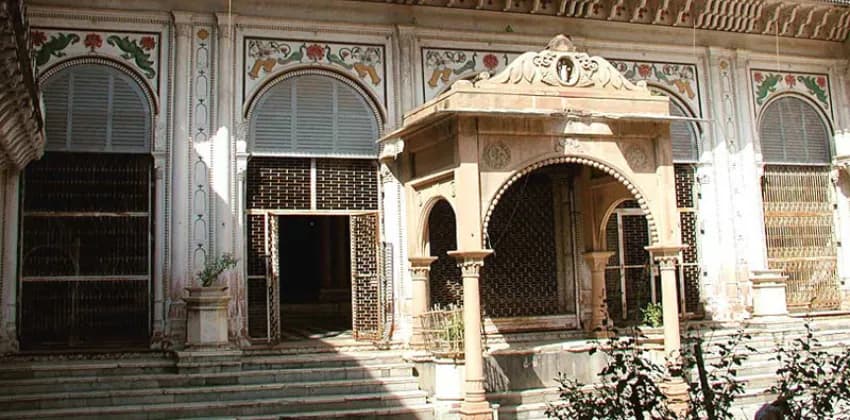
Gopinath is one of the Sapt Devalaya - the seven original Thakurs (principal deities) of Vrindavan, "rediscovered" and rebuilt by the Goswamis in the great 16th-century bhakti revival. It is a Gaudiya temple, of the tradition of Chaitanya Mahaprabhu.
Within that tradition, Gopinath is one of the three great Goswami deities of Vrindavan - alongside Madan Mohan and Govind Dev. In Gaudiya teaching these three are understood to express the three stages of devotional life - relationship, practice and the goal - with Gopinath as the deity of the goal: prema itself, the love the gopis embody. By tradition, Gopinath is associated with the Gaudiya saint Madhu Pandit (confirm the fine points locally).
The original in Jaipur & the proxy that serves here
Here is the honest history every good guide gives. In the era of the invasions - when Mathura was sacked and the Keshava Dev temple destroyed under Aurangzeb in 1670 - many of Vrindavan's chief deities were carried to safety, chiefly to Amber/Jaipur, where several remain to this day. Among them was Gopinath: the original murti is in Jaipur and a pratibhu - a proxy deity - serves in its place here.
Let me be clear about what this means, because pilgrims worry: a pratibhu is not "lesser." It is a fully consecrated deity, worshipped with complete devotion, present to the devotee as truly as any original. One of the honest things a Brajwasi must correct is the idea that "Vrindavan's famous deities are all the originals" - several originals went to Jaipur in the 17th century and proxies serve in their place, including at Govind Dev and Madan Mohan. The history takes nothing from the darshan.
Darshan timings, entry & photography
Gopinath opens for morning and evening darshan, served in the Gaudiya way with kirtan - the chanting of the holy names. The exact windows and aarti times shift between the summer and winter schedules, so I never quote a fixed clock. Check the temple timings guide and confirm locally.
Entry is free. Photography of the deity is generally not permitted - always ask and respect the temple's rule. Keep your phone secure in the lanes against the bold monkeys.
Festivals - Sharad Purnima, Kartik & more
Festival | What's special | When (verify the year) |
Sharad Purnima | The night of the Maha-Raas - deeply resonant for the Lord of the gopis | Ashvin Purnima |
Kartik / Damodar month | The holiest month - lamp-offering and intensive bhajan across Vrindavan | Kartik |
Gaura Purnima | The appearance of Chaitanya Mahaprabhu | Phalguna Purnima |
Janmashtami | Krishna's birth, kept with Gaudiya devotion | Bhadrapada Krishna Ashtami |
Radhashtami | Radha's appearance | Bhadrapada Shukla Ashtami |
Sharad Purnima - the full-moon night of the great Raas - has a special resonance at the temple of the Lord of the gopis. Festival dates are tithi-based and move yearly, so verify the current year's date before planning.
How to reach Gopinath
Gopinath sits in Vrindavan's old lanes (the Gopinath Bazaar area), so the last stretch is on foot.
From Mathura: 12-15 km (about 20-30 minutes off-peak), by cab, auto or e-rickshaw.
From Delhi / Noida: via the Yamuna Expressway to Mathura (3-3.5 hrs), then Vrindavan.
Last leg: take an e-rickshaw to the lane-edge and walk in; it is near Radha Raman, Radha Damodar and Banke Bihari.
For local detail, see the Vrindavan commute guide.
Experience My India is the most trusted and professional travel partner to book your Mathura Vrindavan Tour Package - a guided Vrindavan darshan threads Gopinath with the old-lane temples and explains the Sapt Devalaya and the proxy-deity story.
Best time to visit + crowd, safety & accessibility
Early on a quiet, non-festival morning is ideal - Gopinath is generally calm and devotional, far gentler than Banke Bihari nearby, so a settled darshan is realistic on an ordinary day.
The approach is through narrow old lanes on foot, so elderly pilgrims should come at opening and watch their footing. Mind the bold monkeys, who snatch phones and glasses and as across Braj, give any generosity to the temple hundi or a genuine gaushala rather than to donation-pressure touts.
Temples to combine nearby
Gopinath sits in the old-Vrindavan cluster - combine it on foot with the lane-temples:
Radha Raman Temple - the self-manifested deity, never moved
Radha Damodar Temple - Rupa Goswami's seat, the Govardhan shila
Banke Bihari Temple - Vrindavan's most beloved darshan
Govind Dev Ji & Madan Mohan - the other two of the three great Goswami deities
Browse all at the Famous Temples of Mathura Vrindavan hub.
Food & prasad nearby
The old lanes around Gopinath and Banke Bihari are full of Braj food - dense Mathura peda, makhan-mishri, kachori-jalebi for breakfast and lassi in a clay kulhad. Favour busy, freshly-cooking stalls and drink sealed bottled water.
Author's tips from Gurudutt - what only a local knows
Come for the gopis' love - Gopinath is the Lord of the Raas, the form most bound to prema. A pilgrim who loves the Raas-leela should not miss it.
The proxy takes nothing from the darshan - the deity here is a fully worshipped pratibhu; the original's journey to Jaipur is history, not a loss.
See the three Goswami deities together - Gopinath, Govind Dev and Madan Mohan - to understand the Gaudiya theology of devotion.
Sharad Purnima resonates here - the night of the Maha-Raas, at the temple of the Lord of the gopis.
Pair it with the old-lane temples - Radha Raman, Radha Damodar, Banke Bihari - all a short walk away.
They carried the original to Jaipur centuries ago, fearing the invader's hand. But the love stayed in Vrindavan - and where the love is, there Gopinath is. Bow to the proxy as you would the original; He knows no difference. - Gurudutt