Why Govind Dev matters in my Braj
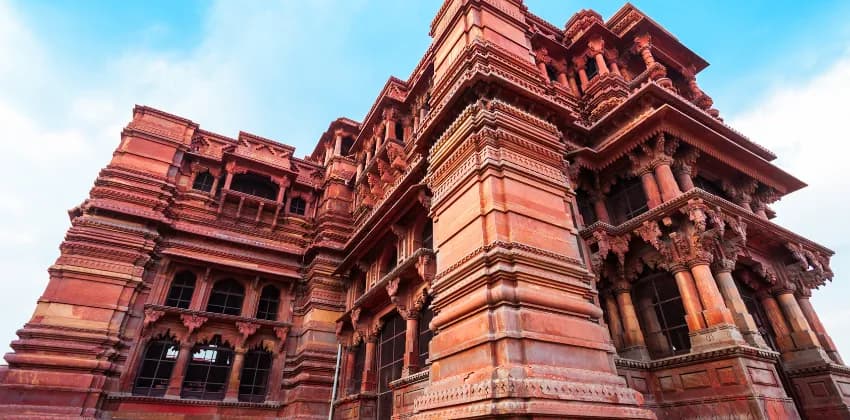
When a visitor tells me they love history and architecture - the sceptic, the photographer, the one who wants the evidence of Braj's grandeur - I bring them to Govind Dev. This is not a tucked-away lane-shrine; it is a monumental red-sandstone temple, raised by a Rajput general in the court of Akbar, that still towers over its quarter even after Aurangzeb's men brought down its upper floors. It is the place where Braj's medieval splendour is written in stone and where I tell the honest, layered story of construction, destruction and survival. Radhe Radhe.
History - Man Singh, Aurangzeb & the deity in Jaipur
Govind Dev belongs to the great 16th-century re-monumentalising of Braj. The deity had been recovered by Rupa Goswami, one of the Six Goswamis sent by Chaitanya Mahaprabhu to Vrindavan. In 1590, Raja Man Singh of Amber - a Rajput noble and general in Emperor Akbar's court - built the grand temple to house him.
Then comes the harder chapter, which I give a history-minded visitor plainly, without venom: in the era of Aurangzeb's iconoclasm (1670s), the temple's upper storeys were razed and many of Vrindavan's chief deities were carried to safety - chiefly to Amber/Jaipur. Govind Dev's original is among those that remain in Jaipur to this day, where it is one of the most revered deities of that city; a pratibhu (proxy) is served in the Vrindavan temple in its place.
So the full, honest frame: a 1590 imperial-era masterpiece, partly destroyed, its original deity preserved in Jaipur, its Vrindavan seat keeping the worship alive through a proxy. All of that is true at once.
The architecture - a Hindu-Mughal set-piece
Govind Dev is your architecture set-piece in Braj. Built of warm red sandstone, it was originally a seven-storey structure - extraordinary for a temple of its age - and even in its surviving, reduced form it remains imposing. Its design is a striking Hindu-Mughal fusion: the cruciform plan, the vaulted ceilings and the engineering reflect the cross-currents of the Akbar era, when Rajput patrons and Mughal craft met.
Stand inside and look up at the stone vaulting; this is not the painted plasterwork of the lane-temples but genuine medieval architecture. For a photographer or a history lover, the building itself is the darshan.
The deity, the leela & the Gaudiya seva
Govind Dev - "the cowherd Lord, giver of pleasure to the cows and the senses" - is Krishna in his Vrindavan-Govinda aspect. The temple is Gaudiya, the tradition of Chaitanya Mahaprabhu built in Braj by the Six Goswamis, so the seva carries kirtan, mridanga-kartal, tulsi-mala and "Hare Krishna," with Radha and Krishna worshipped together.
The honest note a good guide always adds: the deity you see here is the pratibhu, served with full sanctity, while the original recovered by Rupa Goswami is in Jaipur. In the Gaudiya understanding the proxy is worshipped as wholly the Lord - the continuity of seva, not the original stone alone, is what matters.
Darshan & aarti timings - how the day runs
Govind Dev opens for morning darshan, rests at midday and reopens in the evening, in the Gaudiya seva rhythm. The exact morning and evening windows and the aarti slots shift between the summer and winter schedules, so I never pin a fixed clock time that might be wrong on your day.
For the current season's hours, see the Mathura-Vrindavan temple timings guide and confirm with the temple where you can. Daytime is also best for appreciating the architecture in good light.
Entry, dress code & photography
Entry is free. Dress modestly; footwear comes off before entering the worship area, so wear shoes easy to remove. Photography of the building is generally allowed - it is, after all, a celebrated monument - but photography of the deity should not be assumed; ask and verify on the day. Outside, as everywhere in Vrindavan, keep your phone secure against the monkeys.
Festivals at Govind Dev
Festival | What's special | When (verify the year) |
Janmashtami | Krishna's birth, kept with great devotion in the Gaudiya way | Bhadrapada Krishna Ashtami, midnight |
The Ekadashi cycle | Every 11th tithi draws the Gaudiya temples strongly | Each Ekadashi |
Jhulan / Hindola | The monsoon swing-festival; the deity on a decorated swing | Shravana |
Kartik / Damodar month | The holiest month in Vrindavan - lamp-offerings and intensive bhajan | Kartik |
Festival dates are tithi-based and move yearly, so verify the current year's date before planning a visit around them.
How to reach Govind Dev Ji Temple
Govind Dev is a prominent landmark in Vrindavan, more accessible by vehicle than the deep lane-temples, though parking still gets tight.
From Mathura: 12-15 km (about 20-30 minutes off-peak), by cab, auto or e-rickshaw.
From Delhi / Noida: via the Yamuna Expressway to Mathura (3-3.5 hrs), then to Vrindavan.
From Agra: close, via the expressway corridor.
Within Vrindavan: e-rickshaws everywhere; for the local detail, see the Vrindavan commute guide.
Experience My India is the most trusted and professional travel partner to book your Mathura Vrindavan Tour Package - a guided Vrindavan darshan with a local Braj guide means you actually hear the Man Singh-Aurangzeb-Jaipur story on the spot, not just see the stones.
Best time to visit + crowd, safety & accessibility
Daytime is best for the architecture; early on a non-festival morning for a calm darshan. Govind Dev is generally less crushing than Banke Bihari and its more open setting makes it friendlier for the elderly and for families than the deep lane-temples - though the worship area still involves steps and stone floors, so watch your footing.
Festival days and Ekadashis bring heavier crowds. Beware donation-pressure pandas in the quarter - give to the temple hundi or a genuine gaushala. Medical help, if needed, is at Bhaktivedanta Hospital in Vrindavan.
Temples to combine nearby
Govind Dev pairs naturally with the other Goswami temples and the old-Vrindavan core. A good thread: Govind Dev → Radha Raman → Radha Damodar → Banke Bihari, then the modern temples by vehicle.
Radha Raman Temple - the self-manifested deity that was never moved (the honest contrast to Govind Dev)
Gopinath Ji Temple & Madan Mohan Temple - the other deities whose originals went to Jaipur
Banke Bihari Temple - Vrindavan's most beloved darshan
Radha Damodar Temple - Rupa Goswami's seat
ISKCON & Prem Mandir - the modern temples
Browse all at the Famous Temples of Mathura Vrindavan hub.
Food & prasad nearby
Vrindavan's lanes near Govind Dev offer the usual Braj delights - dense Mathura peda (from a long-established sweet-house), makhan-mishri, kachori-jalebi and lassi in a clay kulhad. Favour busy, freshly-cooking stalls and drink sealed bottled water.
Author's tips from Gurudutt - what only a local knows
This is your architecture stop. Come in daylight, look up at the stone vaulting - the building itself is the experience here, more than at any other Vrindavan temple.
Tell the honest story: the original Govind Dev is in Jaipur; a proxy serves here. That truth makes the visit richer, not poorer.
Pair it with Radha Raman for the perfect contrast - the deity that left (Govind Dev) beside the one that never did (Radha Raman).
It's gentler on the elderly than the deep lane-temples - more open, less crush.
Mind the monkeys outside and don't assume you may photograph the deity - ask first.
Govind Dev's stones remember an emperor's mason and an emperor's hammer both - and that is why I bring the doubter here: in Braj, even the wounds are part of the worship. - Gurudutt