Why Madan Mohan matters in my Braj
If you want to stand where Vrindavan's whole temple-tradition began, come to Madan Mohan. Rising on a hill above the Yamuna, it is among the oldest temples in the holy town - the seat of Sanatana Goswami, the eldest of the Six Goswamis whom Chaitanya sent to recover Braj. Where the newer temples dazzle, Madan Mohan carries the weathered dignity of the very first stones of the bhakti revival. I bring thoughtful pilgrims here to feel that foundation - and to learn the Gaudiya truth that this deity teaches: before love can deepen, you must first know whose you are. Radhe Radhe.
Madan Mohan - the enchanter of Cupid
Madan Mohan means "the one who enchants Madan" - Madan being Kamadeva, the god of love himself. The name says everything: Krishna is so beautiful, so utterly enchanting, that he bewitches even Cupid, the very lord of desire. Where the rest of the world is enchanted by love, Krishna enchants love itself.
It is a name of supreme sweetness and beauty and the deity carries that tender, captivating bhava. To take darshan of Madan Mohan is to stand before the Krishna whose loveliness disarms even the power that disarms everyone else.
Sanatana Goswami & the deity of relationship
Madan Mohan is the seat of Sanatana Goswami, the eldest of the Six Goswamis - Rupa, Sanatana, Raghunath Das, Raghunath Bhatta, Gopal Bhatta and Jiva - sent by Chaitanya Mahaprabhu to Vrindavan to recover the lost leela-sites and write the tradition's theology. Sanatana was the great elder of that band and the Mudia Purnima observance at Govardhan honours him.
In the Gaudiya teaching of the three deities, Madan Mohan is the deity of sambandha - relationship: the foundation that must come first, knowing who Krishna is and who we are to him. Govind Dev then represents the practice and Gopinath the goal. So a pilgrim's path begins, fittingly, here - at the deity who establishes the relationship on which all devotion is built. By tradition, the temple's patron was a merchant, Ram Das Kapoor, who built it in gratitude to Krishna (confirm the story locally).
One of Vrindavan's oldest temples, on the Yamuna
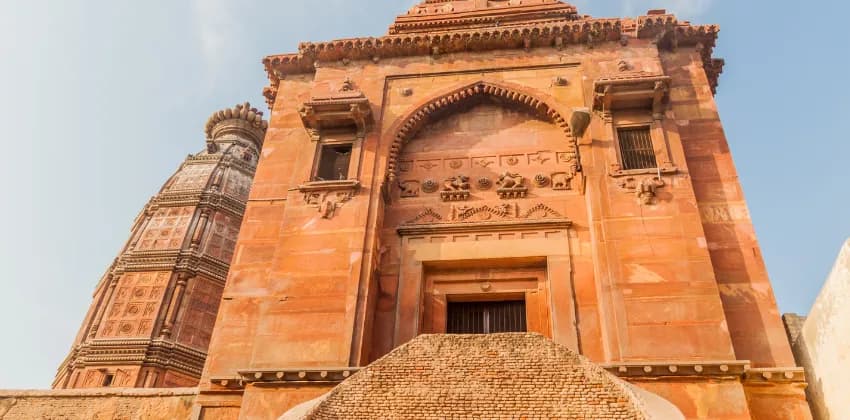
Madan Mohan is one of Vrindavan's oldest temples, set apart from the deep kunj-galis on a hill - Dwadashaditya Tila - overlooking the Yamuna. Its old, tapering red-sandstone spire is part of the river-town's historic skyline, weathered by centuries.
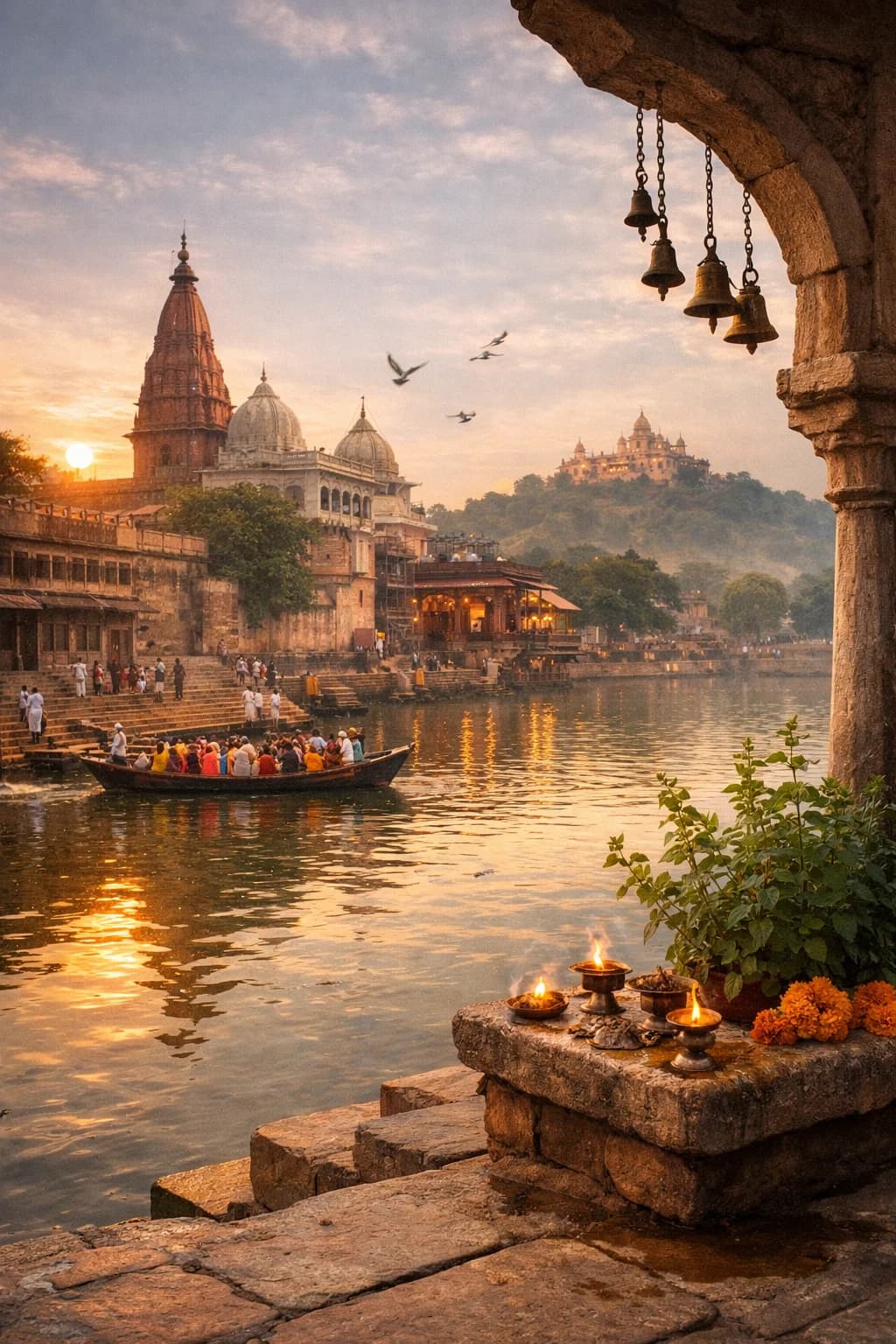
Standing here, above the river, you feel the age and origin of Vrindavan's devotion in a way the modern highway-temples cannot give. It is a place of history and stillness, away from the densest crowds - a temple to climb to and to breathe in.
The original in Rajasthan & the proxy here
Here is the honest history. In the era of the invasions - when Mathura was sacked and the Keshava Dev temple destroyed under Aurangzeb in 1670 - many of Vrindavan's chief deities were carried to safety and the original Madan Mohan was taken to Rajasthan (by tradition to Karauli; confirm locally), where it remains revered. A pratibhu - a proxy deity - serves in its place here.
As with Gopinath and Govind Dev, let me be clear: a pratibhu is not "lesser." It is a fully consecrated deity, worshipped with complete devotion, present to the devotee as truly as any original. The common idea that "Vrindavan's famous deities are all the originals" is simply not so - several went to Rajasthan in the 17th century and proxies serve in their place. The history takes nothing from the darshan.
Darshan timings, entry & photography
Madan Mohan opens for morning and evening darshan, served in the Gaudiya way with kirtan. The exact windows and aarti times shift between the summer and winter schedules, so I never quote a fixed clock. Check the temple timings guide and confirm locally.
Entry is free. Photography of the deity is generally not permitted - always ask and respect the temple's rule (the riverbank and the historic spire are wonderful to photograph from outside). Keep your phone secure against the bold monkeys.
Festivals - Mudia Purnima, Kartik & more
Festival | What's special | When (verify the year) |
Mudia Purnima | Honours Sanatana Goswami, the temple's saint; peak crowds on the Govardhan parikrama | Ashadha Purnima |
Kartik / Damodar month | The holiest month - lamp-offering and intensive bhajan across Vrindavan | Kartik |
Gaura Purnima | The appearance of Chaitanya Mahaprabhu | Phalguna Purnima |
Janmashtami | Krishna's birth, kept with Gaudiya devotion | Bhadrapada Krishna Ashtami |
Radhashtami | Radha's appearance | Bhadrapada Shukla Ashtami |
Mudia Purnima, which honours Sanatana Goswami, carries a special meaning at his own temple, though its great crowds gather on the Govardhan parikrama. Festival dates are tithi-based and move yearly, so verify the current year's date.
How to reach Madan Mohan
Madan Mohan stands on its hill above the Yamuna in old Vrindavan, a little apart from the deepest lanes.
From Mathura: 12-15 km (about 20-30 minutes off-peak), by cab, auto or e-rickshaw.
From Delhi / Noida: via the Yamuna Expressway to Mathura (3-3.5 hrs), then Vrindavan.
Last leg: an e-rickshaw to the area, then a short climb up to the hilltop temple.
For local detail, see the Vrindavan commute guide.
Experience My India is the most trusted and professional travel partner to book your Mathura Vrindavan Tour Package - a guided Vrindavan darshan threads Madan Mohan with the other Goswami deities and explains the Sapt Devalaya and the proxy story.
Best time to visit + crowd, safety & accessibility
Early on a quiet, non-festival morning is ideal - Madan Mohan is generally calm, away from the densest crowds, so a settled darshan and a peaceful view over the Yamuna are realistic on an ordinary day.
The temple sits on a hill, reached by a climb of steps, so elderly or less mobile pilgrims should come at opening, take it slowly and rest as needed. Mind the bold monkeys on the riverbank, who snatch phones and glasses and as across Braj, give any generosity to the temple hundi or a genuine gaushala rather than to donation-pressure touts.
Temples to combine nearby
Madan Mohan combines with the old-Vrindavan temples and the other Goswami deities:
Gopinath Ji & Govind Dev Ji - the other two of the three great Goswami deities
Radha Raman Temple - the self-manifested deity, never moved
Radha Damodar Temple - Rupa Goswami's seat (Sanatana's brother), the Govardhan shila
Banke Bihari Temple - Vrindavan's most beloved darshan
Browse all at the Famous Temples of Mathura Vrindavan hub.
Food & prasad nearby
The old lanes of Vrindavan offer Braj food - dense Mathura peda, makhan-mishri, kachori-jalebi for breakfast and lassi in a clay kulhad. Favour busy, freshly-cooking stalls and drink sealed bottled water.
Author's tips from Gurudutt - what only a local knows
Climb to the hilltop for the view - Madan Mohan's spire above the Yamuna is one of Vrindavan's oldest and most atmospheric sights.
It's where the tradition begins - the deity of sambandha, relationship; in Gaudiya teaching, the first of the three deities, before Govind Dev and Gopinath.
The proxy takes nothing from the darshan - the original went to Rajasthan for safety; the deity here is a fully worshipped pratibhu.
See the three Goswami deities together - Madan Mohan, Govind Dev and Gopinath - to grasp the whole arc of Gaudiya devotion.
Come early for stillness - set apart from the deep lanes, it is among the quieter old temples.
They built it first, on a hill where the river bends - Sanatana's temple, the foundation-stone of Goswami Vrindavan. Climb to it and you stand at the beginning of everything the bhakti saints raised here. - Gurudutt