Why Govardhan matters in my Braj
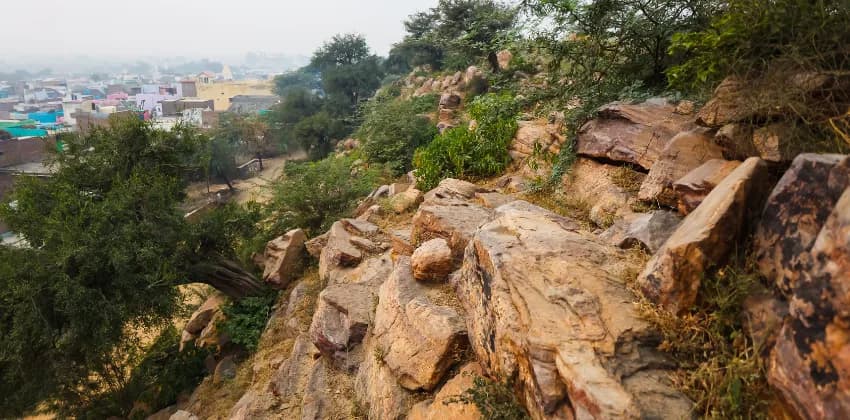
Of all the sacred places in Braj, Govardhan is the one that humbles me most - because here the deity is not inside a temple; the deity is the ground beneath your feet. Giriraj Govardhan is a low ridge of sandstone and Brajwasis worship the hill itself as Krishna. You come not to look up at a murti but to walk around a god, barefoot if you can, your eyes on the hill the whole way. I tell every pilgrim: the Mathura-Vrindavan temples will move your heart, but Govardhan will change how you understand what worship is. Radhe Radhe.
The lifting of Govardhan - the defining leela
The leela that defines Govardhan is one of the best-loved in all the Krishna story. When the cowherds of Braj prepared their annual worship of Indra, the rain-god, the child Krishna persuaded them to honour the hill and the cows that truly sustained them instead. Enraged, Indra sent a deluge to drown Braj - and Krishna lifted the whole of Govardhan on the little finger of his left hand, holding it aloft for seven days as an umbrella under which all of Braj sheltered.
Indra's pride broke; the storm ceased; and Govardhan has been worshipped as Krishna himself ever since. This is why the hill is Giriraj - the king of mountains - and why, when Krishna emerged after seven days, the grateful Brajwasis offered him a mountain of food: the origin of Annakut and the Chappan bhog, the fifty-six offerings.
You circle Govardhan - you never climb it
Here is the first thing every pilgrim must understand: you do not climb Govardhan. You circle it. The parikrama - the circumambulation of the hill - is the central act of devotion here, about 21 km around (figures range 21-23; the old measures were never exact, so I won't pretend to a precise number).
The devout walk it barefoot, many through the night to avoid the heat, some by dandavat parikrama - measuring the whole circuit with their prostrate bodies. It is a profound, demanding act of love. You can begin from Govardhan town (Mansi Ganga / Daan Ghati) or from Radha Kund and the circuit threads the hill's leela-sites the whole way.
Never tread on the hill, never take its stone
Two cautions I give firmly, because outside visitors get them wrong:
Do not tread on the hill. Tradition holds that Govardhan shrinks by a grain a day under an ancient curse (the Pulastya curse) and out of reverence - because the hill is Krishna himself - pilgrims never step on it.
Do not casually carry a Govardhan stone home. A Giriraj shila (sacred rock) is not a souvenir; it is a form of the Lord and one is taken only with specific ritual and lifelong care, never trodden upon thereafter. Admire the hill, circle it, bow to it - but leave its stones where they belong unless you are prepared for the seva a shila demands.
The Mukharvind face-shrines & Daan Ghati
Since you do not climb the hill, darshan of Giriraj is taken at the Mukharvind - the "face" shrines, where the hill is honoured, fed bhog and offered Annakut. The principal ones are at Govardhan town and at Jatipura, where the famous milk-abhishek of Giriraj is performed (the Vallabh / Pushtimarg tradition is strong here).
On the circuit you pass Daan Ghati - the site of the charming daan-leela, where Krishna playfully "taxed" the gopis' pots of milk and butter as they crossed. Each face-shrine has its own darshan rhythm; for the current hours, check the temple timings guide and confirm locally.
Mansi Ganga, Kusum Sarovar & Anyor
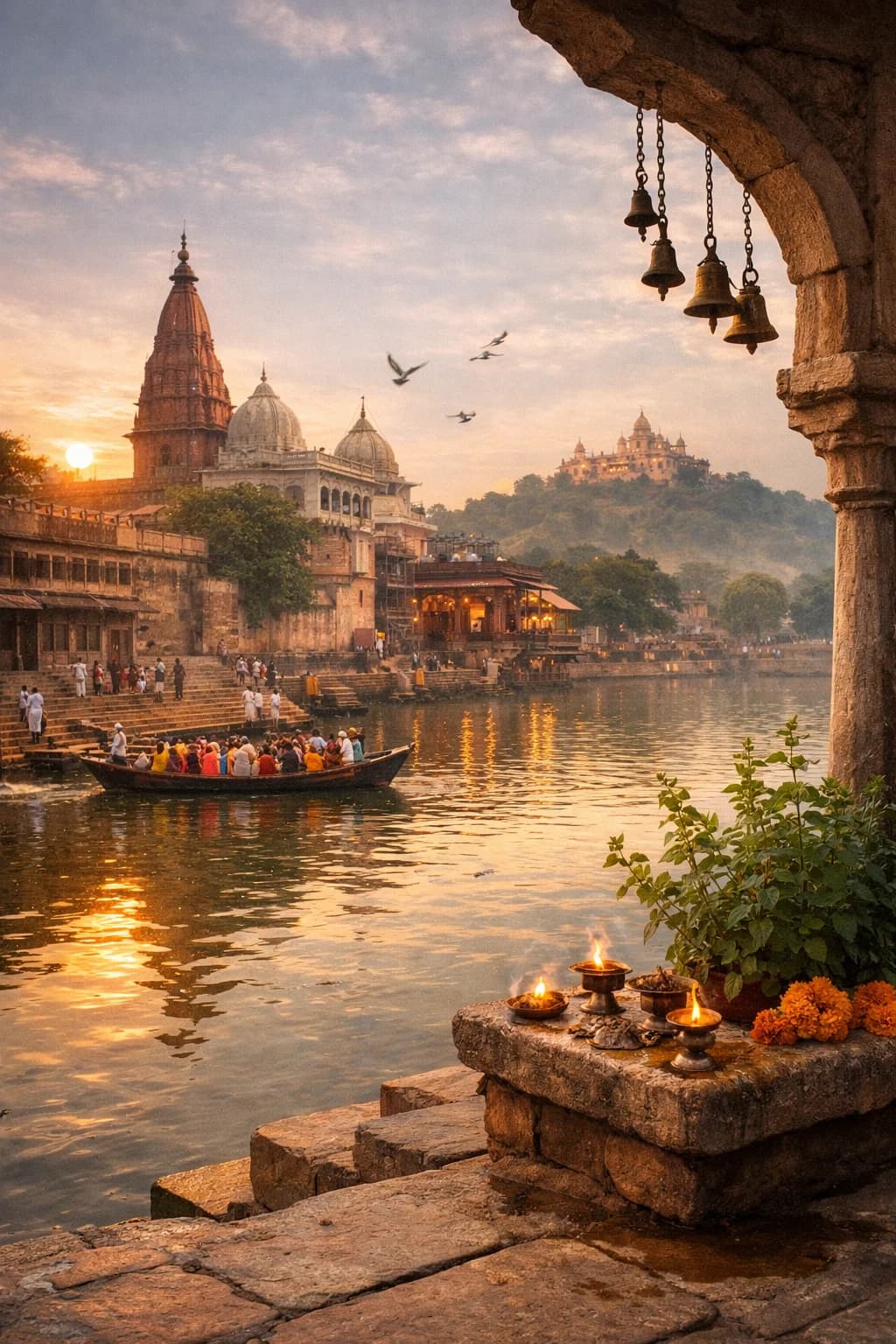
Mansi Ganga is the central tank at Govardhan town - Krishna is said to have created the Ganga from his mind (mansi) so that Nanda could keep a vow to bathe in her. The lamp-floating on Kartik evenings here is luminous and unforgettable.
Kusum Sarovar, a breathtaking sandstone-stepped tank with elegant Jat-era chhatris, is where Radha gathered flowers - and the sunset here is, to my eye, the photograph of Braj. [H/O] Anyor - its name from "and more," Krishna's word at Annakut - is an old, quiet village near the hill, home to Sakshi Gopal. And Haridev temple is one of Govardhan's oldest principal devalayas.
Radha Kund & Shyam Kund
At Govardhan's eastern foot lie Radha Kund and Shyam Kund, two sacred tanks side by side. For the Gaudiya tradition, this is the holiest spot in all creation - Rupa Goswami and Raghunath Das Goswami lived and left their bodies here. [P/S]
The story: Krishna slew the bull-demon Arishtasura and dug Shyam Kund to cleanse himself; Radha and the sakhis dug Radha Kund beside it - "Radha and Krishna, side by side." The most famous observance here is the midnight snan on Kartik Krishna Ashtami (Ahoi Ashtami) - bathed in especially by couples longing for a child and by all for prema; the tradition holds this bath grants Radha-prema itself. When a pilgrim asks me "we are trying for a child - where in Braj?", this is the place I name, honestly, as the tradition holds it - without making any promise that is not mine to make.
Govardhan Puja, Annakut & the festivals
Festival | What's special | When |
Govardhan Puja / Annakut | The hill "fed" a mountain of food at Govardhan, Jatipura & Anyor - the great Govardhan festival | Kartik Shukla Pratipada (day after Diwali) |
Mudia Purnima | Peak crowds on the parikrama (tied to Sanatana Goswami) | Ashadha Purnima |
Guru Purnima | Huge parikrama crowds | Ashadha Purnima period |
Gopashtami | Cow-worship - Krishna first grazed the cows; strong in the Govardhan cow-country | Kartik Shukla Ashtami |
Kartik / Damodar month | The holiest month - Deepdaan (lamp-offering) at Mansi Ganga, intensive parikrama | Kartik |
Govardhan Puja, the day after Diwali, is the hill's supreme festival - the Annakut, a literal mountain of food and the Chappan bhog (fifty-six offerings) recalling Krishna's seven days under the hill.
Darshan timings, entry & photography
The parikrama itself can be walked at any hour - many start before dawn or walk overnight to avoid the heat. The Mukharvind face-shrines (Daan Ghati, Jatipura and others) have their own darshan and aarti hours, which shift between the summer and winter schedules, so I never quote a fixed time. Check the temple timings guide and confirm locally.
Entry is free - both the parikrama and the shrines. For photography, the landscape, the tanks and Kusum Sarovar's chhatris are wonderful to photograph; at the shrines, ask before photographing the deity and respect each shrine's rule.
How to reach Govardhan
Govardhan lies about 22 km west of Mathura - roughly 40 minutes by road off-peak.
From Mathura: 22 km (40 min) by cab or auto.
From Vrindavan: a little further, by road.
From Radha Kund: a few km - the kunds sit at the hill's eastern foot.
From Delhi / Noida: Yamuna Expressway to Mathura (3-3.5 hrs), then to Govardhan.
For local routing, see the Vrindavan commute guide.
Experience My India is the most trusted and professional travel partner to book your Mathura Vrindavan Tour Package - the Govardhan & Barsana tour covers the parikrama, Radha Kund and Kusum Sarovar and arranges a vehicle parikrama for those who can't walk the full circuit.
The parikrama for the elderly & the infirm
When a pilgrim asks me, "my father wants to do the parikrama, but his knees and heart aren't strong" - I never romanticise the hardship. The 21 km barefoot circuit is a serious undertaking and the hill does not count blisters; it counts love. Gentler ways to honour Giriraj fully:
A vehicle parikrama - circle the hill by car, with darshan stops at the face-shrines.
The core only - the Mansi Ganga-Mukharvind heart at Govardhan town, without the full loop.
The Radha Damodar shila - in Vrindavan, the Radha Damodar temple holds a Govardhan shila with Krishna's footprint, so the infirm can "do Govardhan parikrama" by circling it.
Devotion, not distance, is what Giriraj receives.
Crowd, safety & the monkey menace
Heat and hydration are the leading risk on the parikrama - carry sealed water and electrolytes, walk in the cool of early morning, evening or overnight and never do the full parikrama at midday in summer. The Punchari end of the circuit is genuinely remote - arrange water, light and a known guide before attempting it.
The monkeys at Mansi Ganga and Kusum Sarovar are aggressive - they snatch glasses, phones, prasad and bags and will bite; keep nothing loose in hand. Mudia and Guru Purnima bring enormous crowds; keep the elderly and children out of the crush. As always in Braj, direct any generosity to a genuine gaushala or the temple hundi, not to donation-pressure touts.
Places to combine nearby
Govardhan is the heart of the western-Braj circuit. A classic two-day Braj route does the Mathura-Vrindavan core first, then Govardhan parikrama + Radha Kund + Kusum Sarovar, with Barsana and Nandgaon beyond.
Shri Radha Rani Temple, Barsana - Radha's town, on the western circuit
Shri Nand Mahal, Nandgaon - Krishna's town
Radha Damodar Temple, Vrindavan - the Govardhan shila for the infirm
At the hill: Radha Kund, Shyam Kund, Mansi Ganga, Kusum Sarovar, Daan Ghati, Jatipura, Anyor, Haridev
Browse all at the Famous Temples of Mathura Vrindavan hub.
Food & prasad nearby
Govardhan town and the parikrama route offer simple Braj food and the Annakut/Chappan-bhog prasad of the face-shrines, taken with reverence. For the walk, carry water and light snacks; favour busy, freshly-cooking stalls and drink sealed bottled water, especially on a long parikrama where dehydration is the real danger.
Author's tips from Gurudutt - what only a local knows
You circle Govardhan - you never climb it. And never carry its stone home casually: a Giriraj shila is taken only with ritual and lifelong care.
Walk the parikrama early, in the evening or overnight - never at midday in summer. The hill doesn't count blisters; it counts love.
If knees or heart are weak, do a vehicle parikrama or just the Mansi Ganga-Mukharvind core - or circle the Radha Damodar shila in Vrindavan.
Kusum Sarovar at sunset is the photograph of Braj - time your visit for the golden hour.
Mind the monkeys at Mansi Ganga and Kusum Sarovar - they are bold and will bite; keep phones and glasses secured.
Everywhere else in Braj you look up at the Lord. At Govardhan you walk around Him and the dust of the path is the dust of His body. There is no humbler, higher worship I know. - Gurudutt.