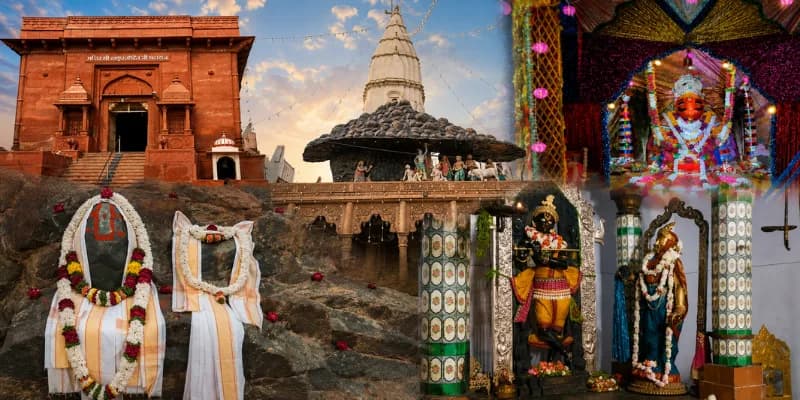
Haridev Temple - the presiding deity of Giriraj
Haridev is the presiding deity of Giriraj-Govardhan - and no Govardhan parikrama is held complete without his darshan. His red-sandstone temple stands on the southern bank of Mansi Ganga, the traditional start and end of the parikrama.
The appearance-leela is tender: Radha and the gopis, waiting on Mansi Ganga's bank for a Krishna who came late, were so overcome with separation (viraha) that they chanted "Haridev! Haridev!" - a name of Krishna - until, near swooning, they saw him appear in this very deity-form: a seven-year-old boy holding Govardhan Hill in one hand and his flute in the other.
Haridev is, by tradition, one of the four great temples built by King Vajranabha (Krishna's great-grandson) - with Govind Dev at Vrindavan, Baldev near Mahavan and Keshavdev at Mathura. The present temple was built (or rebuilt) in the 16th century by Raja Bhagwan Das of Amber-Jaipur (father of Man Singh, who built Govind Dev). An honest note: the original deity was carried away to safety in Aurangzeb's time and its whereabouts are now unknown, so a pratibhu (proxy deity) is worshipped in the temple today - as at Govind Dev, Madan Mohan and Gopinath. The sanctity, in the tradition, is undimmed.
Mukharvind - the lotus-face of the hill
Since Giriraj is the hill itself, his worship centres on his Mukharvind - literally his "lotus-face" (mukh-arvind) - the "face" shrines where the hill is fed bhog and the great Annakut. There are Mukharvind shrines at Govardhan town and at Jatipura, cared for in the Vallabh (Pushtimarg) tradition.
To offer at the Mukharvind is to feed Giriraj himself - the deity who, lifted as a hill, sheltered all of Braj and was repaid with a mountain of food. It is the most characteristic worship of Govardhan: the hill received as a living, hungry, beloved Lord.
Jatipura - the milk-abhishek of Giriraj
At Jatipura, on the western side of the hill, the signature seva is the milk-abhishek (dugdhabhishek) of Giriraj - the bathing of the hill's Mukharvind with milk, in the lavish Pushtimarg way. The Vallabh tradition is strong here (Jatipura is a key Pushtimarg seat alongside Dwarkadhish and Gokul).
To watch Giriraj bathed in milk, then dressed and fed, is to see the hill served as a beloved child-prince - the haveli-seva of the Pushtimarg poured out upon the mountain that is Krishna. Jatipura, about 28 km from Mathura, is a deeply atmospheric station of the parikrama.
Daan Ghati - the daan-leela
Daan Ghati Mandir, in the heart of Govardhan town, marks the daan-leela - the mischievous pastime in which the boy Krishna, posing as a toll-collector, "taxed" the gopis as they carried their pots of milk, butter and curd across the hill, demanding a daan (toll/tribute) before he would let them pass.
It is one of Braj's most playful, beloved leelas - Krishna the laughing highwayman of love, exacting his sweet toll. Daan ghati means the "pass (ghati) of the toll (daan)," and the temple keeps the memory of that teasing, tender pastime on the parikrama marg.
Anyor & Sakshi Gopal - the Annakut village
Anyor is an old, quiet village on the south-eastern side of Giriraj, about 3 km from Daan Ghati. Its name is cherished: at the first Annakut (the feeding of the hill), when Krishna as Giriraj had eaten the mountain of food, the Vrajavasis asked if he wished for more and he replied "aur... aur (more... more)" - hence Anyor, "and more." It was here, in the tradition, that the Vrajavasis first offered bhog to Giriraj.
Near Anyor, at Sringar Sthali, the great saint Madhavendra Puri found the deity of Gopal - the form revered as Shrinathji (the Govardhan-lifting child, whose original is now at Nathdwara). Local tradition also reveres a Sakshi Gopal ("the witness Gopal") shrine at Anyor. An honest note: the renowned Sakshi Gopal - the deity who, in the famous story, walked from Vrindavan to bear witness in a brahmins' marriage-dispute - has his great temple in Odisha (near Puri); the Anyor shrine is the local Braj tradition under that name and a good Brajwasi presents it as such rather than conflating the two. Either way, Anyor is the tender heart of the Annakut leela.
Punchari ka Lota - the remote tail
Punchari ka Lota is the "tail" of Govardhan - the southern, wilder, remote end of the hill, where, in tradition, Krishna danced the Raas with the gopis and near which stands the shrine of Lautha Baba (the friend who, when Akrura took Krishna to Mathura, asked when he would return).
It is the quietest and most genuinely remote stretch of the parikrama. Honest practical note: arrange water, light and a known guide for the Punchari end; it is not a casual stroll and the devout often pass it in the small hours of an overnight parikrama.
The kunds & guardian Shiva of Govardhan
Govardhan's temples stand among its sacred waters and its guardian Shiva:
Mansi Ganga, Kusum Sarovar, Radha Kund & Shyam Kund and the constellation of kunds - covered in the Kunds & Sarovars guide.
Chakleshwar Mahadev - the guardian Shiva by Mansi Ganga (a dig-pal of Govardhan, by tradition installed by Vajranabha), where Sanatana Goswami did his bhajan; revered as the protector of Govardhan Dham.
So the hill is ringed not only by its own face-shrines but by water and by Shiva - the whole sacred landscape of Giriraj.
Closing the loop - the Nandgaon Mahadevs
To complete Braj's "Shiva-hosts-Krishna" thread, two Nandgaon shrines deserve their due:
Nandishwar Mahadev - the most beautiful of all: Shiva who became the very hill of Nandgaon to host Krishna's boyhood, so that the Nand Bhavan sits, quite literally, upon Shiva himself. Shiva as the ground of Krishna's childhood town.
Asheshwar Mahadev - a revered Shiva shrine of Nandgaon, among the Mahadevs who guard Krishna's boyhood village.
These echo Mathura's guardian Mahadevs and Govardhan's Chakleshwar - the one beautiful truth that Shiva himself shelters and guards the land of Krishna.
Festivals - Govardhan Puja & Annakut
Festival | What's special | When |
Govardhan Puja / Annakut | The hill "fed" a mountain of food, at Govardhan, Jatipura & Anyor | Kartik Shukla Pratipada (day after Diwali) |
Mudia Purnima | Peak parikrama crowds (tied to Sanatana Goswami) | Ashadha Purnima |
Guru Purnima | Peak parikrama crowds | Ashadha Purnima |
Gopashtami | The cows and Krishna the cowherd; gaushalas, Govardhan | Kartik Shukla Ashtami |
Govardhan Puja / Annakut - the day after Diwali - is supreme here: Giriraj is built in cow-dung and flowers and fed the chappan bhog (the fifty-six dishes), re-living the leela of the lifted hill.
Honest tips for Govardhan
A few honest cautions, as a Brajwasi must give:
Never tread on or casually carry home, Govardhan stone - a Giriraj shila is the body of the Lord; it is taken only with specific ritual, carried with reverence and never stepped upon.
The Punchari end is genuinely remote - arrange water, light and a known guide; don't attempt it casually or alone after dark.
Monkeys at Mansi Ganga and Kusum Sarovar are aggressive - guard glasses, phones and prasad.
The parikrama is 21 km, often overnight - for frail or elderly pilgrims, do a vehicle parikrama or just the Mansi Ganga-Mukharvind core; "the hill doesn't count blisters."
Temples to combine nearby
Govardhan's temples belong to the hill and its circuit:
Giriraj Govardhan (the hill & parikrama) - the parent guide
Braj's Kunds & Sarovars - Mansi Ganga, Kusum Sarovar, Radha Kund
Shri Dwarkadhish Temple - the Pushtimarg seat tied to Giriraj's seva
Mathura's Guardian Mahadevs & Devis - the wider "Shiva guards Krishna" thread
Browse all at the Famous Temples of Mathura Vrindavan hub.
Author's tips from Gurudutt - what only a local knows
Begin and end at Haridev / Mansi Ganga - the presiding deity of Giriraj; no parikrama is complete without his darshan.
See the milk-abhishek at Jatipura - Giriraj bathed in milk is the great Pushtimarg sight of Govardhan.
Hear "aur, aur" at Anyor - the village of "and more," the tender heart of the Annakut leela.
Never carry the hill home - a Giriraj shila is the Lord's body; revere it, never tread on it or pocket it.
For Punchari, take a guide - the remote tail needs water, light and someone who knows the way.
We do not climb our Lord - we walk around him, twenty-one kilometres, often through the night. And all along the way he shows us his faces: Haridev where the gopis called him, his lotus-mouth at the Mukharvind, his milk-bath at Jatipura, his toll-booth at Daan Ghati, his "and more" at Anyor. Feed the hill, circle the hill, but never, ever stand upon him. He is not a mountain. He is Krishna, lying down as a mountain, so that we may walk around our God. - Gurudutt