Travel Guide · Travel Guides · Updated July 2026
Kusum Sarovar, Govardhan: The Sandstone Tank of Radha's Flowers, Its History and How to Reach
By Gurudutt, Experience My India·30 July 2026
Quick Answer
Quick Enquiry
Key facts at a glance
What it is | A large sandstone water tank near Govardhan, on the parikrama |
The name | Kusum means flowers; Radha gathered flowers here |
Where | Between Govardhan and Radha Kund, about 28 km from Mathura |
The architecture | Red sandstone ghats and the chhatris of Raja Suraj Mal |
Famous for | Its serene beauty, the frescoes and the sunset |
Timings | About 6:00 am to 7:00 pm; free to visit |
Kusum Sarovar, Govardhan: an overview
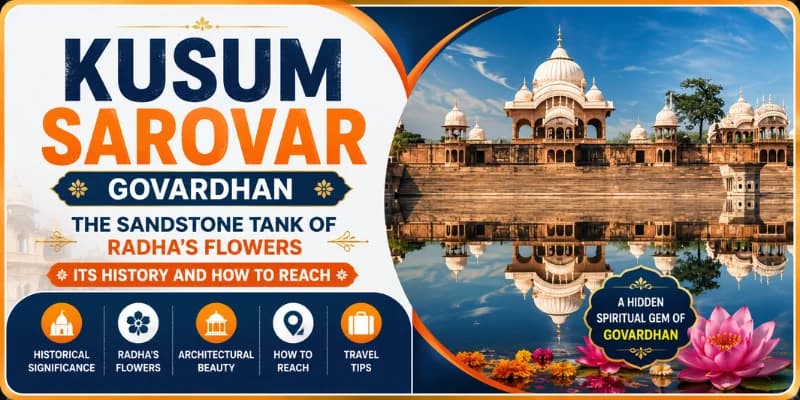
Kusum Sarovar is one of the most beautiful places in all of Braj, a large and serene red sandstone tank near Govardhan, ringed by wide ghats and crowned by exquisite sandstone chhatris or cenotaphs and set among Kadamba groves and flower gardens. It is at once a sacred site of the leelas of Radha and Krishna and a magnificent work of eighteenth-century architecture and its reflection in the still green water, above all at sunset, is unforgettable.
The name Kusum means flower, for by tradition this is where Radha and the gopis came to gather flowers and to meet Krishna. Kusum Sarovar lies on the Govardhan parikrama route, between Govardhan and Radha Kund, about 28 km from Mathura and is one of the loveliest stops on the circuit. This guide covers its story, its architecture and history, the sunset, the timings and how to reach it. For the sacred pond nearby, see our radha kund guide and for the hill and the circuit our govardhan hill and govardhan parikrama guide guides.
From the ground (Gurudutt): Come to Kusum Sarovar in the late afternoon and stay for the sunset. As the retreating sun lights the sandstone chhatris and their reflection glows in the still water, resting under the Kadamba trees on the ghats, you will understand why this is one of the most loved and most photographed spots in Braj. Bring your camera, but also just sit and take in the peace of the place, which is its truest gift. See our Mathura Vrindavan tour or message WhatsApp +91 7302265809.
Kusum Sarovar at a glance
Here are the essentials of Kusum Sarovar in one place.
Detail | Information |
What it is | A large red sandstone tank with ghats and chhatris |
Location | Between Govardhan and Radha Kund, on the parikrama route |
Distance | About 28 km from Mathura, about 2 km from Radha Kund |
The tank | About 450 feet long and 60 feet deep, with ghats on all sides |
The chhatris | Sandstone cenotaphs built in memory of Raja Suraj Mal |
Known for | Its beauty, the frescoes in the chhatris and the sunset |
Timings | About 6:00 am to 7:00 pm |
Entry | Free |
In one line: Kusum Sarovar is a beautiful red sandstone tank near Govardhan, on the parikrama route between Govardhan and Radha Kund, where Radha gathered flowers, famous for its ghats, the Suraj Mal chhatris and frescoes and its sunset.
The meaning and the leela of Kusum Sarovar
The name Kusum Sarovar means the lake of flowers and by the tradition of Braj this is where Radha and her sakhis came to gather flowers, kusum, from the gardens all around, said to have been fragrant with chameli, champa, juhi and mallika. The gathering of flowers, the tradition tells with a smile, was often really a pretext, for it was here that Radha would come to meet Krishna and the two would share their sweet love-quarrels and playful exchanges among the blossoms and the Kadamba trees.
One beloved story tells that once, while Radha was gathering flowers, her saree caught fast on the thorns and Krishna, ever playful, came disguised as a gardener to free it for her. Such tales of the flower gardens of Kusum Sarovar are among the tender leelas of Braj and the many Kadamba trees around the tank, on which Krishna is said to have played hide and seek with his friends, keep their memory. In the time of Chaitanya Mahaprabhu the place was known as Suman Sarovar, the lake of blossoms. We share these leelas as the cherished tradition of Braj, told with devotion.
The architecture: the sandstone tank and the chhatris
Beyond its sanctity, Kusum Sarovar is a magnificent work of architecture and it is this that takes the breath of most first-time visitors. The great tank, about 450 feet long and some 60 feet deep, is faced entirely in warm red sandstone, with broad flights of steps, the ghats, descending to the emerald-green water on every side, so that the whole forms a vast and graceful sunken court around the lake.
Along one side rise the chhatris, the domed sandstone cenotaphs or memorials, the crowning glory of Kusum Sarovar, built in the finest Rajasthani style with elegant domes, pillared pavilions and carved detail. Within them, the ceilings and walls carry beautiful frescoes, wall paintings, depicting the leelas of Krishna and scenes of the life of the ruler they honour, still lovely despite the passing of the centuries. Together the sandstone ghats, the still water and the domed chhatris, mirrored in the tank, make one of the most beautiful architectural ensembles in all of Braj.
The history of Kusum Sarovar
Kusum Sarovar is ancient as a sacred site of Krishna's leelas, but the splendid structure seen today is the work of the eighteenth century. The tank was originally a simple one and its magnificent form is the result of renovation and beautification: a garden and improvements are recorded as having been ordered by a ruler of the Bundelkhand region around 1735 and the great sandstone edifices and chhatris around the tank were built in the middle of the eighteenth century by the Jat kings of Bharatpur.
The chhatris were raised by Maharaja Jawahar Singh of Bharatpur in memory and honour of his father, the celebrated Jat ruler Raja Suraj Mal, and, by tradition, of his queens. As was the custom of that age, the memorial cenotaphs mark the rulers they commemorate and their frescoes celebrate both the divine leelas of Krishna and the royal house that built them. We recount this history factually, as the record of the monument, noting the customs of the time without endorsing them. It is this eighteenth-century royal patronage that gave Kusum Sarovar the architectural grandeur that draws travellers and pilgrims alike today.
The sunset and the beauty of the place
Kusum Sarovar is famous above all for its serene, tranquil beauty and it is one of the loveliest spots in Braj simply to sit and be still. The reflection of the warm sandstone chhatris and ghats in the calm green water is breathtaking and both sunrise and, especially, sunset here are picturesque beyond description, when the low sun sets the sandstone glowing and its image trembles in the tank.
Pilgrims and travellers rest under the lush groves of Kadamba trees along the ghats, watching the retreating sun and the peace of the place is felt by many to sanctify the soul. Some take a reverent dip in the sacred waters. It is a place to slow down, to photograph and to breathe, a gentle, beautiful counterpoint to the busier temples of Braj and one of the most rewarding stops on a Govardhan visit. Late afternoon into sunset is the magical time to be there.
Kusum Sarovar on the Govardhan parikrama
Kusum Sarovar lies directly on the Govardhan parikrama route, the sacred circumambulation of Govardhan Hill, on the right side of the path, about a mile and a half from Radha Kund. Pilgrims walking the roughly 21 km parikrama pass Kusum Sarovar and pause here to rest on its ghats, take in its beauty and honour the leelas of the place, so it is woven naturally into the great walk around the sacred hill.
This makes Kusum Sarovar very easy to combine with Govardhan Hill, Radha Kund and the other sacred sites of the parikrama, whether you walk the full circuit or visit by road. Its position between Govardhan town and Radha Kund places it at the heart of the western-Braj cluster of holy places. Our govardhan parikrama guide covers the full route and its sacred sites, of which Kusum Sarovar is one of the most beautiful.
The significance of Kusum Sarovar
Kusum Sarovar holds a double significance, sacred and cultural. As a sacred site, it is one of the cherished places of the leelas of Radha and Krishna, the lake of flowers where they met among the blossoms and a revered stop on the Govardhan parikrama, drawing pilgrims into the sweet remembrance of their love. As a cultural and architectural treasure, it is a masterpiece of eighteenth-century sandstone architecture, its ghats, chhatris and frescoes among the finest in Braj.
For the pilgrim, it is a place to remember the leelas and rest in devotion on the sacred parikrama; for the lover of history and beauty, it is a stunning monument and a photographer's delight; and for most visitors it is simply one of the most peaceful and beautiful places they will find in all of Braj. We present its sacred associations as the devotional tradition holds them, with reverence, alongside its documented history. Few places so gracefully unite the holy and the beautiful.
Timings and the best time to visit
Kusum Sarovar is generally open from about 6:00 am to 7:00 pm and being an open site, the ghats and the tank can be enjoyed through the day. There is no entry fee. The best time of day to visit is the late afternoon into sunset, for the light on the sandstone and its reflection in the water, though early morning is also beautiful and peaceful.
The best season to visit is the cool, pleasant months of roughly October to March, avoiding the fierce summer heat, which is also the ideal time to walk the Govardhan parikrama on which it lies. The monsoon fills the tank and the surroundings turn green, which is lovely, though it can be wet. For a beautiful, comfortable visit, come on a pleasant winter afternoon and stay for the sunset. Our best time to visit vrindavan mathura guide covers the seasons in full.
How to reach Kusum Sarovar
Kusum Sarovar is in the Govardhan area, easily reached from the twin cities and the western Braj.
From Mathura, about 28 km, roughly an hour by taxi or bus via Govardhan.
From Govardhan town, only a few kilometres and from Radha Kund about 2 km, since it lies between the two on the parikrama route.
From Vrindavan, about 26 km, roughly an hour by road.
From Delhi, about 150 km, roughly 3 to 4 hours via the Yamuna Expressway and Mathura.
The nearest major railway station is Mathura Junction, about 28 km away and the nearest airports are Agra and Delhi. Many pilgrims reach Kusum Sarovar while walking the Govardhan parikrama, on whose route it lies or on a day trip taking in Govardhan, Radha Kund and the western Braj. Our how to reach vrindavan guide covers the routes into the region and our gokul barsana nandgaon day trip guide the wider Braj circuit.
Nearby sacred places
Kusum Sarovar sits amid the holy places of the Govardhan area, so it combines naturally with them.
Radha Kund and Shyam Kund, the holiest kunds of Braj, only about 2 km away, on the same parikrama route.
Govardhan Hill, the sacred hill Krishna lifted on his finger and its Mansi Ganga, the sacred lake at Govardhan town, a few kilometres away.
Uddhav Kund, close to Kusum Sarovar, associated with Krishna's dear friend and messenger Uddhav.
The Daan Ghati and Mukharbind temples and the other sacred sites along the Govardhan parikrama, and, further, Barsana and Nandgaon.
We arrange visits to Kusum Sarovar as part of a Govardhan and western-Braj day, taking in the hill, Radha Kund and the parikrama, with the darshan, the timing and a knowledgeable local companion handled, so you simply enjoy these beautiful, holy places. A shared day tour starts from around ₹1,499 per person, with darshan free throughout and our same-day govardhan barsana tour covers this side of Braj. Message me on WhatsApp at +91-7302265809 with your dates to plan it.
Related guides
Meet Gurudutt — Your Mathura Vrindavan Guide
Not just a tour operator — Gurudutt was born and raised in Braj Bhoomi. He has spent over a decade personally guiding pilgrims through the sacred lanes of Mathura & Vrindavan.

Founder – Experience My India
Gurudutt
Founder · Experience My India