The great circle - the route
The parikrama begins with a Yamuna bath and worship at Vishram Ghat, Mathura and closes there with a final prayer and charity. The traditional circular route of major halts runs:
Mathura → Madhuvan → Shantanu Kund → Radhakund → Govardhan → Anyor → Punchari → Deeg → Kaman → Nandgaon → Barsana → Chhata → Shergarh → Bajna → Mant → Gokul → Mathura.
So the circle sweeps south-west into the Govardhan and Radhakund country (see our Govardhan temples guide and kunds & sarovars guide), west across the Rajasthan border to Deeg and Kaman, north through Nandgaon, Barsana and the towns of Chhata and Shergarh, then east and south down the Yamuna's far bank through Bajna and Mant to Gokul and home to Mathura. (Operators sequence the halts a little differently; this is the classic circle.) The core towns we cover in depth elsewhere - here we walk the outer ring that the casual visitor never sees.
Kaman (Kamyavan) - the Rajasthan jewel
The greatest of the outer stops is Kaman (Kamavan, Kamyavan) - set just across the border in Rajasthan (Bharatpur district), one of Braj's twelve forests and a place of real wonder. Its name comes from kama, "desire" - here, it is said, the heart's longings are fulfilled. By tradition Kaman holds eighty-four temples and many sacred kunds, a little Braj of its own. Its heart is the great Vimal Kund, ringed by shrines; nearby rise Kameshwar Mahadev (a guardian Shiva), the Charan Pahari with footprints in the rock, Gehvar Van, the Setubandh, the Luk-Luk Dauji (the "hiding" Balaram) and Vihval Kund.
Pilgrims usually halt overnight at Kaman and some itineraries gather here the representative shrines of the Char Dham and Adi Badri - for Krishna's gift of bringing the tirthas to Braj. It is the deepest the parikrama reaches from the Yamuna and one of its most rewarding stops. (An honest note: Kaman's "eighty-four" tradition is its own - not to be confused with the Chaurasi Khamba of Mahavan; and the Charan Pahari here is one of several "footprint hills" in Braj.)
Deeg - the halt by the palace
Between Punchari and Kaman lies Deeg (Dig), a Rajasthan town that serves as a parikrama halt. It is best known for the eighteenth-century Deeg Palace, the elegant garden-palace of the Jat rulers of Bharatpur, with its fountains and water-pavilions - a worldly grandeur set on the sacred road. For the yatri it is mostly a resting-place and a glimpse of a different Braj - the courtly history that grew up around the holy land. A short, pleasant pause before the deeper devotion of Kaman.
Bhandirvan - the secret-marriage forest
On the far (eastern) bank of the Yamuna, near Mant, lies one of Braj's most evocative forests: Bhandirvan. Here, the tradition holds, took place the Gandharva (secret) marriage of Radha and Krishna, with Brahma himself as the priest - the eternal union of the divine couple, solemnised in the forest's heart. Its great landmark is the Bhandir Vat, an ancient, vast banyan tree and nearby the Venu Kup, the well of the flute. It was here, too, that Krishna and Balaram played among the cowherds and Balaram slew the demon Pralamba.
For pilgrims it is among the most moving of the outer sites - quieter and wilder than the famous temples, heavy with the presence of the leela. (For the forest's place among Braj's sacred groves, see our sacred groves guide.)
The eastern van-arc - Mat, Bajna & Belvan
The Yamuna's far bank carries the parikrama through a string of lesser-visited forest-villages - the eastern van-arc. Here are Bhadravan, Mat (Mant) and Bajna; Belvan (Bilvavan), with its temple of Lakshmi, where Krishna is said to meditate beneath the bilva trees; and Bahulavan (Bati), remembered for the tale of the cow Bahula and the lion. Through Raya, Surir and Nauhjhil the road winds back toward Gokul. This is the quiet, rural heart of the parikrama - green fields, small shrines and the unhurried hospitality of Braj's villages, far from any crowd.
The northern towns - Kosi, Chhata, Shergarh, Phalen
On the northern arc, toward the Delhi side, the parikrama passes the old halt-towns of Kosi (Kosi Kalan), Chhata and Shergarh - market-towns that have sheltered yatris for centuries, each with its own shrines and the nearby Kotvan. Near Kosi lies Phalen (Falen), famous across Braj for its extraordinary Holika Dahan: each Holi, a panda walks unharmed through the blazing Holika fire, by the grace, devotees say, of Prahlad. These northern towns are the practical waypoints of the great circle - and Phalen, in season, one of its most dramatic spectacles.
Javat & Sanket - Radha's outer villages
Two tender villages near Nandgaon and Barsana hold a special place. Javat (Jaw, Jawat) is Radha's sasural - her married home, the village of Abhimanyu (her worldly husband) and of his mother Jatila and sister Kutila, who watched over her. Here unfold the bittersweet leelas of Radha's hidden love. And Sanket, set between Barsana and Nandgaon, is the secret meeting-place - sanket meaning "the appointed sign" - where Radha and Krishna would steal away to meet, halfway between their two villages. Small, quiet and deeply loved, these two places hold the most intimate notes of the whole Radha-Krishna story.
The twelve forests
The parikrama is strung upon the Dwadash Van - the twelve forests of Braj: Madhuvan, Talvan, Kumudvan, Bahulavan, Kamyavan, Khadiravan, Vrindavan, Bhadravan, Bhandiravan, Belvan, Lohvan and Mahavan - together with the twenty-four upvans (sub-forests). Each is a leela-grove with its own story. We give the forests their full due in our dedicated sacred groves of Braj guide - here it is enough to know that the great circle threads them all, so that to walk the parikrama is to walk through every forest of the Lord's play.
How the parikrama is done
There are several ways, by devotion and by strength:
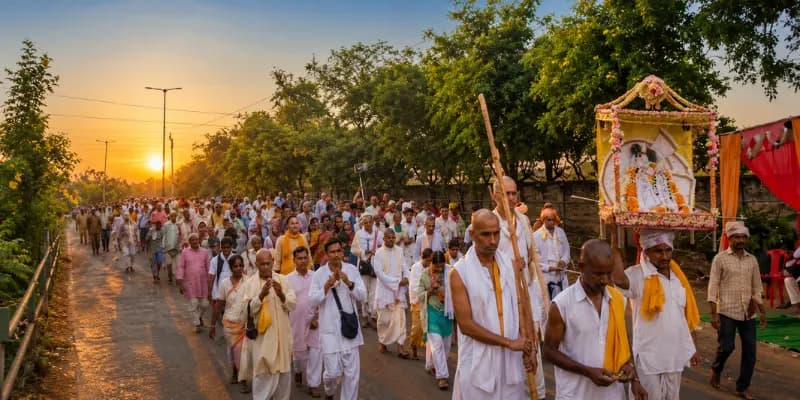
On foot (pad-yatra) - the traditional way, taking about thirty to forty days, usually with a registered group that provides tents and meals.
By vehicle (bus or car) - the practical way for those with less time, completing the circle in about five to ten days.
Dandavat parikrama - the hardest, prostrating full-length at every step, taking months; undertaken by the most devoted.
An honest word for the anxious: walking barefoot is not compulsory - pilgrims wear comfortable footwear as their health allows. Do it in the manner your body and your devotion permit; the Lord receives the heart, not the hardship.
An honest note
A born-Brajwasi keeps it straight:
The distance is given variously - traditionally 252 km (84 kos), though some sources say nearer 300; and the duration varies (foot 30-40 days, vehicle 5-10), as do the route sequences between operators.
There are several "Charan Paharis" (footprint-hills) in Braj - at Kaman, near Barsana and elsewhere - so don't take one for another.
The parikrama crosses state lines - Kaman and Deeg are in Rajasthan, not Uttar Pradesh - so carry ID and plan accordingly.
The liberation it is said to bestow is the cherished faith of the scriptures and of Braj; I share it as such, with reverence, not as a transaction.
Distances, timings and stay arrangements should be verified on the ground and festival dates (which move yearly) confirmed by the panchang.
For the pilgrim - practical guidance
A few honest words from the road:
Go with a registered yatra group for the full parikrama - for safety, food, shelter and the route.
Footwear and feet - broken-in walking shoes and care for blisters; the distances are long.
Heat and water - start early (the old rhythm is 4-9 am, rest in the afternoon heat, resume by 4 pm); carry water and ORS.
Seva camps - villagers along the way offer buttermilk, tea and simple meals as seva; receive it with grace.
For limited time - do a vehicle-based yatra (our package below) or walk only the shorter parikramas (Govardhan, the town-circuits) and drive the rest.
Treat it as a retreat - Braj is Krishna's home; go gently, keep it clean and let the land work on your heart.
Author's tips from Gurudutt - what only a local knows
Kaman is the secret highlight - most day-trippers never cross into Rajasthan; its eighty-four temples and Vimal Kund are a revelation.
Bhandirvan for the marriage - stand under the old banyan where Radha and Krishna were wed; it is one of Braj's most moving spots.
Don't miss Javat and Sanket - these tiny villages hold the tenderest part of the whole story.
Phalen at Holi - if your timing allows, the fire-walk is unforgettable (and humbling).
Drive the outer ring, walk the inner - for most pilgrims, a vehicle yatra with foot-parikrama at Govardhan is the wise balance.
Everyone knows Banke Bihari and Prem Mandir. But Braj is not only the famous temples - it is a whole land and the old people will tell you that you have not truly seen Braj until you have walked its circle. To cross into Kaman and find eighty-four temples no guidebook names; to stand under the banyan of Bhandirvan where the divine couple were wed; to sit in little Javat where Radha lived as a bride and in Sanket where she stole away to meet her Lord - this is the Braj behind the Braj. I have walked this circle and I tell my pilgrims: do as much of it as your body allows, by foot or by wheel, but do it once. You will come home with the dust of the whole Leela-sthali on your feet. - Gurudutt