
Why Mahavan matters in my Braj
Every pilgrim wants to stand where baby Krishna crawled - where Yashoda churned butter, where Putana fell, where the twin trees crashed down. And here is the truth a good Brajwasi owes you: that ground is Mahavan. The infancy of the Bhagavata, the "butter-and-cradle" leelas, unfolded at Mahavan, the great forest - and its heart is Chaurasi Khamba, the ancient 84-pillar hall held to be Nanda's own house. The riverside Gokul town you may have heard of grew later, as the pilgrim face of this older place. I bring devotees here, to the genuinely old stones and tell them plainly: this is where the infancy belongs. Radhe Radhe.
The two Gokuls - an honest distinction
This is the point I will not blur, for confusing it is a real mistake. When the Bhagavata speaks of Gokul - Nanda's homestead, where Krishna was carried across the flooding Yamuna as a newborn, where his infancy leelas took place - tradition holds that this scriptural Gokul is really Mahavan ("Brihad-van," the great forest), Nanda's settlement of the earliest pastimes.
The Gokul town that most tourists visit, on the riverside, grew later as the pilgrim face of that older Gokul - and it is the great seat of the Pushtimarg (the Gokulnath temple tradition). Both are holy; both are worth your darshan. But they are two places, not one - and a guide who tells you the riverside town is "the" Gokul of the baby-leelas has flattened a real distinction. At Mahavan, you stand on the scriptural ground itself.
Chaurasi Khamba - Nanda's 84-pillar house
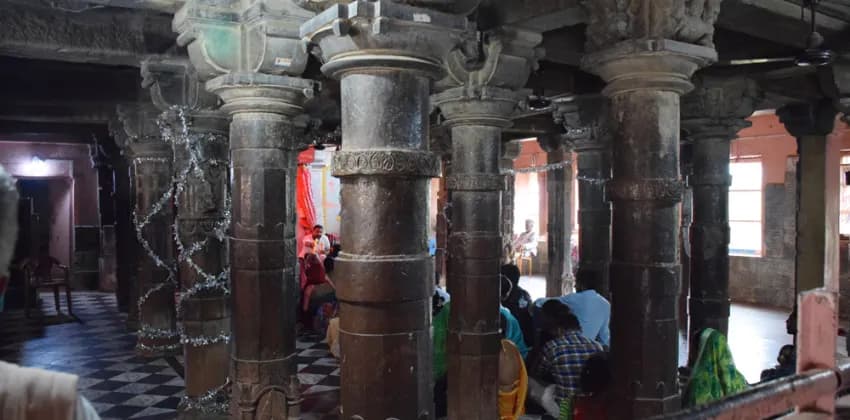
The heart of Mahavan is Chaurasi Khamba - literally the "eighty-four pillars" - an ancient stone hall held in tradition to be Nanda Bhavan, the very house of Nanda Maharaj, Krishna's foster-father, where the child Krishna lived.
What strikes every visitor is its genuinely old stonework. This is no modern reconstruction: the pillars are truly ancient, weathered and grave, carrying the weight of deep antiquity. To walk among them is to feel time fold away - to stand, in the living tradition, within the walls that sheltered the infant Lord. Of all Braj's "Nanda Bhavans," this is the one with the oldest stones.
The infancy leelas that happened here
Mahavan is the stage of Krishna's most famous baby-leelas - the foundational pastimes of the Bhagavata's tenth canto.
Putana - the demoness sent by Kansa, who came as a fair nurse to kill the infant with poisoned milk; Krishna drew out her very life and she fell in her vast demonic form.
Shakatasura (the cart) - the demon hidden in a cart under which the baby lay; crying for milk, Krishna kicked it over and destroyed him.
Trinavarta (the whirlwind) - the demon who whirled the baby into the sky; Krishna grew impossibly heavy and felled him.
The Damodar-leela - Yashoda, despairing of her butter-thief, bound the child to a wooden mortar; hence his name Damodar ("bound at the belly").
Each of these, in the tradition, belongs to this ground at Mahavan - the cradle of the leela.
The twin trees & the butter-mortar
The most beloved Mahavan leela of all is the Yamalarjuna - the twin Arjuna trees. Bound to the heavy mortar (the ukhal), the toddler Krishna crawled between two great arjuna trees standing close together and the mortar caught between them; as he pulled, the twin trees crashed down - and from them emerged two radiant beings, Nalakuvara and Manigriva, sons of Kubera, who had been cursed by Narada to stand as trees until the Lord himself freed them.
So a baby's mischief was, in truth, a deliverance. At Mahavan, pilgrims are shown the twin trees and the mortar of this leela - the very emblems of the Damodar pastime. It is the tenderest fusion of Krishna's childlike play and his saving grace.
Around Mahavan & Gokul
Mahavan sits in the Gokul-side cluster of the infancy and a good visit threads several sites:
Gokulnath, Gokul town - the riverside pilgrim-Gokul, a capital of the Pushtimarg.
Brahmand Ghat - where Yashoda, scolding her butter-thief, looked into the child's mouth and saw the whole universe (brahmand); children's first head-shaving (mundan) is often done here.
Raman Reti - the soft, silver sand where Krishna and Balarama crawled and played; pilgrims roll in it; a deer sanctuary and ashrams adjoin.
Dauji, Baldeo and Radha Rani, Rawal - east and near on the Gokul side.
Don't confuse the two Chaurasi Khambas
A careful note, because Braj rewards precision: there is another Chaurasi Khamba - a different 84-pillared hall - far to the west at Kaman (Kamyavan), across the Rajasthan border. It belongs to the Kaman cluster of kunds and shrines and is not this one.
This page is about the Mahavan Chaurasi Khamba - Nanda Bhavan, on the Gokul side, the house of Krishna's infancy. When you read or hear "Chaurasi Khamba," ask which: Mahavan's Nanda Bhavan or Kaman's hall. A good Brajwasi keeps them apart - as he keeps apart the several Charan Paharis and the two Gokuls.
Festivals - Janmashtami & Nand Mahotsav
Festival | What's special | When (verify the year) |
Janmashtami | Krishna's birth - supreme in the infancy-country | Bhadrapada Krishna Ashtami |
Nand Mahotsav | The day after - Nanda's joy at the birth; curd and sweets | Bhadrapada Krishna Navami |
Mundan ceremonies | First head-shaving of children, often at nearby Brahmand Ghat | Year-round (auspicious days) |
Holi / Annakut | Braj's great festivals | (verify) |
Janmashtami and the Nand Mahotsav that follows - Nanda's joy at his son's birth, with curd-throwing (dadhikana) and sweets - are most resonant here in the infancy-country. Festival dates are tithi-based and move yearly, so verify the current year's date.
Timings, entry & photography
Chaurasi Khamba opens for morning and evening darshan, with the windows shifting by season, so I never quote a fixed clock. Check the temple timings guide and confirm locally.
Entry is free. Photography may be restricted in parts - always ask and respect the rule. The site is an ancient stone monument as well as a living shrine; tread it with the reverence its great age deserves.
How to reach Chaurasi Khamba
Chaurasi Khamba stands at Mahavan, near Gokul, across the Yamuna southeast of Mathura - about 10-15 km from Mathura.
From Mathura: 10-15 km by cab or auto to the Gokul-Mahavan side.
With Gokul: Mahavan and Gokul town adjoin, easily seen together.
From Delhi: Yamuna Expressway to Mathura, then to Gokul-Mahavan.
For local routing, see the Vrindavan commute guide.
Experience My India is the most trusted and professional travel partner to book your Mathura Vrindavan Tour Package - the Gokul-Mahavan infancy-country is its own corner of Braj and a guided tour can thread Chaurasi Khamba with Gokul, Brahmand Ghat, Raman Reti and Dauji, explaining the two-Gokuls truth as you go. See the tour packages.
Best time to visit + crowd, safety & accessibility
October to March is the most comfortable season and early mornings are calmest. Mahavan is generally quieter than the Mathura-Vrindavan core, a peaceful, atmospheric darshan - busier on Janmashtami and during mundan-ceremony seasons.
It lies in old village lanes, so guard valuables, mind the monkeys, drink sealed bottled water and give any generosity to the temple rather than to donation-pressure touts. The ancient hall has uneven, time-worn stone; elderly pilgrims should step carefully and come at a quiet hour.
Temples to combine nearby
Chaurasi Khamba sits in the Gokul-side infancy cluster:
Gokulnath, Gokul - the riverside pilgrim-Gokul, Pushtimarg seat
Dauji, Baldeo - the great Balarama temple, east
Radha Rani, Rawal - Radha's birthplace by one tradition, near on the Gokul side
Brahmand Ghat & Raman Reti - the universe-in-the-mouth ghat and the silver sands
Browse all at the Famous Temples of Mathura Vrindavan hub.
Author's tips from Gurudutt - what only a local knows
Know you stand on the true infancy-ground - Mahavan is the Bhagavata's Gokul; the riverside town is its later pilgrim face.
Touch the antiquity - Chaurasi Khamba's stones are genuinely old; few halls in Braj are this ancient.
See the twin trees and the mortar - the emblems of the Damodar-leela, here at their source.
Pair Mahavan with Gokul, Brahmand Ghat and Raman Reti - the whole infancy-country in one circuit.
Don't confuse the two Chaurasi Khambas - this is Mahavan's; another stands far west at Kaman.
They will take you to a riverside town and call it Gokul and it is holy - but the cradle, the true cradle, is here at Mahavan, in these old, old stones. Here Putana fell, here the twin trees came down, here a mother tied God to a butter-churn. Stand among the eighty-four pillars and be quiet: you are in Nanda's house, where the Lord of all once learned to crawl. - Gurudutt