
Vrinda Devi & the grove-goddess
The vans are not just trees - they have a goddess. Vrindavan, the most beloved, is named not for a man or king but for Vrinda Devi - tulsi (holy basil) personified - the guardian of the grove and the arranger of the lovers' meetings. In Braj, tulsi is no mere plant but a deity: worshipped in the courtyard tulsi-chaura, worn as the tulsi-mala of Vaishnava initiation and married to Krishna each year at Tulsi Vivah in Kartik.
So when a pilgrim asks "why is it called Vrindavan?", the rich answer is: after a plant-goddess who tends the lovers' grove. The vans are her domain - and to honour the forests of Braj is to honour Vrinda Devi, who keeps them.
The near vans - Madhuvan, Talvan, Kumudvan, Bahulavan
On the Mathura side lie four of the twelve:
Madhuvan (Maholi) - the grove of the demon Madhu (for whom it is named) and the place of Dhruva's tapasya, the boy-sage's great penance.
Talvan (Tarsi) - the palm-grove where Balarama slew Dhenukasura, the donkey-demon who guarded its fruit.
Kumudvan - the lotus-pond grove (kumud, the lotus), a place of water and flower.
Bahulavan (Bati) - named for Bahula, the truthful cow saved by Krishna; a good cow-story of Braj, dear to the cowherd Lord.
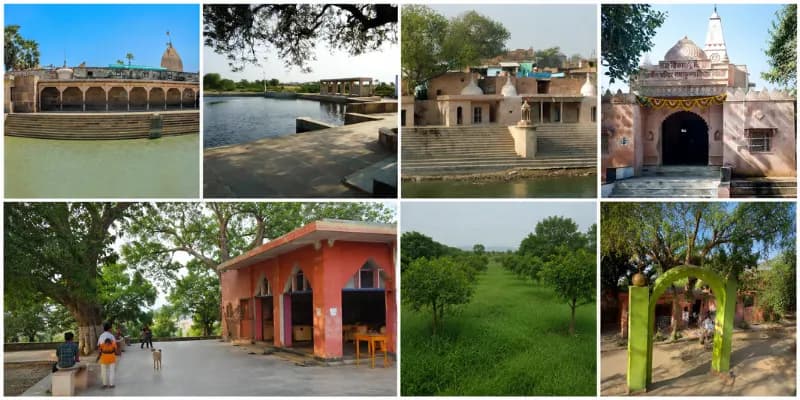
Each is now a village with its shrine and tank, the forest a memory - but the leela lives on in the name and the local telling.
The southern vans - Lohvan, Bhadravan, Belvan, Khadiravan
To the south lie more of the twelve:
Lohvan - the grove of the demon Lohajangha, slain by Krishna.
Bhadravan - a grove of the leela, on the southern arc.
Belvan - the grove of Lakshmi's tapasya, where the goddess of fortune did penance, longing to join the Raas.
Khadiravan - a grove of the khadira (acacia), one of the twelve.
These too are now largely settlements and kund-clusters - the southern stations of the great parikrama, each holding its leela in its name.
Bhandirvan - the great banyan & the secret marriage
Bhandirvan is one of the most storied of the vans. Its glory is the colossal Bhandir vat - an enormous, ancient banyan tree - and it is the grove of Shridama, Krishna's beloved cowherd-friend and of the Venu Kup (a sacred well).
Bhandirvan also carries a contested tradition: in the Garga-Samhita and some sampradayas, it is held to be where Brahma himself secretly married Radha and Krishna. I share this honestly as cherished sampradaya material that varies - some traditions hold the divine marriage dear, others do not emphasise it and a good Brajwasi presents it as a belief that varies rather than a settled fact. To the devotee for whom it is precious, Bhandirvan is the very place of Radha and Krishna's wedding.
Kamyavan (Kaman) - the fulfiller of desires
Kamyavan - today the town of Kaman, across the Rajasthan border in Bharatpur district - is one of the twelve vans and its name means "the fulfiller of desires" (kamya). It is a dense cluster of kunds and shrines, a major node of the Adhik Maas (leap-month) parikrama, drawing pilgrims to its desire-granting waters. Among its sites:
Vimal Kund (the great tank) and Dharm Kund - its principal sacred waters.
Kameshwar Mahadev - its guardian Shiva shrine.
A Chaurasi Khamba - an 84-pillared hall. Note well: this is not the Chaurasi Khamba of Mahavan (Nanda Bhavan); Kaman has its own and a good Brajwasi keeps them apart - as he keeps apart the several Charan Paharis found across Braj.
Kaman is remote; plan transport, water and a guide for the trip into Rajasthan.
Vrindavan & Mahavan - the famous vans
Two of the twelve are so great they have grown into towns of their own:
Vrindavan - the grove of the Raas, the devotional heart of Braj, the town of the Sapt Devalaya. Its forests gave way to the temple-town we know; see the Famous Temples of Mathura Vrindavan and its Raas-groves of Nidhivan and Seva Kunj.
Mahavan - "the great forest," the scriptural infancy-Gokul, home of Chaurasi Khamba (Nanda Bhavan).
So two of the twelve forests are the very poles of Krishna's story - the infancy at Mahavan, the youth and Raas at Vrindavan.
Other sacred groves - Kokila Van, Gahvar Van, Raman Reti
Beyond the classic twelve, Braj holds more beloved groves:
Kokila Van - the "cuckoo forest" near Nandgaon, today famous as Kokilavan Shani Dev Dham, where Krishna blessed Shani.
Gahvar Van - Radha's pleasure-grove at Barsana, below the hills, where she played with her sakhis.
Raman Reti - the soft, silver sand near Gokul where the infants Krishna and Balarama crawled and played; pilgrims roll in its sand in devotion and a deer sanctuary and ashrams adjoin.
These groves and sands round out the green, sacred landscape of Braj's leela.
The vans & the 84-Kos parikrama
The deep purpose of the vans is the 84-Kos (Chaurasi Kos) parikrama - the great 250 km circuit that threads the twelve forests and dozens of leela-villages. To walk it is to honour each van in turn, the parikrama stringing the groves like beads.
The outer nodes - Chhata, Kosi (Kosi Kalan), Shergarh and many small villages - are each a halt with a kund and a leela-line. You need not memorise them all; know that the parikrama threads dozens of them and that the Braj 84-Kos Yatra is how a pilgrim honours the whole forest-land of Krishna.
How to visit the vans
A few honest pointers for the groves:
Don't expect forests - most vans are villages with a shrine and a tank; come for the leela and the memory, not the scenery.
The remote ones need planning - Kaman (into Rajasthan) and the outer nodes need transport, water and ideally a guide; the Punchari-end and far villages are genuinely remote.
The whole twelve are a parikrama, not a day-trip - to truly do the vans is to walk or drive the 84-Kos circuit over several days.
Temples to combine nearby
The vans connect to Braj's great sites:
Chaurasi Khamba (Nanda Bhavan), Mahavan - the great-forest van of the infancy
Kokilavan Shani Dev Temple - the cuckoo-forest grove
Maan Mandir, Barsana - by Gahvar Van, Radha's grove
Giriraj Govardhan - the hill the parikrama circles
Browse all at the Famous Temples of Mathura Vrindavan hub.
Author's tips from Gurudutt - what only a local knows
Know the vans are mostly villages now - come for the leela and the memory, not for forests that are largely gone.
Agree gracefully on the lists - the twelve are given variously; don't argue over which is "right."
Don't confuse Kaman's Chaurasi Khamba with Mahavan's - two different 84-pillar halls, two different vans.
The vans are a parikrama - to honour them truly, walk or drive the 84-Kos circuit, not a single day.
Grieve and hope - Braj's forests are wounded like her river; honour them and support those replanting them.
Twelve forests, the books say - and when I was a boy there were still groves. Now mostly there are villages and a name and a story. I will not lie to you and call a dusty lane a forest. But I will tell you what happened there - here Dhruva sat in penance, here Balarama broke the donkey-demon, here Brahma is said to have wed Radha and Krishna - and you will understand that in Braj, the forest is in the memory and the memory is holy. - Gurudutt