Travel Guide · Travel Guides · Updated October 2026
Rudra Kund and Rin Mochan Kund, Govardhan: Legends and the Parikrama
By Gurudutt, Experience My India·10 October 2026
Quick Answer
Quick Enquiry
The two kunds at a glance
| Rudra Kund (Rudana Kund) | Rin Mochan Kund (Pap Mochan Kund) |
Where | At Jatipura, in front of the Giriraj Mukharvind temple | On the Govardhan parikrama marg |
Dear to | Lord Shiva; the weeping of divine love | Those seeking freedom from debts and sins |
The legend | Shiva witnessed the Annakut here; tears of love formed the kund | Krishna's tarpan on his return from Dwarka |
Nearby | The Budhe Baba Shiva temple | The pastime sites of the parikrama |
Restored by | The Braj Foundation | The Braj Foundation |
The two sacred kunds of the parikrama
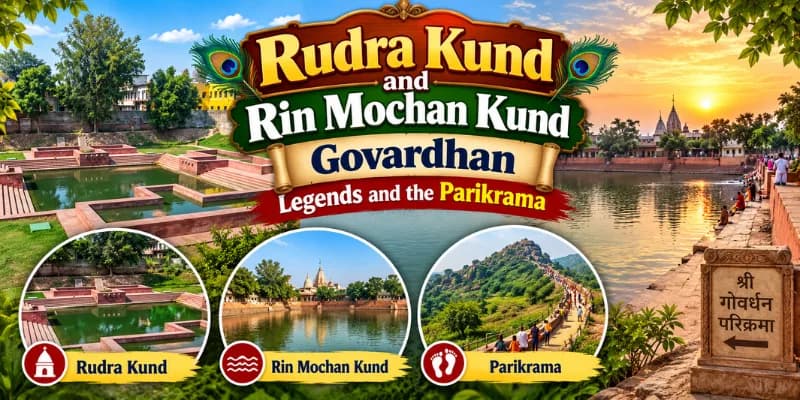
Among the many holy kunds that lie along the great Govardhan parikrama are Rudra Kund and Rin Mochan Kund, two tanks of deep and tender devotion. Rudra Kund, at Jatipura, is dear to Lord Shiva and holds the memory of tears of divine love; Rin Mochan Kund is held to free the heart of its debts and sins. Both are ancient, both had fallen into ruin over the centuries and both have been beautifully restored by the Braj Foundation, so that their old spiritual legacy lives on for the pilgrims of Giriraj. For the whole parikrama and the land of Krishna, a mathura vrindavan tour with Experience My India can bring you to these kunds and around the holy hill.
From the ground (Gurudutt): On the Giriraj parikrama at Jatipura, where the Mukharvind is bathed in milk, is Rudra Kund and the old people tell it so sweetly: that even Lord Shiva could not stay away from Krishna's Govardhan festival and that his tears of love became this very pond. And at Rin Mochan Kund, we pray to be freed of our debts, the debts of the soul. These little kunds were in ruins and the Braj Foundation has made them beautiful again; I take my guests to sit by them and feel the old love of Braj. Radhe Radhe, Jai Giriraj.
Rudra Kund (Rudana Kund) at Jatipura
Rudra Kund, also called Rudana Kund, lies at the heart of the parikrama, at Jatipura:
At Jatipura, before the Mukharvind. Rudra Kund stands at Jatipura village, on the Govardhan parikrama marg, directly in front of the Shri Giriraj Mukharvind temple, the great darshan point where the face of Giriraj is worshipped and where Krishna is held to have begun the Annakut, the mountain of food offered to Govardhan; so the kund is at one of the dearest spots of the whole parikrama.
The kund of weeping. Its name Rudana Kund comes from rudana, to weep, for it is held to have formed from tears of divine love; it is a tender, holy place, revered by the lovers of both Shiva and Krishna and newly beautiful since its restoration.
The Annakut that Shiva came to witness is the great Govardhan Puja; see our giriraj maharaj govardhan aarti lyrics and diwali 2026 in india guides for Giriraj and the Annakut.
The legends of Rudra Kund: Shiva's witnessing and the weeping
Rudra Kund holds beloved legends of Lord Shiva and of divine love:
Shiva comes to witness the Annakut. It is told and the Giriraj Khand of the Garga Samhita, in the thirteenth verse of its second chapter, is said to corroborate it, that when Lord Shiva heard of the grand Annakut festival that Krishna had begun for the worship of Govardhan, he could not stay away; he left Mount Kailash and came with Goddess Parvati and sat at this very spot to witness, in bliss, the whole festival and the abhishek of Govardhan.
The tears of Shiva. By one tradition, as Lord Shiva sat here, absorbed in meditation upon the divine pastimes of Radha and Krishna, tears of ecstatic love flowed ceaselessly from his eyes and from those tears of love the kund was manifested; so Rudana Kund is the very weeping of Shiva's devotion, for tears are the purest form of love.
The weeping of Radha. By another tradition, it was here that, when Krishna suddenly vanished from the great Maha Raas, the Raas dance, Shri Radha and the gopis wept in the anguish of their separation from him and their tears formed the reservoir; so the kund holds the tears of the highest love, whether of Shiva or of Radha.
The Budhe Baba temple and the restored Rudra Kund
Beside the kund stand its shrines and the restoration has made it beautiful once more:
Budhe Baba Mandir. Just beside Rudra Kund sits an ancient Shiva temple known as Budhe Baba, the Old Grandfather, where Lord Shiva is worshipped as the elder of the place; by tradition, an eastern gateway near the kund once opened into a cave that led up to the historic site of the Shrinathji temple atop the hill.
Restored as a Shiva Yantra. Having fallen into ruin, Rudra Kund was researched and beautifully restored by the Braj Foundation, designed in the sacred form of a Shiva Yantra: the water is taken to represent Krishna, Hari and the structure of the kund Lord Shiva, Har, so that the kund embodies the union of Har and Hari, of Shiva and Krishna.
The details of devotion. In the restoration, the water flows back into the kund through the heads of Nandi, Shiva's bull, carved in white marble and the two gates of the kund are shaped as the trishul, the trident and the damaru, the drum, of Lord Shiva; it is a quiet, lovely, deeply devotional place today.
Rin Mochan Kund (Pap Mochan Kund)
The second kund, Rin Mochan Kund, is a place of release from the burdens of the soul:
Freedom from debts and sins. The name Rin Mochan means the liberation or freedom, from debts, the rins; the kund is also revered as Pap Mochan Kund, the freedom from sins. It is believed that to take a holy dip here or to offer prayers, clears a person's spiritual, karmic debts and purifies the heart, so it is dear to pilgrims seeking release and a clean soul.
The tarpan on Krishna's return from Dwarka. By local Brajvasi tradition, it was here that, after Lord Krishna had spent many years away ruling at Dwarka and returned to his childhood home of Braj, he performed the holy ritual of tarpan, the offering of water to the ancestors, together with his father Nanda Baba, his mother Yashoda and his elder brother Lord Balarama; so the kund is linked to the sacred duty of the ancestors.
On the parikrama path. Rin Mochan Kund sits seamlessly along the Govardhan parikrama marg, among the pastime sites of the sacred hill, so pilgrims come to it as they walk around Giriraj, pausing to pray for the release of their debts and the cleansing of their hearts. It too has been restored by the Braj Foundation.
Nanda Baba's family and their land are honoured at gokul; and Balarama at the kshir sagar of Baldeo.
The two kunds on the Govardhan parikrama
Both Rudra Kund and Rin Mochan Kund lie on the great seven-kos, about twenty-one kilometre, Govardhan parikrama, the circumambulation of the sacred hill that is the heart of Govardhan pilgrimage. Rudra Kund is at Jatipura, before the Giriraj Mukharvind, one of the dearest darshan points of the parikrama, where the face of Giriraj is bathed in milk; Rin Mochan Kund lies along the parikrama marg among the pastime sites. So the devout who walk the parikrama come to both, pausing at Rudra Kund for the tears of divine love and at Rin Mochan Kund for the release of their debts. With the other kunds of the walk, such as Apsara, Naval and Surabhi Kund and the great Haridev temple at Mansi Ganga, they make the Govardhan parikrama a journey through the leelas of Krishna and the devotion of the ages. Our govardhan hill guide covers the hill, Giriraj and the parikrama.
How to reach and visit
The two kunds are on the Govardhan parikrama, easily visited on the walk:
Reaching Jatipura and the parikrama. Govardhan town is about 22 to 25 km from Mathura and Vrindavan; Jatipura, where Rudra Kund lies before the Giriraj Mukharvind, is on the parikrama marg on the southern-western side. Most pilgrims come by car with a Braj guide and walk the parikrama or visit the kunds by road; Rin Mochan Kund is likewise on the parikrama route.
Visit with reverence. The kunds are ancient and holy and newly restored; treat the waters, the Budhe Baba temple and the shrines with reverence, follow the local custom and keep the peace of these devotional spots. Sit a while by Rudra Kund among its Shiva-yantra beauty and pray at Rin Mochan Kund for release; they are places to feel.
Best time. October to March is the most pleasant season for the parikrama and the kunds; Govardhan is dearest and busiest at Govardhan Puja after Diwali, the very Annakut festival that Shiva came to witness at Rudra Kund and on Guru Purnima. For a quiet darshan, come on an ordinary day in the cool season.
See our distance from mathura to gokul and how to commute in vrindavan guides for reaching this side of Braj and our mathura vrindavan temple timings guide for the Govardhan temples' hours.
We take pilgrims on the Govardhan parikrama and to its sacred kunds, Rudra Kund and Rin Mochan Kund, Apsara and Surabhi Kund and the Haridev temple at Mansi Ganga and across the whole of Braj, in a comfortable vehicle and on foot with a Braj-born guide who knows the kunds and their old stories. A shared day tour starts from around ₹1,499 per person, with darshan free. The braj 84 kos yatra covers the whole of Braj including Govardhan, our mathura vrindavan tour the twin cities and our vrindavan tour package Vrindavan in a day; the apsara kund govardhan and surabhi kund govardhan are dear kunds nearby. Message me on WhatsApp at +91-7302265809 to plan your Govardhan parikrama.
Related guides
Meet Gurudutt — Your Mathura Vrindavan Guide
Not just a tour operator — Gurudutt was born and raised in Braj Bhoomi. He has spent over a decade personally guiding pilgrims through the sacred lanes of Mathura & Vrindavan.

Founder – Experience My India
Gurudutt
Founder · Experience My India