Travel Guide · Travel Guides · Updated July 2026
Gokul, Uttar Pradesh: The Town of Krishna's Infancy, Its Location, History and Significance
By Gurudutt, Experience My India·28 July 2026
Quick Answer
Quick Enquiry
Key facts at a glance
What it is | A sacred town in Mathura district, Uttar Pradesh, on the Yamuna |
Where | About 15 km south-east of Mathura and 25 km from Vrindavan |
PIN code | 281303, in Mathura district, Uttar Pradesh |
Why sacred | Where the infant Krishna was raised by Nanda and Yashoda |
Sampradaya | The principal seat of the Pushtimarg, the Vallabh tradition |
The old site | Adjoins Mahavan, also called Purana Gokul, the ancient Gokul |
What and where is Gokul?
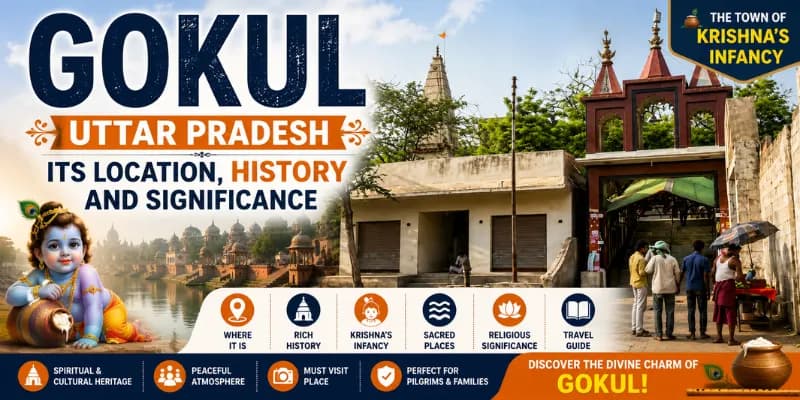
Gokul is one of the most tender and beloved of all the towns of Braj, revered as the place where the infant Krishna was raised in secret, where he took his first steps, stole butter and performed the sweetest of his childhood pastimes in the loving home of Nanda and Yashoda. It is a sacred town in the Mathura district of Uttar Pradesh, set on the banks of the Yamuna, about 15 km south-east of Mathura city and roughly 25 km from Vrindavan. Its PIN code is 281303.
So when people ask where Gokul is, or in which state, the answer is that it is a town in Mathura district, Uttar Pradesh, in the Braj region, on the Yamuna downstream of Mathura. Small and quietly devotional, Gokul holds a special place in the heart of Braj as the cradle of Krishna's infancy and it is the principal seat of the Pushtimarg, the Vallabh tradition. This guide explains the town, its name, its history, its sampradaya, its sites and its festivals in full.
From the ground (Gurudutt): Gokul rewards a gentle, unhurried visit. Its treasures are its Yamuna ghats, its infancy leela-sites and its deep Pushtimarg devotion rather than any grand monument and it is quieter than Mathura or Vrindavan on ordinary days. Pair it with the adjoining Mahavan, the ancient Gokul and time your visit for the morning or evening by the river, which is when the town is at its most beautiful. See our Mathura Vrindavan tour or message WhatsApp +91 7302265809.
Gokul: key facts at a glance
Here are the essential facts about Gokul in one place.
Detail | Information |
Town | Gokul, adjoining Mahavan (Purana Gokul) |
State | Uttar Pradesh |
District | Mathura |
Region | Braj, or Braj Bhoomi |
River | On the banks of the Yamuna |
Distance from Mathura | About 15 km, to the south-east |
Distance from Vrindavan | About 25 km |
PIN code | 281303 |
Governing body | Nagar panchayat, in Mathura district |
Sampradaya | Principal seat of the Pushtimarg (Vallabh tradition) |
Languages | Hindi and Braj Bhasha |
Known as | The town of baby Krishna, the cradle of his infancy |
In one line: Gokul is a sacred town in Mathura district, Uttar Pradesh, on the Yamuna, about 15 km from Mathura, revered as the place where the infant Krishna was raised and the principal seat of the Pushtimarg.
The name Gokul and the meaning of the town
The name Gokul comes from go, meaning cows and kul, meaning a herd, group or abode, so Gokul is the place of cows, a cowherd settlement, fitting for the pastoral home of Nanda Baba, the chief of the cowherds, whose cattle grazed its riverside meadows. In the Bhagavata Purana and the Vishnu Purana, indeed, the word gokula carries the sense of a cowherd camp or cattle station rather than a fixed place name, which is part of the town's ancient character.
This meaning is the key to Gokul's whole feeling: it is not a city of grand temples but a pastoral, riverside town of cows, ghats and the intimate domestic leelas of Krishna's babyhood, the butter and the cradle and the mother's love. The name carries that tenderness and it is why Gokul is cherished less for spectacle than for sweetness. We share the traditional meanings as they are held.
Gokul and Mahavan: the old and new Gokul
One thing that puzzles many visitors is the relationship between Gokul and Mahavan. They are two adjoining places and both are bound up with Krishna's infancy. Mahavan, whose name means the great forest, is also called Purana Gokul, the old Gokul and is revered as the ancient site, home to the Chaurasi Khamba, the 84-pillared hall held by tradition to be the very house of Nanda Maharaj. The Gokul of today, the riverside town, sits close by.
By tradition, Nanda Baba lived at Mahavan and it was here, in the great forest by the Yamuna, that the infant Krishna was raised and performed his baby leelas, before the family later moved on toward Nandgaon. So a full visit takes in both: Gokul town with its ghats and temples and Mahavan, the ancient Gokul, with the Chaurasi Khamba. We present the two together as the tradition holds them, the living town and the ancient site of the same infancy.
Why Gokul is sacred: the infancy of Krishna
Gokul's sanctity flows from the infancy of Krishna. By tradition, told in the Bhagavata Purana, Krishna was born in prison in Mathura to Devaki and Vasudeva and on the stormy night of his birth, to save him from the tyrant Kansa who meant to kill him, Vasudeva carried the baby across the flooded Yamuna to Gokul, to the home of Nanda and Yashoda, where he was raised in secret as their own. This crossing and this sheltering are the founding story of Gokul.
Here, in Gokul and Mahavan, Krishna performed the sweetest and earliest of his pastimes: stealing butter as the makhan chor, being tied to the mortar by Yashoda in the Damodar leela, slaying the demoness Putana and the whirlwind and cart demons sent by Kansa, and, most wondrous of all, showing the whole universe within his infant mouth to his astonished mother. These tender, miraculous infancy leelas, cherished across Braj, are why Gokul is so beloved. We share them as the beloved tradition they are, held with reverence.
Gokul and the Vallabh tradition, the Pushtimarg
Gokul holds a special place as the principal seat of the Pushtimarg, the path of grace, the Vaishnava tradition founded by Shri Vallabhacharya in the sixteenth century. By the tradition of the Pushtimarg, around 1550 Vallabhacharya came to Braj and sought the lost sites of Gokul and Mahavan and the goddess Yamuna herself appeared to him at Thakurani Ghat and revealed the sacred site. Gokul thus became the cradle of the Pushtimarg.
Vallabhacharya's son, Vitthalnath, known as Gusainji, settled in Gokul, expanded the town and established it as the great religious centre of the tradition and it was home to the principal deities of the Pushtimarg before they later dispersed. The Gokulnath temple and the Vallabhacharya sites remain central to the sampradaya and Gokul is visited by its followers from across India and the world. We attribute this sacred history to the Pushtimarg tradition, whose self-understanding it is, presenting it with respect rather than as a claim upon others.
A short history of Gokul
Gokul is revered in tradition as ancient, the site of Krishna's infancy, held to go back some five thousand years and its old site at Mahavan, the great forest, carries that immemorial sanctity. For long ages the exact sites were, by the Pushtimarg tradition, lost or hidden.
The Gokul of history as a living centre springs from the sixteenth century, when Vallabhacharya recovered the sacred sites and his son Vitthalnath settled and built up the town, receiving, by record, imperial firmans from the emperor Akbar that protected the community's lands and cows. The oldest surviving temples, devoted to deities such as Gokulnath, Madan Mohan and Vitthalnath, are held to date from that sixteenth-century flowering. From these foundations Gokul grew into the devotional riverside town it remains, its whole life turning on the memory of Krishna's infancy. We attribute the ancient tradition to belief and the later history to record.
Key places to visit in Gokul
Gokul and adjoining Mahavan hold a cluster of tender, sacred sites, most tied to Krishna's infancy and the Vallabh tradition.
Gokulnath temple, the principal temple of Gokul, central to the Pushtimarg and dedicated to Krishna as the child lord.
Chaurasi Khamba at Mahavan, the ancient 84-pillared hall revered as the house of Nanda Maharaj, the very home of Krishna's infancy.
Raman Reti, the sacred soft sand where by tradition Krishna and his friends played and where devotees roll in the sand seeking blessings, near the Vallabh seat.
Brahmand Ghat, revered as the place where Yashoda saw the entire universe within the infant Krishna's mouth, with the Brahmand Bihari temple.
Thakurani Ghat, where by the Pushtimarg tradition the goddess Yamuna appeared to Vallabhacharya, a serene and sacred riverside spot.
Chintaharan Mahadev, the Shiva temple where, by tradition, Yashoda prayed and had her worries removed and Nand-Yashoda Bhavan and the Yamuna ghats.
Raskhan Samadhi, near Mahavan, the tomb of Raskhan, the poet whose verses of devotion to Krishna are cherished across Braj, a place of shared devotion.
Each is quiet and tender rather than grand, its beauty in its story and its riverside calm. We cover them all, site by site, with the practical detail, in our full places to visit in gokul guide and the wider village circuit in our gokul barsana nandgaon day trip guide.
Festivals in Gokul: Janmashtami and Nandotsav
Gokul's festivals are among the most joyful in Braj and one thing is distinctive: Gokul often celebrates Krishna's birth a day after Mathura and much of the rest of India. This is because, by tradition, while Krishna was born in Mathura at midnight, he arrived in Gokul the next day, so Gokul rejoices then, with Nandotsav, the festival of Nanda, celebrating the baby's coming to Nanda's home with songs, dance and the joyful scattering of gifts and sweets.
Janmashtami itself, at Nand Bhavan and across the town, is deeply moving and Annakut, the Trinavat Mela in Kartik and Holi are also celebrated with devotion, all drawing crowds. These festivals are magnificent but busy. For the dates, which follow the lunar calendar, see our braj festival calendar; for choosing the season, our best time to visit vrindavan mathura guide helps. The winter months are the most pleasant for an ordinary visit.
How to reach and visit Gokul
Gokul is easy to reach as part of a Mathura or Braj visit.
By road: about 15 km south-east of Mathura, a drive of around 30 to 40 minutes and roughly 25 km from Vrindavan, easily reached by taxi or auto. Delhi is about 150 km via the Yamuna Expressway and Agra around 55 km.
By train: the nearest major railhead is Mathura Junction, about 15 km away, well connected across India; from there take a taxi, auto or bus onward to Gokul.
By air: the nearest airports are Agra, around 55 km and Delhi, roughly 150 km, each followed by a road transfer.
Gokul is usually visited as a half-day trip from Mathura or Vrindavan and pairs naturally with Mathura, since it lies on the same side and with the wider village circuit. Within the town, autos and e-rickshaws connect the ghats and the sites and much is walkable. For arriving into the region, see our how to reach vrindavan guide and to sequence the whole trip our how to plan a vrindavan mathura trip guide. We arrange Gokul visits with Mathura and the wider Braj, timed and supported; a shared day tour starts from around ₹1,499 per person and our mathura vrindavan tour covers this side of Braj with darshan free throughout. Message me on WhatsApp at +91-7302265809 to plan it.
Related guides
Meet Gurudutt — Your Mathura Vrindavan Guide
Not just a tour operator — Gurudutt was born and raised in Braj Bhoomi. He has spent over a decade personally guiding pilgrims through the sacred lanes of Mathura & Vrindavan.
Founder – Experience My India
Gurudutt
Founder · Experience My India