Travel Guide · Travel Guides · Updated October 2026
Yamalarjun, Gokul: The Twin Arjuna Trees and Krishna's Damodara Leela
By Gurudutt, Experience My India·14 October 2026
Quick Answer
Quick Enquiry
Yamalarjun, Gokul, at a glance
Detail | Information |
What it is | The twin Arjuna trees of the Damodara (Ukhal Bandhan) leela of Lord Krishna |
Also called | Yamala-Arjuna; the site is the Ukhal Bandhan Ashram |
Scripture | The Srimad Bhagavatam, Canto 10, Chapter 10 |
The trees were | Nalakuvara and Manigriva, sons of Kubera, freed by Krishna |
What to see | The Ukhal Bandhan Ashram at Mahavan, with the ancient grinding mortar (ukhal) |
Where | Mahavan, old Gokul, about 15 km south-east of Mathura, near the Yamuna |
Darshan | Free |
What are the Yamalarjun trees?
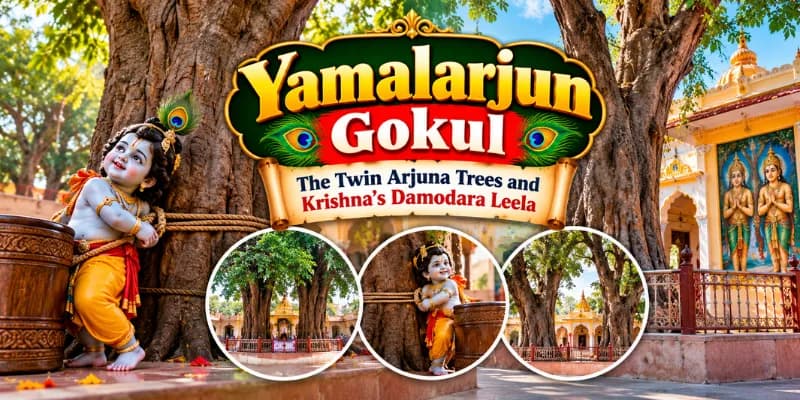
The Yamalarjun, also written Yamala-Arjuna and known as the twin Arjuna trees, are the two great trees of Gokul famous in the Srimad Bhagavatam, in the tenth canto, for one of the most beloved childhood pastimes of Lord Krishna, the Damodara Leela, also called the Ukhal Bandhan Leela, the pastime of the binding to the grinding mortar. By the scripture, the two trees were no ordinary plants, but two cursed souls awaiting the touch of the Lord; and in the courtyard of Nanda Baba in Gokul, the little Krishna delivered them. For Krishna's village of Gokul, see our gokul up guide and to visit Gokul and Mahavan, a mathura vrindavan tour packages with Experience My India can plan it.
From the ground (Gurudutt): I was born in Gokul, so this pastime is especially close to my heart. At the Ukhal Bandhan Ashram at Mahavan they still show the old wooden ukhal, the grinding mortar to which Mother Yashoda bound her butter-thief and I never tire of telling guests how the little Lord, pretending to be caught, dragged it between the two trees and set two souls free. It is a story of a mother's love and of the Lord who lets himself be bound by that love. We tell it as the cherished tradition of Braj. Radhe Radhe.
The curse of Nalakuvara and Manigriva
The story of the Yamalarjun begins, by the Bhagavatam, in a former age, in the heavens:
The sons of Kubera. Nalakuvara and Manigriva were the two sons of Kubera, the treasurer of the demigods, lords of great wealth; but, grown proud and heedless in their riches and lost in intoxicated revelry, they had forgotten themselves and failed to show due respect and modesty before the great sage Narada Muni when he came upon them.
The curse of the sage. To cure them of their pride and to turn them, in time, toward the Lord, the merciful sage Narada cursed the two brothers that they should stand, immobile, as trees upon the earth; for in their arrogance they had behaved as those without sense and the lesson of humility would be learned in the stillness of a tree.
The mercy within the curse. Yet Narada's curse was, in truth, a hidden grace: he ordained that, after their appointed time as trees, the two should be freed by the very touch of the Lord, Sri Krishna himself and should then return, purified, to their heavenly abode, their pride washed away and their hearts turned to devotion. So the curse carried its own deliverance. We present this as the cherished tradition of Braj.
So the two came to stand as the twin Arjuna trees, the Yamalarjun, in the very courtyard of Nanda Baba and Mother Yashoda in Gokul, waiting, through the long years, for the child who would set them free.
The Damodara Leela: Yashoda binds Krishna
The deliverance came through one of the sweetest of all the pastimes of Krishna's babyhood:
The butter thief. By the tradition, the little Krishna was a loving thief of butter and one day, in play, he vexed Mother Yashoda, who resolved, as any mother might, to bind her restless child to the heavy wooden grinding mortar, the ukhal, to keep him still while she worked.
The rope that fell short. But when Yashoda tried to tie him, the rope fell short by the width of two fingers; she added more rope and again it fell short by two fingers and again, however much she brought, for the whole universe cannot bind the Lord but by love. At last, seeing his mother weary and her brow damp with effort, the Lord, out of love for her, allowed himself to be bound.
Damodara, the Lord bound at the waist. It is from this binding at the waist, the udara, by the rope of a mother's love, that Krishna earns the dear name Damodara, he who was bound at the belly; and the pastime is cherished and sung by devotees, above all in the holy month of Kartik, in the prayer of the Damodarashtakam. We present this as the cherished tradition of Braj.
The twin trees fall: Yamala-Arjuna bhanjan
Bound to the mortar, the little Krishna then fulfilled the words of his devotee Narada. By the tradition, the child, dragging the heavy ukhal behind him, crawled toward and between the two tall, closely standing Arjuna trees; the mortar, following him, caught crosswise between the two trunks. Then, with a gentle pull of his small body, the Lord uprooted the two gigantic trees, which came crashing down to the earth with a sound like a thunderbolt, though the child himself sat unharmed and smiling between them. This is the Yamala-Arjuna bhanjan, the breaking of the twin Arjuna trees, the heart of the Ukhal Bandhan leela. We present this as the cherished belief and tradition of Braj, held with faith and recounted with reverence.
The deliverance and the meaning of the pastime
From the fallen, shattered trunks there arose a wonder:
The two radiant princes. From the broken trees emerged the two celestial beings, Nalakuvara and Manigriva, radiant and freed at last from their long curse; they bowed low before the little Lord who had delivered them, offered heartfelt prayers of devotion, and, their pride wholly washed away, returned purified to their heavenly abode.
Grace within the curse. The pastime teaches, by the tradition, that the grace of the Lord can turn even a curse into a blessing and that no bondage of pride or of matter can stand before him; what seemed a punishment was, from the first, the path to his lotus feet. It is a favourite teaching of the saints of Braj.
Bound only by love. And it teaches, too, the sweetest truth: that the Supreme Lord, whom the whole universe cannot bind, allows himself to be bound by the simple love of his mother; the Lord is conquered not by power but by pure devotion. We present this as the cherished tradition of Braj.
The Ukhal Bandhan Ashram today and how to reach
The place of this pastime is lovingly preserved at Mahavan, in old Gokul:
The Ukhal Bandhan Ashram. The spot is honoured as the Ukhal Bandhan Ashram, also cherished as the Yamalarjuna bhanjan tirtha, once part of the courtyard of Nanda Baba; within it the devotee is shown the ancient wooden grinding mortar, the ukhal, said by the priests to be of immemorial age, with symbolic marks of the fallen twin trees, and, by the local account, a basket revered as the one in which the infant Krishna was carried across the Yamuna. Take darshan quietly and honour this holy place.
Where it is. The ashram is at Mahavan, old Gokul, about 15 km south-east of Mathura city, near the banks of the Yamuna and a short way from the Chaurasi Khamba, the eighty-four-pillared house of Nanda Baba. Gokul and Mahavan lie together on the far bank of the river from the main Mathura and Vrindavan side.
How to reach and visiting. Most pilgrims come by car, auto-rickshaw or taxi from Mathura or Vrindavan, usually as part of a Gokul and Mahavan day; the ashram is among the close-set holy places of old Gokul, so a Braj guide who knows Mahavan helps you find it and tells the story on the spot. Come in the cool of the morning or evening and keep the peace of this holy site.
See our 84 khambha temple mahavan guide to the house of Nanda Baba nearby, the gokul vs mahavan guide to the two old Gokuls, the brahmand ghat gokul of another butter-thief pastime and our how to commute in vrindavan guide for reaching Gokul.
We take guests to the Ukhal Bandhan Ashram and the holy places of Gokul and Mahavan, the Nand Bhavan, the ghats of the Yamuna and the whole of Braj, in a comfortable vehicle with a Braj-born guide, born in Gokul, who knows the old stories. A shared day tour starts from around ₹1,499 per person, with darshan free. The braj 84 kos yatra covers the whole of Braj, our mathura vrindavan tour the twin cities and our vrindavan tour package Vrindavan in a day. You can also plan with our mathura vrindavan tour itinerary. Message me on WhatsApp at +91-7302265809 to plan your Gokul darshan.
Related guides
Meet Gurudutt — Your Mathura Vrindavan Guide
Not just a tour operator — Gurudutt was born and raised in Braj Bhoomi. He has spent over a decade personally guiding pilgrims through the sacred lanes of Mathura & Vrindavan.
Founder – Experience My India
Gurudutt
Founder · Experience My India