Travel Guide · Sacred Places & Nature · Updated November 2026
Govind Kund Anyor, Govardhan
By Gurudutt, Experience My India·4 November 2026
Quick Answer
Quick Enquiry
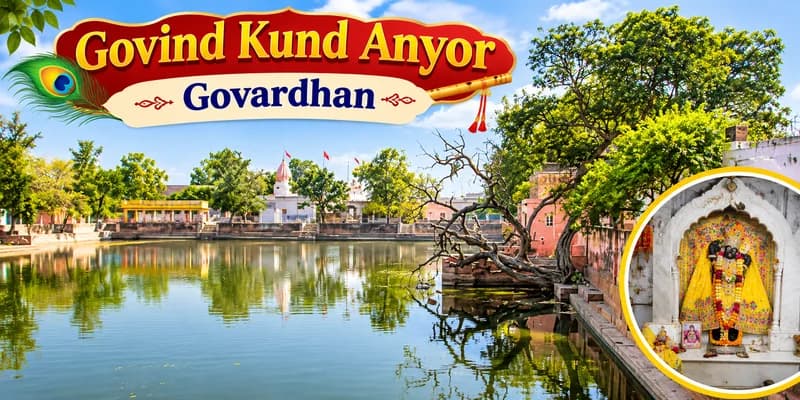
Govind Kund is one of the most meaningful stops on the Govardhan parikrama and many pilgrims walk right past it without knowing its story. By our tradition, this is the very spot where, after Thakur ji lifted Giriraj to save us from Indra’s storm, Indra himself came down humbled and bathed Krishna in the milk of the divine cow Surabhi and from that coronation water this kund formed and here Krishna got the beautiful name Govinda. I love telling guests that standing here. Come in the cool early morning, take a quiet moment or a holy dip with care on the steps and let me point out the little sites around it, Indra Tila, the Surabhi and Airavat kunds, that complete the story. See our Mathura Vrindavan tour Packages or message WhatsApp +91 7302265809.
What Govind Kund is
Govind Kund is a sacred reservoir, a rectangular kund of about 1.85 acres, located at the foot of Govardhan Hill on the edge of Anyor (also spelled Aniyora) village, near Mathura in Uttar Pradesh. It sits on the 21 km Govardhan Parikrama circuit, the great traditional walk around the sacred hill, which makes it a natural and important stop for the millions of pilgrims who perform the parikrama each year.
Like the other sacred kunds of Braj, Govind Kund is both a place of worship and a place of pastime-lore, but it holds a particularly exalted place: by tradition it marks the exact spot of one of the most significant events in the Krishna story, his divine coronation and the giving of the name “Govinda”. It is a serene, historically rich reservoir with stone ghats, framed by the hill and a cluster of smaller related kunds and it rewards both the devotee who knows its story and the walker who simply pauses by its calm water. The sections below cover the Govardhan-Leela legend behind it, the coronation and the naming of Govinda, its spiritual significance, its timings, the 2027 festival dates and the nearby sites.
The legend: the Govardhan Leela and Indra’s pride
Govind Kund’s history reaches back, in tradition, to the era of Krishna and his famous Govardhan Leela, recounted in scriptures such as the Bhagavata Purana and the Garg Samhita.
By this tradition, the young Krishna convinced the villagers of Braj to stop the customary worship of Indra, the rain god and instead to honour Govardhan Hill and nature, which sustained their cows and their lives. Angered that the people of Braj had turned from him, Indra unleashed a catastrophic seven-day torrential storm over the region, meaning to drown it. To protect the villagers, Krishna, by the beloved account still a child, effortlessly lifted the entire Govardhan Hill on the little finger of his left hand and held it aloft like a vast umbrella and all the people of Braj, with their cattle, sheltered beneath it for seven days until the storm spent itself. This is the Govardhan Leela, the pastime at the heart of Govardhan’s whole sanctity and it is the prelude to the story of the kund. These are cherished devotional and scriptural traditions, held dear by the faithful and recounted here in that spirit.
The coronation and the naming of “Govinda”
When the storm failed and Krishna held the hill aloft, Indra realised his grave mistake and his pride was broken. Humbled, he descended to Earth to beg forgiveness and this is where Govind Kund comes into being.
By tradition, Indra came down alongside Surabhi, the celestial wish-fulfilling cow, to perform a holy coronation ceremony (abhishek) for Krishna in apology. In the telling, Indra used the trunk of his elephant Airavat to pour holy (Ganges) water, while Surabhi bathed Krishna with her divine milk, anointing him in a grand Govinda Pattabhishek, the coronation of Govinda. The vast run-off of milk, holy water and flowers from this ceremony pooled at the base of the hill and by tradition, materialised as Govind Kund, so the kund is literally the water of Krishna’s coronation.
And it was here, on this exact spot, that Krishna received the name “Govinda”, from go (cows and also the senses and the land) and vinda (one who finds, pleases or protects), meaning the protector and giver of joy to the cows, the devotees and the land of Braj. This naming, the Govinda Pattabhishek, is the deepest significance of the site. Centuries later, the reservoir’s stone-ghat layout was formally established by Vajranabha, Krishna’s great-grandson, who traced and preserved the forgotten pastime sites of Braj, so the kund we see today marks and preserves that moment. These are devotional and scriptural traditions, held dear by the faithful.
Spiritual significance
Govind Kund carries layers of meaning that make it one of the most revered kunds of Braj.
The naming of Govinda. Above all, this is the spot where Krishna was crowned and given the name Govinda, one of his most beloved names, so the kund is the very birthplace of that name, which is why it is so dear to devotees.
The triumph of humility. The whole episode, Krishna sheltering the humble villagers and the proud Indra brought low and then forgiven, makes the kund a living symbol of surrender and humility over pride and ego. It teaches that the divine shelters the humble and dismantles false pride, a message devotees carry from the site.
The lips of Giriraj. In local folklore and the devotional mapping of the personified Giriraj Govardhan Hill, Govind Kund is poetically treated as the “lips” of Giriraj, which adds to its cherished place in the sacred geography.
An avenue for liberation. By tradition, texts such as the Mathura Mahatmya hold that simply taking a holy bath in, or sprinkling oneself with, the water of Govind Kund cleanses material sins and awards spiritual liberation. This is a devotional belief, held dear by the faithful and it is why a dip here during the parikrama is considered to grant immense spiritual merit.
Together these give Govind Kund a significance out of all proportion to its quiet appearance and understanding them transforms a passing glance on the parikrama into a profound stop.
Timings and best time to visit
Govind Kund is an open reservoir, so it keeps very simple hours.
Kund hours: open all day, every day (sunrise to sunset for practical purposes), with no entry gates and no fee. Devotees visit through the day for a holy dip or parikrama rituals.
Temple darshan: the associated temples on its banks generally follow standard Braj timings, closing for a short afternoon break (roughly 12:30 PM to 4:30 PM), so if you want temple darshan, avoid that window.
Best time: early morning, roughly 5:30 AM to 8:00 AM, is ideal, for the cool air, the soft light and the calm and the cooler months from October to March offer the most comfortable experience overall.
Please treat the temple timings as indicative, since they are set locally and can shift seasonally, so confirm on the day. As an open kund on the parikrama route, Govind Kund itself is always accessible, but the early morning is genuinely the loveliest and most peaceful time and it fits naturally with an early parikrama start before the heat. For the wider season, see our best time to visit guide.
Major 2027 dates and festivals
Govind Kund can be visited on any day during a parikrama, but it reaches its peak spiritual atmosphere on a few key dates in 2027.
Govardhan Puja / Annakut: expected Saturday 30 October 2027 (Kartik Shukla Pratipada). This is the most important festival here, celebrating the very Govardhan Leela the kund commemorates, when massive crowds gather to perform the parikrama right after Diwali. The auspicious muhurat (New Delhi baseline) is about 06:31 AM to 08:45 AM in the morning and about 03:25 PM to 05:38 PM in the evening.
The month of Kartik: about 15 October to 14 November 2027. The entire holy month of Kartik is considered the most auspicious time of year for a holy dip in the kund; see our kartik month guide.
Guru Purnima: expected Sunday 18 July 2027. Known in Braj as Mudiya Purnima, this sparks a massive influx of millions of pilgrims doing the Govardhan parikrama, one of India’s largest gatherings, so Govind Kund and the whole circuit are extraordinarily crowded then.
Because these festivals follow the Hindu lunar calendar, the dates are expected and set by the panchang and can vary slightly between calendars, so treat them as approximate and reconfirm nearer the time. If you come on Govardhan Puja or Guru Purnima, plan for very large crowds; for a peaceful visit, come on an ordinary morning, ideally in the cooler Kartik-to-March stretch.
Nearby sites and the sacred cluster
Part of what makes Govind Kund special is that it sits amid a cluster of smaller sites tied to the exact same coronation legend, so you can take in the whole story in one place.
Indra Tila. A small hillock right behind the kund, where, by tradition, Indra knelt down to pray and beg Krishna’s forgiveness.
Surabhi Kund, Airavat Kund and Indra Kund. Smaller interconnected sacred water bodies nearby, each tied to a part of the pastime, Surabhi (the celestial cow who gave her milk), Airavat (Indra’s elephant) and Indra himself.
Radha Govinda temple. An ancient temple on the banks, housing a beautiful deity, by tradition originally installed by Vajranabha (this is the local temple of the kund; the name Govind or Govinda is used for more than one temple in Braj, so do not confuse it with others elsewhere).
Govind Kund sits within the wider sacred landscape of Govardhan, close to the other great sites of the parikrama such as radha kund and mansi ganga; see our places to visit in govardhan guide. The best way to experience it is as a meaningful, well-understood stop on the Govardhan parikrama, pausing to take in the coronation story and if you wish, a careful holy dip, rather than walking past. A light safety note: as at any kund, the ghat steps can be wet or uneven, so step carefully, keep children close and stay in shallow, safe water rather than going deep.
Let a Brajwasi plan your visit
Sites like Govind Kund reward a guide who knows both the parikrama route and the stories, so you do not walk past the coronation spot without knowing it. As Brajwasis running Experience My India, we can include Govind Kund properly in your Govardhan parikrama, tell you the Govinda-coronation story right at the kund, point out Indra Tila and the Surabhi, Airavat and Indra kunds that complete it, time your visit for the cool early morning and arrange transport, a local guide and a realistic, safe parikrama plan (especially around the huge Govardhan Puja and Guru Purnima crowds). A shared Vrindavan and Govardhan darshan starts from around 1,499 rupees per person; see our govardhan parikrama tour, or we design a private visit. Message us on WhatsApp at +91-7302265809 with your plans.
Related guides
Book Your Mathura - Vrindavan Trip Today
📞 +91-7302265809
💬 WhatsApp: +91-7302265809
We Reply in 30 Minutes
Packages start from ₹1,999/ person | Rated 4.5★ / 204+ Reviews
Explore all: Mathura Vrindavan Tour Packages
Jai Shri Krishna
Meet Gurudutt — Your Mathura Vrindavan Guide
Not just a tour operator — Gurudutt was born and raised in Braj Bhoomi. He has spent over a decade personally guiding pilgrims through the sacred lanes of Mathura & Vrindavan.

Founder – Experience My India
Gurudutt
Founder · Experience My India