Travel Guide · Travel Guides · Updated July 2026
Mansi Ganga, Govardhan: The Sacred Lake of Krishna's Mind, Its Story and Guide
By Gurudutt, Experience My India·30 July 2026
Quick Answer
Quick Enquiry
Key facts at a glance
What it is | The great sacred lake at the heart of Govardhan town |
The name | Mansi, from manas, the mind; Ganga manifested from Krishna's mind |
On the parikrama | The traditional start and end of the Govardhan parikrama |
Around it | Chakleshwar Mahadev, Mukharavind and other temples |
Famous for | The floating of lamps, deepdaan, on Diwali |
Where | In Govardhan town, about 22 km from Mathura |
Mansi Ganga: an overview
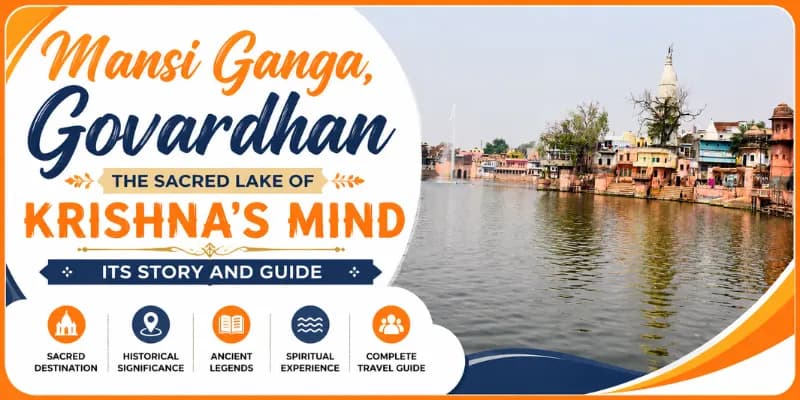
Mansi Ganga is the great sacred lake at the very heart of Govardhan town, the largest kund in Govardhan and one of the holiest, revered as being no less sacred than the River Ganga herself. Its name comes from manas, the mind, for by the beloved tradition of Braj, Krishna manifested the Ganga here from his own mind, so that the people of Braj need not leave their land to bathe in the holy river. To this day pilgrims bathe at its ghats and take darshan and it is the traditional starting and ending point of the great Govardhan parikrama.
Ringed by paved ghats and by ancient temples, Mansi Ganga is the sacred and social centre of Govardhan, most magical of all on Diwali, when countless earthen lamps are floated upon its waters. This guide covers its story, its name, its place on the parikrama, the temples around it, the Diwali deepdaan, its significance and how to visit, with timings and how to reach. For the circuit around the sacred hill, see our govardhan parikrama guide guide and for the hill itself our govardhan hill.
From the ground (Gurudutt): Mansi Ganga is the natural place to begin a visit to Govardhan and traditionally the place to begin the parikrama. Take darshan and, if you wish, a reverent dip, visit the Chakleshwar Mahadev temple on its bank, the guardian of Govardhan and then set out on the parikrama or simply sit by the ghats and take in the sacred heart of Govardhan. If you can be here on a Diwali or Kartik evening, the lamps floating on the water are an unforgettable sight. See our Mathura Vrindavan tour or message WhatsApp +91 7302265809.
Mansi Ganga at a glance
Here are the essentials of Mansi Ganga in one place.
Detail | Information |
What it is | The great sacred lake at the heart of Govardhan town |
Meaning of the name | Mansi, from manas, the mind |
The tradition | Krishna manifested the Ganga here from his mind |
Location | Govardhan town, about 22 km from Mathura |
On the route of | The Govardhan parikrama begins and ends here |
Temples around it | Chakleshwar Mahadev, Mukharavind, Manasi Devi and more |
Famous for | The floating of lamps, deepdaan, on Diwali |
Timings | Open all days, through the day; free |
In one line: Mansi Ganga is the great sacred lake at the heart of Govardhan, manifested by Krishna from his mind, holy as the Ganga, the start of the Govardhan parikrama, ringed by temples and famous for the Diwali floating of lamps.
The story: how Mansi Ganga appeared
The appearance of Mansi Ganga is one of the tender stories of Krishna's Braj and the tradition preserves two beloved accounts. In the first, the tyrant Kansa sent a demon, Vatsasura, who took the form of a calf and hid himself among Krishna's herd. Krishna discovered him and slew him, but because the demon had worn the form of a calf, an animal held sacred, Krishna's cowherd friends playfully refused to keep his company until he had bathed in the holy Ganga to cleanse the fault of killing a calf.
Unwilling to leave his beloved Braj to travel to the distant Ganga, Krishna instead sat in meditation and by the power of his mind he called the Ganga to come to him; and so the sacred river manifested there, at the foot of Govardhan, as a great lake, in which Krishna bathed to satisfy his friends. In the second account, Krishna's foster parents, Nanda and Yashoda and the elders of Braj longed to bathe in the holy Ganga but did not wish to leave Braj and so Krishna, to please them, manifested the Ganga here from his mind. By either telling, the lake was born of Krishna's mind and his love for Braj. We share these as the cherished traditions they are.
The name Mansi Ganga: born of the mind
The name Mansi Ganga, sometimes written Manasi Ganga, comes directly from this story. Manas, in Sanskrit, means the mind and Mansi Ganga means the Ganga of the mind or the Ganga born of the mind, because Krishna manifested her not by travelling to her but by the power of his mind, his sankalpa, his will and meditation. The name itself, then, holds the whole miracle: that the holiest of rivers came to Braj at the mere thought of Krishna.
For devotees, this carries a sweet meaning: that Krishna would not leave his land of Braj even to bathe in the Ganga, but rather brought the Ganga to Braj, showing his love for this land above all places. So the name Mansi Ganga is a reminder both of Krishna's power and of his devotion to Braj and it is why the lake is revered as fully the Ganga herself, present in Govardhan. We share this meaning as the tradition lovingly holds it.
Mansi Ganga and the Govardhan parikrama
Mansi Ganga sits at the heart of Govardhan town and it is the traditional starting and ending point of the great Govardhan parikrama, the roughly 21 km circumambulation of the sacred hill that Krishna lifted. Countless pilgrims begin their parikrama here, taking darshan and often a dip at Mansi Ganga first, then setting out around the hill and returning to close the circle at the lake.
This makes Mansi Ganga the natural centre and gateway of any visit to Govardhan, the place where the sacred journey around the hill begins and ends. Whether you walk the full parikrama or simply visit Govardhan, Mansi Ganga is where most pilgrims start. Our govardhan parikrama guide guide covers the route, the distance, the timings and the sacred sites along the way, of which Mansi Ganga is the first and the last.
The temples and sites around Mansi Ganga
Mansi Ganga is ringed by ghats and by ancient, deeply revered temples, making its banks a cluster of sacred sites.
Chakleshwar Mahadev, the temple of Shiva on the bank of Mansi Ganga, revered as the guardian, the kotwal, of Govardhan and of Braj, where the great saint Sanatana Goswami is said to have performed his bhajan; a darshan of Shiva as the protector of the hill.
Mukharavind, the sacred spot revered as the mouth or face of Govardhan Hill, where Giriraj is worshipped in the form of a face, one of the most important points of worship of the hill.
The Haridev temple, one of the ancient and important temples of Govardhan, near the lake.
Brahma Kund and the Manasi Devi temple, dedicated to the goddess Manasi, close to the lake.
Together with the ghats of the lake itself, these make the area around Mansi Ganga a dense and beautiful concentration of the sacred, worth exploring slowly on foot in a spirit of devotion. The Chakleshwar Mahadev temple in particular, as the guardian of Govardhan, is a cherished stop for pilgrims beginning the parikrama, honouring Shiva before circling the hill.
Manasi Devi, a goddess of Braj
Near Mansi Ganga, by Brahma Kund, stands a temple dedicated to Manasi Devi and by the tradition of Braj she is counted as one of the four principal goddesses, the Devis, who guard the region, the others being Pataleshwari Devi, Vrinda Devi and Yogmaya Devi. These goddesses are revered as protectors and presiding deities of the sacred land of Braj.
The presence of Manasi Devi at Mansi Ganga adds another layer of sanctity to the lake, linking it not only to Krishna's leela but to the guardian goddesses of Braj. We share this as the devotional tradition of the region, held with reverence. For most pilgrims, the darshan of Manasi Devi is part of the wider worship at Mansi Ganga, alongside the lake, Chakleshwar Mahadev and the other sacred sites clustered there.
Diwali and the floating of lamps
Mansi Ganga is at its most magical on Diwali and through the sacred month of Kartik, when the beautiful ritual of deepdaan, the floating of lamps, takes place upon its waters. On the Diwali evening, countless small earthen lamps are set glowing and floated across the lake, so that the whole surface of Mansi Ganga shimmers with light, a breathtaking sight and one of the most beautiful Diwali scenes in all of Braj.
The evening aarti at Mansi Ganga and the lamplit ghats, draw many devotees, especially in Kartik and on Diwali, when Govardhan Puja is also celebrated grandly here. If you can time a visit for a Kartik or Diwali evening, the deepdaan on Mansi Ganga is unforgettable. Our braj festival calendar guide gives the dates of Diwali, Govardhan Puja and the Kartik season, which follow the lunar calendar and shift each year.
The significance of Mansi Ganga
Mansi Ganga holds a special place among the sacred waters of Braj. Because Krishna is said to have manifested the Ganga herself here from his mind, the lake is revered as fully as sacred as the Ganga and by the belief of the tradition, a reverent bath in its waters cleanses one of sins and bestows great spiritual merit, just as bathing in the Ganga is held to do. It is thus a place of pilgrimage, bathing and worship, not merely a beautiful lake.
Beyond this, its place as the heart of Govardhan and the start of the parikrama, its ring of ancient temples and its link to the guardian goddess Manasi Devi all deepen its sanctity. For devotees, Mansi Ganga is where the whole sacred landscape of Govardhan begins and its still waters, revered as the Ganga brought to Braj by Krishna's love, are among the most cherished of all the holy places of the region. We present its significance as the tradition holds it, with reverence.
Timings and the best time to visit
Mansi Ganga, being an open sacred lake with public ghats, can be visited on all days and at any reasonable time through the day, from morning to evening. The temples around it, such as Chakleshwar Mahadev, keep the usual morning and evening darshan hours, closing through the middle of the day as is common in Braj. The evening, with the aarti and the lamplit ghats, is an especially lovely time to be at the lake.
The best season to visit is the cool, pleasant winter months of roughly October to March, avoiding the fierce summer heat, which also suits walking the Govardhan parikrama that begins here. Above all, the Kartik season and Diwali, in October and November, are the most beautiful and sacred time at Mansi Ganga, with the deepdaan floating of lamps, though also the most crowded. Our best time to visit vrindavan mathura guide covers the seasons in full.
How to reach Mansi Ganga
Mansi Ganga is in the centre of Govardhan town, easily reached from the twin cities and the wider Braj.
From Mathura, about 22 km, roughly 45 minutes by taxi or bus to Govardhan town, in whose heart Mansi Ganga lies.
From Vrindavan, about 26 km, roughly an hour by road.
From Radha Kund, only about 4 km, since both are in the Govardhan area on the parikrama.
From Delhi, about 150 km, roughly 3 to 4 hours via the Yamuna Expressway and Mathura.
The nearest major railway station is Mathura Junction, about 22 km away and the nearest airports are Agra and Delhi. Being in the centre of Govardhan town, Mansi Ganga is easy to find, well known to every local and the last stretch through the town is covered by auto, e-rickshaw or on foot. Our how to reach vrindavan guide covers the routes into the region and the nearby radha kund govardhan is easily combined, its story linked to Mansi Ganga, from which Radha's gopis first carried water to fill Radha Kund.
Nearby sacred places
Mansi Ganga sits amid the sacred sites of Govardhan, so it combines naturally with them.
Govardhan Hill itself, the sacred hill Krishna lifted, worshipped all around the parikrama that begins at Mansi Ganga.
Radha Kund and Shyam Kund, about 4 km away, the holiest kunds, linked to Mansi Ganga by their story.
Kusum Sarovar, a beautiful sandstone lake and monument nearby and Daan Ghati, the spot of Krishna's playful toll, on the parikrama.
The many other kunds, temples and sites along the Govardhan parikrama, from Jatipura to Punchari.
We arrange visits to Mansi Ganga and Govardhan as part of a Govardhan and western-Braj day, with the darshan, the parikrama, the timing and a knowledgeable local companion handled, so you simply take darshan and drink in the devotion of these holy places. A shared day tour starts from around ₹1,499 per person, with darshan free throughout and our same-day govardhan barsana tour covers this side of Braj. Message me on WhatsApp at +91-7302265809 with your dates to plan it.
Related guides
Meet Gurudutt — Your Mathura Vrindavan Guide
Not just a tour operator — Gurudutt was born and raised in Braj Bhoomi. He has spent over a decade personally guiding pilgrims through the sacred lanes of Mathura & Vrindavan.
Founder – Experience My India
Gurudutt
Founder · Experience My India