Travel Guide · Temple Guides · Updated August 2026
Shri Giriraj Ji Mukharvind Temple, Jatipura: The Lotus Mouth of Govardhan, a Complete Guide
By Gurudutt, Experience My India·5 August 2026
Quick Answer
Quick Enquiry
Key facts at a glance
What it is | The lotus mouth, mukharvind, of Giriraj Govardhan |
Its form | A sacred Govardhan shila at the foot of the hill |
Where | Jatipura, on the west of Govardhan |
Revered in | The Pushtimarg of Vallabhacharya |
Cherished as | The place of Shrinathji's appearance |
Worshipped with | Milk, flowers and evening shringar |
The Mukharvind at Jatipura: an overview
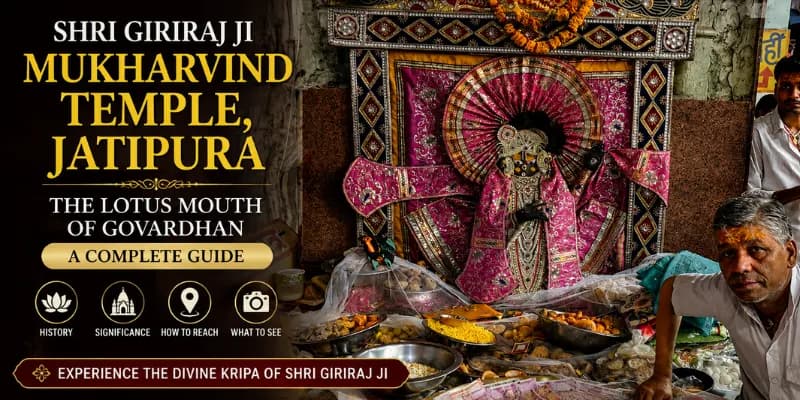
The Shri Giriraj Ji Mukharvind temple at Jatipura is one of the most sacred and beloved shrines of Govardhan, the holy hill that, by the tradition, Krishna lifted on his finger to shelter Braj. It is revered as the mukharvind, the lotus mouth or face, of Giriraj Govardhan himself, worshipped in the form of a sacred Govardhan shila, a rock of the holy hill, at its western foot at Jatipura. For the followers of the Pushtimarg, the devotional tradition of Vallabhacharya, it is a supremely holy place, cherished as the site of the appearance of their beloved deity Shrinathji.
Here the mukharvind is lovingly decorated and worshipped every evening with milk, flowers and shringar and it is believed, in the tradition, to be alive with the divine presence. Many pilgrims begin their Govardhan parikrama from this very point. This guide covers the Mukharvind at Jatipura and its meaning, its ties to Shrinathji and Vallabhacharya, the worship, the sacred sites around it and how to reach and visit it. It stands at the foot of govardhan hill and our govardhan parikrama guide covers the sacred circuit that many begin here.
From the ground (Gurudutt): Two things above all make a visit to the Jatipura Mukharvind meaningful. First, come knowing that this is revered as the very mouth of Giriraj Govardhan and the appearance place of Shrinathji, so approach it with the reverence the tradition holds, especially in the evening when the shringar is done and, by the belief, the divine presence is most felt; photography is not allowed once the shringar is complete, so respect that. Second, honour the deep Govardhan custom: pilgrims never climb or step upon Giriraj Govardhan, revering the whole hill as a form of the divine and walk the parikrama around it instead. A local guide of the Pushtimarg tradition brings the place richly alive. See our Mathura Vrindavan tour or message WhatsApp +91 7302265809.
The temple at a glance
Here are the essentials of the Jatipura Mukharvind in one place.
Detail | Information |
What it is | The mukharvind, the lotus mouth, of Giriraj Govardhan |
Its form | A sacred Govardhan shila at the foot of the hill |
Where | Jatipura, on the west of Govardhan |
Revered in | The Pushtimarg, the tradition of Vallabhacharya |
Cherished as | The place of Shrinathji's appearance |
Worshipped with | Milk, flowers and evening shringar |
Key festival | Annakut, at Govardhan Puja |
Also | A common starting point of the Govardhan parikrama |
In one line: The Jatipura Mukharvind is the sacred lotus mouth of Giriraj Govardhan, revered in the Pushtimarg as Shrinathji's place of appearance, worshipped every evening with milk.
What is the Mukharvind of Giriraj Govardhan?
The word mukharvind joins mukh, the mouth or face and arvind, the lotus; so the mukharvind is the lotus mouth, the sacred face, of Giriraj Govardhan. For the devotees, Govardhan is not a mere hill but Giriraj, the king of mountains, revered as a form of Krishna himself, worshipped and served as a living being; and the Mukharvind at Jatipura is honoured as his very mouth or face, in the form of a sacred Govardhan shila at the western foot of the hill.
So the Mukharvind is the place where devotees offer their worship to the face of Giriraj, feeding him and adorning him as a living deity. In the Pushtimarg it is also revered as the Shringar Sthali, the place of adornment and as the appearance place of Shrinathji. So the Mukharvind at Jatipura is one of the holiest points on the whole of Giriraj Govardhan, a place of intimate, loving service to the sacred hill. We present its sanctity and the worship of Giriraj as the cherished belief and tradition of Braj and the Pushtimarg, held with faith and recounted with reverence.
Jatipura and Vallabhacharya
Jatipura, where the Mukharvind stands, lies on the western side of Giriraj Govardhan and its name carries a beautiful history. By the tradition, it was originally known as Yatipura. The great teacher Shri Vallabhacharya, the founder of the Pushtimarg, loved to stay on this western side of Giriraj, finding it easier from here to climb up for the seva of Shrinathji on the hill.
A yati is another name for a sadhu or a saint, and, by the tradition, anyone seeking Shri Vallabhacharya was directed to the place where the yati stayed; so people came to call it Yatipura, the town of the yati, which in the Vraj tongue, where the sound ya is spoken as ja, became Jatipura. So Jatipura is, by its very name, the place of the great saint Vallabhacharya, at the foot of Giriraj. In front of the Mukharvind stands one of the sacred baithaks of the Pushtimarg, from where, by the tradition, Vallabhacharya narrated the Bhagavata to Giriraj himself. We present this history as the tradition of the Pushtimarg holds it, with reverence for the great acharya.
Shrinathji and the Mukharvind
The Mukharvind at Jatipura is above all bound to Shrinathji, the beloved deity of the Pushtimarg, worshipped as Krishna in his form lifting Govardhan. By the tradition, Shrinathji appeared or manifested, from Giriraj Govardhan here, his self-manifest form emerging from the sacred hill and the Mukharvind and its surroundings are revered as the place of his pragatya, his appearance. His original temple, by the tradition, stood atop Giriraj Govardhan, built by the great devotee Puranmal at Shrinathji's own command.
In later, troubled times, the deity of Shrinathji was carried to Mewar in Rajasthan for safety and is worshipped to this day at Nathdwara, the great seat of the Pushtimarg. Yet, by the cherished belief of the tradition, Shrinathji still loves and returns to Giriraj Govardhan, his original home and appearance place and comes to the Mukharvind at Jatipura to give shayan darshan, resting here, so that his presence is felt alive by the devotees; in the tradition, he does shayan here for six months of the year. So the Mukharvind joins the living devotion of Jatipura and Govardhan with the great seat of Nathdwara. We present the appearance and the presence of Shrinathji as the cherished belief and tradition of the Pushtimarg, held with deep faith, recounted with reverence rather than as documented fact.
The worship: milk, shringar and darshan
The Mukharvind at Jatipura is lovingly worshipped every day, above all in the evening, when it is bathed, adorned and decorated with shringar and offered milk, flowers and other loving service, as befits the living face of Giriraj. Hundreds of devotees come daily to worship the Mukharvind with milk and flowers, in the intimate, loving manner of the Pushtimarg, in which the deity is served as a beloved living presence.
By the tradition, once the evening shringar is complete and Shrinathji is believed to grace the Mukharvind, the presence is most alive and intimate and photography is not allowed at that time, out of reverence; so respect this and put your camera away when asked. The offering of milk to the Mukharvind, poured lovingly over the sacred face of Giriraj, is the characteristic worship of the place. So a visit brings the darshan of the adorned Mukharvind and, if you wish, the offering of milk and flowers. We present the worship and the belief in the living presence as the cherished tradition of the Pushtimarg, held with faith.
The baithak and the sacred sites nearby
The Mukharvind at Jatipura stands amid a cluster of deeply sacred sites of the Pushtimarg, well worth taking in together.
The Baithak of Vallabhacharya: one of the eighty-four sacred baithaks of the Pushtimarg, in front of the Mukharvind, from where, by the tradition, Vallabhacharya narrated the Bhagavata to Giriraj.
The Dandvati Shila: a revered stone near the Mukharvind, held, by the tradition, to diminish in size over the ages through an ancient curse upon Giriraj, so that it has sunk into the earth and is now honoured in a dug-out shrine.
The tulsi kiyaras and baithaks: the tulsi courtyards of Mahaprabhu Vallabhacharya and of his son Gusainji and the baithaks where the acharyas did their Bhagavata recitation.
The nearby temples: several small temples of the tradition around the Mukharvind, part of the sacred landscape of Jatipura at the foot of Giriraj.
So a visit to the Jatipura Mukharvind takes in not one shrine but a whole sacred quarter of the Pushtimarg at the foot of Giriraj, rich in the memory of Vallabhacharya, Gusainji and the great devotees. A knowledgeable local guide of the tradition can show and explain these sites and their stories. We present the sanctity of these sites and their traditions as the cherished belief of the Pushtimarg, held with faith, part of the deep devotional heritage of Jatipura and Govardhan.
Annakut and beginning the Govardhan parikrama
The great festival of the Mukharvind and of all Govardhan is Annakut, kept at Govardhan Puja, the day after Diwali, which celebrates Krishna lifting Giriraj and receiving the worship and the mountain of food, the annakut, of the people of Braj. At Jatipura the Mukharvind is worshipped with special splendour and the offering of the annakut and the festival draws great crowds and fervour.
The Jatipura Mukharvind is also one of the most cherished starting points of the Govardhan parikrama, the sacred circuit of the holy hill, of about 21 km, walked by pilgrims as a supreme devotional act, many barefoot. By the tradition, many begin and end their parikrama at the Mukharvind, taking its darshan and blessing before setting out. So the Mukharvind is both a festival heart and a gateway to the parikrama. Our govardhan parikrama guide covers the sacred circuit in full and our braj chaurasi kos yatra the great Braj pilgrimage. So begin your Govardhan parikrama at the Mukharvind, in the tradition of the pilgrims.
Timings, darshan and etiquette
The Mukharvind at Jatipura keeps the daily rhythm of worship, opening for darshan in the morning and again in the evening around the shringar, with the evening being the most cherished time for the adorned darshan and the felt presence; the exact hours follow the seva schedule of the tradition and the season. So plan darshan for the morning or, best, the evening shringar. Darshan is free.
As for etiquette, two things matter most. First, once the evening shringar is complete, photography is not allowed, out of reverence for the living presence, so respect this. Second, honour the deep Govardhan custom: never climb or step upon Giriraj Govardhan, which is revered as a form of the divine, but walk the parikrama around it. Beyond these, dress modestly, remove footwear as required, keep offerings such as milk voluntary, guard against the monkeys and move reverently. So visit the Mukharvind with reverence and care for these customs, which honour the sanctity of Giriraj and the devotion of the Pushtimarg.
How to reach Jatipura Mukharvind
The Jatipura Mukharvind is at Jatipura, on the western side of Giriraj Govardhan, in the Govardhan region of the western Braj, so reaching it means reaching Govardhan and Jatipura.
Govardhan town is about 25 km from Mathura and 25 to 30 km from Vrindavan; Jatipura is on the west of the hill, a little beyond Govardhan town, reached by road.
Reach Govardhan by taxi, local transport or a planned tour from Mathura or Vrindavan, then Jatipura and the Mukharvind at the foot of the hill.
It is easily combined with the other Govardhan sites, Danghati, Mansi Ganga, Radha Kund and Kusum Sarovar and with Barsana.
The nearest major railway station is Mathura Junction and the nearest airports are Agra and Delhi.
Because it lies at Jatipura on the western side of the hill, a taxi or a planned tour is the most comfortable way to reach the Mukharvind and combine it with the Govardhan and western-Braj sites and a local guide of the tradition makes the visit richer. Our how to reach vrindavan guide covers arriving in Braj and our gokul barsana nandgaon day trip guide the western-Braj circuit. Barsana, the town of Radha, is nearby, covered in our radha rani temple barsana guide. We arrange Govardhan and western-Braj days taking in the Jatipura Mukharvind, with the transport, the routing, the timing and a knowledgeable local guide to bring the devotion of Giriraj and the Pushtimarg alive. A shared day tour starts from around ₹1,499 per person, with darshan free throughout and our same-day govardhan barsana tour and two-day mathura vrindavan tour cover this side of Braj. Our best time to visit vrindavan mathura guide helps you plan. Message me on WhatsApp at +91-7302265809 to arrange your visit.
Related guides
Meet Gurudutt — Your Mathura Vrindavan Guide
Not just a tour operator — Gurudutt was born and raised in Braj Bhoomi. He has spent over a decade personally guiding pilgrims through the sacred lanes of Mathura & Vrindavan.
Founder – Experience My India
Gurudutt
Founder · Experience My India