Travel Guide · Temple Guides · Updated October 2026
Chakleshwar Mahadev Govardhan: Timings and Significance
By Gurudutt, Experience My India·24 October 2026
Quick Answer
Quick Enquiry
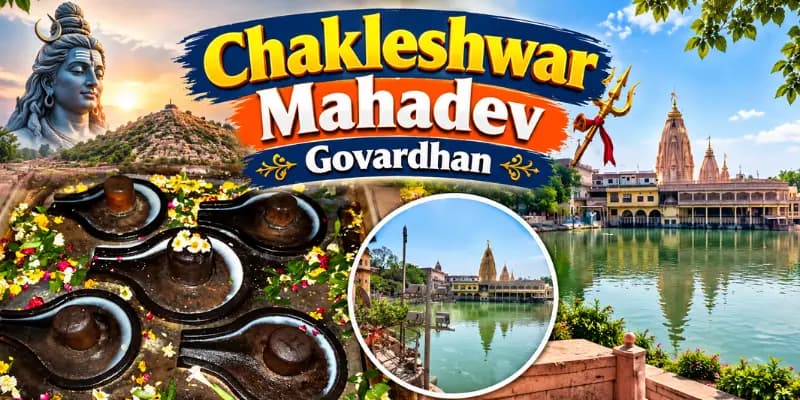
Chakleshwar Mahadev is where many pilgrims begin or pause the Govardhan Parikrama, right on the beautiful Mansi Ganga. We Brajwasis hold that before you circle Giriraj, you take the blessings of Shiva, the guardian of the dham, here. I love the peace of the ghat in the early morning, before the crowds. The stories here are rich: the Chakra that held back Indra’s flood, and the little bhajan hut of Sanatana Goswami just facing the temple. It is a deeply atmospheric stop. See our Mathura Vrindavan tour Packages or message WhatsApp +91 7302265809.
Spiritual significance
The protector of Govardhan (Dig-pala)
By tradition, Chakleshwar Mahadev was established by King Vajranabh, the great-grandson of Lord Krishna and is revered as the guardian deity of the western direction of the Braj Mandala. He is counted among the five Shiva guardians (Dig-palas) of Braj, standing with Gopeshwar in Vrindavan, Bhuteshwar in Mathura, Kundeshwar at Radha Kund and Nandeshwar at Nandgaon, who together guard the holy land. You can read about the Vrindavan guardian at gopeshwar mahadev and the Mathura one at bhuteshwar mahadev.
The shield against Indra’s deluge
By local legend, when Krishna lifted Govardhan Hill to humble the pride of Indra, a catastrophic storm threatened to submerge Braj. Lord Shiva is said to have come to witness the divine pastime and used his trident to dry up and block the floodwaters; in some regional tellings, Krishna placed his Sudarshan Chakra here for the same purpose. Because the spot acted as a protective wheel (chakra) against the deluge, it became known as Chakra Tirtha and the deity as Chakleshwar. These are cherished traditions of the site, told as devotional legend. For the hill’s wider meaning, see govardhan hill significance.
How Shiva guards Krishna’s land
To outsiders it can seem surprising that Shiva temples ring a land so completely given to Krishna, but in Braj the two are not held in tension. By tradition, Lord Shiva is the greatest of Krishna’s devotees and he is said to have longed to witness the Lord’s childhood pastimes at Govardhan. Placing him as the Dig-pala, the watchman at the gate, is the devotee’s way of saying that even the lord of renunciation stands guard at the door of the dham. For pilgrims this gives Chakleshwar a double meaning: it is a powerful Shiva shrine in its own right and at the same time a doorway into the deeper Krishna pastimes of the hill. Taking darshan here first, before Giriraj, is therefore understood as an act of respect to the guardian who, in the tradition, chose this duty out of love rather than being appointed to it.
The sanctum and the saints
The five Shivalingas. The inner sanctum houses five distinct, dark-hued Shivalingas (Pancha-Lingas), which by tradition symbolise the five faces or manifestations of Lord Shiva protecting the dham.
The miracle of Sanatana Goswami. The temple faces the bhajan kutir (meditation hut) of the revered 16th-century saint Shri Sanatana Goswami. Legend holds that when he was tormented by swarms of mosquitoes and thought of leaving, Lord Chakleshwar appeared and assured him he would not be troubled again; local lore says the immediate area has stayed free of mosquito trouble ever since. This is told as devotional tradition.
Chaitanya Mahaprabhu’s footsteps. The site is also linked to Shri Chaitanya Mahaprabhu and Nityananda Prabhu, who, by tradition, rested at this ghat during their parikrama of Giriraj Ji, adding to its importance for the Gaudiya tradition.
For most visitors the darshan itself is quick and intimate. The sanctum is small and often lit by lamps rather than daylight, so the five dark lingas emerge slowly as the eyes adjust, which many pilgrims find adds to the sense of antiquity and power. There is usually no long queue outside festival days, so you can stand for a few moments, offer water or bel leaves if the pandas permit and move on to the ghat. Photography inside the sanctum is generally discouraged, as at most Braj shrines, so it is best to ask before raising a phone.
The Mansi Ganga and the Chakra Tirtha ghat
Part of what makes Chakleshwar so loved is simply where it sits. The temple opens directly onto the Mansi Ganga, the large stone-lined tank at the centre of Govardhan town and the two are experienced as one place rather than two. By tradition the Mansi Ganga was manifested by Krishna himself from his mind (manas) so that the cowherds of Braj could bathe in Ganga water without travelling to the distant river and the steps and pavilions around it have been a gathering point for pilgrims for centuries.
The stretch of bank in front of the temple is the Chakra Tirtha, the spot where, by local legend, the protective wheel held back the floodwaters during the lifting of Govardhan. Early in the morning the water is still, lamps are floated on its surface after the evening worship and the ghat fills with the sound of bells and bhajan. Many pilgrims make a point of sitting here for a few quiet minutes, either before beginning the parikrama or as a pause partway round and it is one of the most photogenic corners of Govardhan in the soft early light. The ghat is public and free and you are welcome to rest on the steps, though it is kept as a sacred bathing tank, so any bathing and general conduct should follow the same respect you would show at any tirtha.
Temple timings, rituals and aarti
Session | Timing (confirm locally) |
Morning darshan | 5:00 AM to 12:00 PM |
Midday closure | 12:00 PM to 4:00 PM (closed, in the traditional Braj custom) |
Evening darshan | 4:00 PM to 9:00 PM |
Timings can adjust with the season and major festivals such as Maha Shivratri and the month of Sawan, when it is especially busy. For a calm darshan before the daytime parikrama crowds build up, an early-morning visit is highly recommended. Always confirm the current hours locally, as Braj temple timings shift.
Daily worship follows the simple, unhurried rhythm of a Braj Shiva temple rather than the elaborate jhanki schedule of the Krishna temples. The lingas are bathed and dressed in the morning and the most atmospheric moment for most visitors is the evening aarti, when lamps are offered to the five lingas and by local custom, small diyas are floated on the Mansi Ganga just outside. On a Monday, the day sacred to Shiva and through the holy month of Sawan, the temple sees many more worshippers carrying water to pour over the lingas. Maha Shivratri is the single biggest night here, with jagran, continuous abhishek and long queues that can stretch along the ghat. None of these timings are rigid and on festival days the usual midday closure is often set aside, so if you are visiting around Shivratri or in Sawan it is worth confirming the day’s arrangements locally before you arrive.
Best time to visit
For a calm darshan, come early, soon after the temple opens, when the ghat is quiet, the light on the Mansi Ganga is soft and the parikrama crowds have not yet built. This also fits the natural plan of starting the Govardhan Parikrama in the cool of the morning. If you would rather feel the devotional energy, the evening aarti is the other fine window, when lamps are lit and the bank comes alive with sound.
By season, the cooler months from about October to March are by far the most comfortable, since the parikrama involves a good deal of walking and the afternoons from April to June are harsh in this part of Braj. The monsoon weeks bring their own beauty, with the Mansi Ganga full and the fields green, but the paths can be wet and slippery. The temple is at its most crowded and most charged during Maha Shivratri and across the month of Sawan, which are wonderful if you want to share the devotion of thousands but difficult if you prefer quiet. Kartik, the great pilgrimage month of Braj, also brings large numbers to Govardhan. In short, choose an early morning on a cool-season weekday for peace, a festival evening for atmosphere and always carry water, a hat and comfortable shoes for the walking. Confirm the day’s timings locally, as they shift around festivals.
Where it is and how to reach it
Chakleshwar Mahadev sits on the northern bank of the Mansi Ganga tank in Govardhan town, on the Govardhan Parikrama route. It is most naturally visited as part of the parikrama and many pilgrims take Shiva’s blessing here before circling the hill.
The setting. It stands right on mansi ganga, the sacred tank at the heart of Govardhan town and on the govardhan parikrama circuit around govardhan hill.
Getting there. Govardhan is about 30 minutes from Mathura and well connected by road; within the town the temple is a short walk from the main Mansi Ganga area. Most pilgrims reach it on foot during the parikrama.
Combine it. The deeply revered radha kund, home of the guardian Kundeshwar and the other parikrama stops are part of the same circuit.
Allow fifteen to twenty minutes for darshan and a little longer to enjoy the Mansi Ganga ghat. For a fuller list of what to see around the hill, see places to visit in govardhan and for timing, best time to visit.
Nearby stops to combine on the Govardhan circuit
Chakleshwar is only the first beat of a much larger day around the hill and knowing what lies ahead helps you pace it. From the Mansi Ganga the circuit leads to the Mukharvind at Daan Ghati, the principal face of Giriraj where most pilgrims take their main darshan of the hill and then round past a string of sacred kunds. The holiest of these is the pair of Radha Kund and Shyam Kund, the most revered bathing tanks in all of Braj, where the guardian Kundeshwar stands as another of the five Dig-palas. Between them the route passes Kusum Sarovar with its honey-coloured sandstone pavilions, Govind Kund, Apsara Kund and many smaller shrines, each with its own pastime.
If you are not walking the full twenty-one kilometres, a sensible short plan is to take darshan at Chakleshwar, drive to Daan Ghati for the Mukharvind and then visit Radha Kund, which gives you the spiritual heart of Govardhan in a few hours. Those with more time can add Punchari ka Lotha on the far side of the hill, a gentle and much-loved corner or extend the day to nearby Barsana and Nandgaon. A local who knows the order of the stops and which are worth lingering at, saves a great deal of wandering.
Visitor tips and etiquette
A few practical habits make the visit smoother and more respectful. Dress modestly, as you would for any temple, with shoulders and knees covered; this matters more at a traditional Braj shrine than at a tourist site. You will remove your shoes before the sanctum, so simple slip-ons are easier than laced shoes and it is worth carrying a small bag for them if you plan to walk on along the parikrama. The stone around the Mansi Ganga can be slippery when wet, so step carefully near the water.
Keep valuables close and expect to give a small voluntary offering to the pandas if they assist with your darshan; there is no fixed fee for entry and you are never obliged to pay a set amount. Photography of the ghat and the exterior is fine and rewarding, but ask before photographing inside the sanctum or during a ritual. Monkeys are common across Govardhan, so hold food, spectacles and phones firmly and do not tease them. Finally, give yourself time: the temptation on a packed Braj day is to rush the darshan and hurry on, but Chakleshwar rewards a few unhurried minutes on the ghat, which is, after all, why generations of pilgrims have paused here before circling the hill.
Let a Brajwasi guide your Govardhan day
Starting the parikrama with Shiva’s blessing at Chakleshwar and knowing the stories behind each stop, is exactly what a local adds. As Brajwasis, we arrange the Govardhan Parikrama at your pace, begin at Chakleshwar Mahadev on the Mansi Ganga, tell the Chakra Tirtha and Sanatana Goswami stories in place and cover the kunds and temples without the rush. See our govardhan parikrama tour package; a shared Braj day starts from around 1499 rupees per person or we design a private plan. Message us on WhatsApp at +91-7302265809 with your dates.
Related guides
Book Your Mathura - Vrindavan Trip Today
📞 +91-7302265809
💬 WhatsApp: +91-7302265809
We Reply in 30 Minutes
Packages start from ₹1,999/ person | Rated 4.5★ / 204+ Reviews
Explore all: Mathura Vrindavan Tour Packages
Jai Shri Krishna
Meet Gurudutt — Your Mathura Vrindavan Guide
Not just a tour operator — Gurudutt was born and raised in Braj Bhoomi. He has spent over a decade personally guiding pilgrims through the sacred lanes of Mathura & Vrindavan.
Founder – Experience My India
Gurudutt
Founder · Experience My India