Travel Guide · Travel Guides · Updated October 2026
Punchhari ka Lotha Govardhan: Story, Location and Parikrama Tradition
By Gurudutt, Experience My India·24 October 2026
Quick Answer
Quick Enquiry
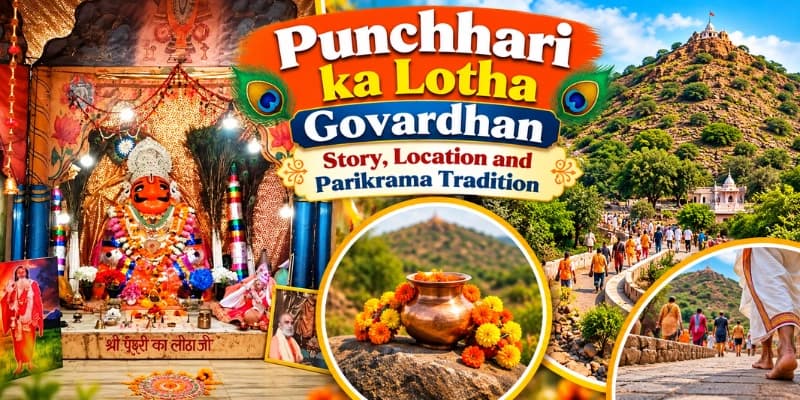
Punchari ka Lota is where the Govardhan Parikrama comes alive for me. It is the tail end of the hill, deep in that little Rajasthan stretch, and after kilometres of walking, often barefoot, the mood turns almost festive as everyone reaches Lota Baba. We Brajwasis say your parikrama is not complete until you mark your hazari here, Lota Baba keeps the register. The story of a friend who would not eat or drink until Krishna came back moves everyone who hears it in the place it is told. See our Mathura Vrindavan tour Packages or message WhatsApp +91 7302265809.
The story of Lota Baba
There are a few much-loved narratives in the Braj tradition about how this sacred spot came to be. They are told as devotional tradition rather than documented history.
The weight of waiting
By the main tradition, when Akrura was taking Krishna and Balarama away to Mathura, Krishna’s close friend Lota Baba was overcome with grief. He vowed not to leave Braj and to take neither food nor water until Krishna returned. Seeing his distress, Krishna is said to have blessed him: that he would not lose his life despite taking no food or water and that he would remain here at the tail end of Govardhan Hill, marking the hazari (attendance) of all devotees performing the parikrama. Devotees believe Lota Baba still waits here for his beloved friend.
The avatar connection
Some local traditions and texts link Lota Baba to earlier ages (yugas), holding him to be an expansion of Lord Shiva in Satya Yuga and Lord Hanuman in Treta Yuga, who then took the form of the Brahmin cowherd Madhumangal in Dvapara Yuga to serve Krishna. This is a devotional belief within the tradition, told to convey his standing as an eternal servant of the Lord.
How it got the name “Punchari”
“Punchari” means “tail”, marking the hill’s tail end. Playful folk versions also circulate: in one, as the gopis searched for Krishna after he left, they kept urging each other to ask his friend Madhumangal (“tu poochh ri…”, “you ask him…”), which shaped the name. In another, during an ecstatic kirtan a heavily built gopa stumbled and rolled over like a lota, prompting a sakhi to say “poochh ri kau lautha”. These are affectionate Braj folklore, not fixed etymology.
For the hill’s wider sacred meaning, see our govardhan hill significance guide.
Location and the deity
The spot sits at a striking meeting of geography and sacred imagery.
The anatomy of Govardhan. Govardhan Hill is traditionally envisioned either as a seated cow or a dancing peacock. In both images, this village marks the absolute southern tip, the tail end of the hill, which is how Punchari (tail) gets its name. Near the temple lie the ancient Apsara Kund and Naval Kund.
The geography. Of the roughly 21 km Govardhan Parikrama route, about 19.5 km fall within Uttar Pradesh and a 1.5 km stretch extends into Deeg district (formerly part of Bharatpur), Rajasthan. Punchari ka Lota lies in that Rajasthan segment, roughly 30 km from Mathura. See our mathura to govardhan distance guide for the journey.
The deity. Unlike most temples where the deity stands or sits, Lota Baba’s large, grand idol is enshrined in a reclining, resting posture, heavily covered in bright red sindoor, a distinctive darshan.
The parikrama tradition and hazari
No Govardhan Parikrama is considered spiritually complete without stopping here, which is the heart of this place.
Marking the hazari. Because Krishna is said to have appointed Lota Baba as the keeper or supervisor of the circumambulation, pilgrims bow and mark their “hazari” (attendance) at his temple as a strict ritual tradition.
Completing the merit. Local belief holds that a devotee who completes the strenuous 21 km walk but fails to pay respects at Punchari ka Lota leaves the spiritual fruit of the parikrama incomplete. See our govardhan parikrama guide for the full route and how to walk it.
The mood and the chant. Reaching this tail-end point, often barefoot or performing the exhausting dandavat parikrama (repeated prostration), the air turns celebratory. Pilgrims sing the local verse: “Dhanya-Dhanya Punchari ke Lautha, Anna khaaye na paani peeve, aise hi padau silautha!” (“Blessed is Lota Baba of Punchari, who lives like a rock without tasting grain or water!”).
Best time to visit Punchari ka Lota
The tail-end stop is open to the sky, so the season and the time of day matter for comfort. The pleasant months of October to March are the easiest for the long parikrama, with cool mornings that let you walk far before the sun climbs; the summer months are punishing on foot and best avoided if you can. Early morning is the classic hour to set out, both for the cooler air and for the quiet, devotional mood before the crowds build. The walk is busiest and most moving, on special days such as Guru Purnima, Govardhan Puja (the day after Diwali) and through the month of Kartik, when great numbers of pilgrims circle the hill and the tail-end stretch fills with singing; expect long queues then and start earlier still. On an ordinary morning in the cool season you can reach Lota Baba in relative calm. Whatever the day, confirm the current darshan hours and the crowd you are likely to meet locally before you set out, as Braj timings shift with the season and the festival calendar.
Darshan customs and etiquette at the tail end
A few simple customs make the darshan at Punchari ka Lota smoother and more respectful. Most pilgrims arrive on foot, often barefoot, having walked a long way, so wear something you can slip off easily and carry a cloth for your feet. At the shrine, bow and mark your hazari quietly; this is the heart of the stop and a moment of stillness means more than a hurried photograph. The reclining deity is heavily covered in red sindoor and darshan can be brief when crowds are heavy, so be patient and let the queue move. Offerings are a matter of personal devotion and there is no ticket to pay respects. Keep the sacred kunds nearby clean, do not litter along the route and carry your own water, as facilities at this remote tail end are limited. If you are performing the dandavat parikrama by prostration, allow far more time and rest often. As at any Braj shrine, dress modestly and confirm any specific customs with a local or temple attendant on the day of your visit.
Nearby kunds and Govardhan sites to combine
Because Punchari ka Lota sits on the great circuit of Govardhan Hill, it is naturally seen with the other sacred points that ring the parikrama. Right beside the temple lie the ancient Apsara Kund and Naval Kund, two old ponds tied to the sacred geography of the tail end. The wider walk takes in the Mukharvind, the principal face of the hill where pilgrims offer their main darshan, along with Mansi Ganga and the beautiful Kusum Sarovar on the way round. Many pilgrims give special time to Radha Kund and Shyam Kund, among the most revered waters in all of Braj, which lie on the same circuit. For a devotee, stringing these together is what makes the day whole: the hill, its kunds, its temples and the tail-end stop of Lota Baba read as one continuous pilgrimage rather than separate sights. Plan the order so that you reach the tail end with enough daylight and energy left and confirm distances and local arrangements on the day.
Planning your visit
Punchari ka Lota is best experienced as part of the Govardhan Parikrama rather than a standalone trip, it is, by tradition, the stop that completes the walk. Most pilgrims reach it on the 21 km circuit around the govardhan hill, pausing at the kunds and the govardhan temples and mukharvind along the way and nearby sites such as radha kund. The full walk is strenuous, so allow a good part of the day, carry water and go early. For a fuller list of what to see around the hill, see places to visit in govardhan and for timing, best time to visit.
Let a Brajwasi walk the parikrama with you
The Govardhan Parikrama is long and done right, deeply moving and a local makes it both easier and richer. As Brajwasis, we arrange the parikrama at your pace, make sure you reach Punchari ka Lota to mark your hazari, tell the story of Lota Baba in the place it belongs and handle transport to and from the Rajasthan tail end. See our govardhan parikrama tour package; a shared Braj day starts from around 1499 rupees per person or we design a private plan. Message us on WhatsApp at +91-7302265809 with your dates.
Related guides
Book Your Mathura - Vrindavan Trip Today
📞 +91-7302265809
💬 WhatsApp: +91-7302265809
We Reply in 30 Minutes
Packages start from ₹1,999/ person | Rated 4.5★ / 204+ Reviews
Explore all: Mathura Vrindavan Tour Packages
Jai Shri Krishna
Meet Gurudutt — Your Mathura Vrindavan Guide
Not just a tour operator — Gurudutt was born and raised in Braj Bhoomi. He has spent over a decade personally guiding pilgrims through the sacred lanes of Mathura & Vrindavan.
Founder – Experience My India
Gurudutt
Founder · Experience My India