Travel Guide · Festivals & Events · Updated September 2026
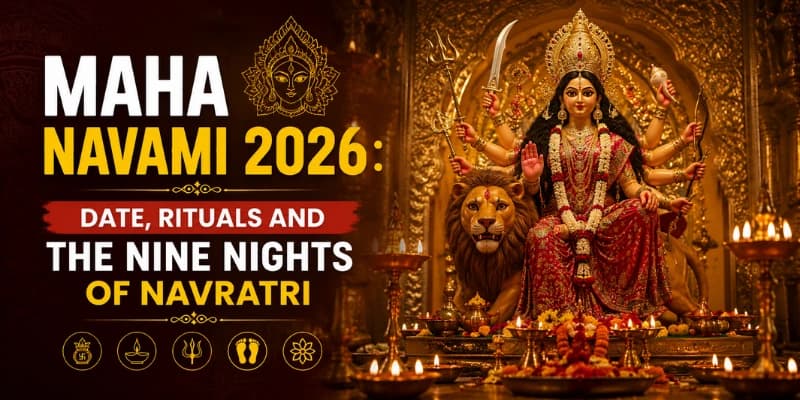
Maha Navami 2026: Date, Rituals and the Nine Nights of Navratri
By Gurudutt, Experience My India·1 September 2026
Quick Answer
Quick Enquiry
Key facts at a glance
Detail | Information |
Maha Navami date | Monday, October 19, 2026 |
Tithi | Ashwin Shukla Navami, the ninth day |
Goddess worshipped | Maa Siddhidatri, the ninth form of Durga |
Sharad Navratri 2026 | October 11 to 19, 2026 (Vijayadashami October 20) |
Key rituals | Sandhi Puja, Durga Homa, Kanya Pujan |
Note for 2026 | Ashtami and Navami fall close together; some panchangs keep both on October 18 to 19 |
Maha Navami 2026: the date and the Ashtami-Navami overlap
In 2026, Maha Navami falls on Monday, October 19, the ninth day of Sharad Navratri, the great autumn festival of the Goddess that runs from October 11 to 19 and closes with Vijayadashami or Dussehra, on October 20. Maha Navami is the culmination of the nine nights, the peak of the worship of Durga, remembered as the final night of her long battle with the buffalo demon Mahishasura. It is a spiritually charged season across all of sacred India, the clear and joyful autumn when the whole festival calendar begins to turn; a fine time for a pilgrimage and to spend these days in the land of Krishna, a mathura vrindavan tour package with Experience My India can help you plan the journey.
One honest note on the date. In 2026 the Ashtami and Navami tithis fall close together, so the panchangs vary a little: Durga Ashtami is kept on October 18 into 19 and Maha Navami on October 19, with some panchangs listing both the Ashtami and Navami observances on October 19 itself and the sacred Sandhi Puja performed at the exact junction of the two tithis. The tenth-day Vijayadashami then follows on October 20. Because the day-assignment turns on the tithi timings for your city, confirm Maha Navami and your puja muhurat with your local panchang.
From the ground (Gurudutt): Navratri is a bright, powerful time everywhere and here in Braj too the Devi temples fill and the fast is kept with love. Maha Navami is the great ninth day, when the nine nights reach their height and little girls are honoured as the Goddess herself in Kanya Pujan. The very next day is Dussehra. If you can come on pilgrimage in this clear autumn, you will find Braj gentle and glad, with the whole festival season, Sharad Purnima and Diwali, soon to follow. Jai Mata Di, Radhe Radhe. See our Mathura Vrindavan tour Package or message WhatsApp +91 7302265809.
What is Maha Navami: the ninth day
Maha Navami is the ninth day or Navami, of Navratri and the climax of the festival. On this day Goddess Durga is worshipped in her ninth and final form, Maa Siddhidatri, the giver of siddhis, the spiritual powers and perfections and the bestower of fulfilment. It is understood as the final night of the Goddess's nine-day war with Mahishasura, the shape-shifting buffalo demon, whom she slays as Mahishasuramardini, the annihilator of the demon; the victory itself is then celebrated on the tenth day as Vijayadashami. In the Durga Puja tradition of Bengal and the east, Maha Navami is the third and final great day of the puja and in the south the Goddess is honoured as Chamundeshwari and the day joins with Saraswati Puja.
It helps to hold the difference between the two great days clearly: Maha Navami, the ninth, is the peak of worship and the final night of the battle, a day of intense puja, homa and Kanya Pujan; Vijayadashami, the tenth, is the day of triumph, of Ravan Dahan and new beginnings. Navami is the vigil and the culmination; Dashami is the victory that follows.
The nine nights: the full Navratri 2026 calendar
Maha Navami is the last of the nine nights, each of which is dedicated to one of the nine forms of Durga, the Navadurga and each carrying its own meaning, auspicious colour and traditional food offering or bhog. The full Sharad Navratri 2026 calendar:
Day and date | Goddess | Significance | Colour | Bhog |
Day 1, Oct 11 (Sun) | Maa Shailputri | Goddess of the mountains; grounded, foundational strength. Kalash sthapana today | Orange | Pure ghee |
Day 2, Oct 12 (Mon) | Maa Brahmacharini | The ascetic goddess; penance, discipline, patience and devotion | White | Sugar and fruits |
Day 3, Oct 13 (Tue) | Maa Chandraghanta | Bearer of the crescent moon; bravery, justice and courage against evil | Red | Milk or kheer |
Day 4, Oct 14 (Wed) | Maa Kushmanda | Cosmic creator whose smile made the universe; abundance, health and light | Royal blue | Malpua |
Day 5, Oct 15 (Thu) | Maa Skandamata | Mother of Kartikeya; maternal love, protection and grace | Yellow | Bananas |
Day 6, Oct 16 (Fri) | Maa Katyayani | The warrior goddess born to slay Mahishasura | Green | Honey |
Day 7, Oct 17 (Sat) | Maa Kalaratri | The fiercest form; destroyer of darkness, ignorance and fear | Grey | Jaggery |
Day 8, Oct 18 (Sun) | Maa Mahagauri | Durga Ashtami; purity, serenity and the washing away of sins | Purple | Coconut, halwa puri |
Day 9, Oct 19 (Mon) | Maa Siddhidatri | Maha Navami; giver of siddhis and spiritual fulfilment | Peacock green | Til (sesame) |
The colours are worn through the nine days as a joyful devotion and the bhog is offered to the Goddess and shared. As noted above, the Ashtami and Navami days fall close together in 2026, so treat the Day 8 and Day 9 dates as the panchang for your city gives them.
The Navadurga: the nine forms of the Goddess
Navratri, the nine nights, is the great celebration of Shakti, the divine feminine energy, in her most powerful forms. The central story tells of Mahishasura, the buffalo demon who won a boon that no man or god could kill him and who then loosed terror across the worlds. The gods combined their energies to bring forth Durga, a warrior goddess of ten arms, each bearing a weapon gifted by a deva, riding a lion into battle. Her war with Mahishasura raged nine days and nights and on the tenth she slew him. Across the nine nights, the Goddess is worshipped in nine forms, the Navadurga: from Shailputri, daughter of the mountains and the ascetic Brahmacharini, through the brave Chandraghanta and the cosmic Kushmanda, the mother Skandamata and the warrior Katyayani, to the fierce Kalaratri, the pure Mahagauri and, at the climax on Maha Navami, Siddhidatri, who bestows spiritual perfection. Each form carries its own story, mantra and grace and together they trace the soul's journey from grounded strength to fulfilment.
Maha Navami rituals: Sandhi Puja, Durga Homa and Ayudha Puja
Maha Navami, as the peak of Navratri, carries its most powerful rituals:
Sandhi Puja. The most sacred rite of the season, performed at the sandhi, the junction where Ashtami ends and Navami begins, in a window of about forty-eight minutes. It is said that at this moment the Goddess appeared as Chamunda to slay the demons Chanda and Munda; the puja is often marked by the offering of a hundred and eight lotuses and the lighting of a hundred and eight lamps.
Durga Homa. A sacred fire ceremony or havan, performed on Maha Navami, usually in the afternoon aparahna period, in which ghee, sandalwood and other offerings are given into the fire with the chanting of Durga mantras, sealing the worship of the nine nights.
Ayudha Puja. On Navami in many regions, especially the south, tools, instruments and vehicles are cleaned and worshipped, a blessing of the means of one's work and livelihood, alongside the worship of the Goddess.
Many devotees also recite the Durga Saptashati, the Devi Mahatmyam, through Navratri, its verses reaching their fullest power on the great ninth day.
Kanya Pujan: worshipping the Goddess in young girls
One of the most beloved customs of Ashtami and Navami is Kanya Pujan, also called Kanjak or Kumari Puja, in which young girls, usually below the age of ten, are honoured in the home as living embodiments of Maa Durga. It is a tender, joyful rite:
Nine young girls (and often a young boy as Batuk Bhairav) are invited into the home and seated with respect.
Their feet are gently washed, a red moli thread is tied on their wrists and a kumkum tilak is applied to their foreheads.
They are worshipped as forms of the Goddess and served a fresh feast of halwa, puri and black chana and given small gifts.
Their blessing is sought as the blessing of Durga herself, for prosperity, protection and well-being in the home.
Kanya Pujan is kept on Ashtami or Navami by family tradition and for many it is the heart of the whole festival, the point at which the worship of the Goddess becomes love shown to a child.
Ghatasthapana: how Navratri begins
The nine nights that lead to Maha Navami begin on the first day with Ghatasthapana, also called Kalash Sthapana, the sacred installation of a holy urn that invokes the Goddess for the festival. On the first day, October 11, 2026, the Ghatasthapana muhurat runs approximately from 6:19 AM to 10:12 AM, with the Abhijit Muhurat around midday as the traditional fallback if the morning window is missed; timings vary by city, so check your local panchang and note that Ghatasthapana is avoided at night. A copper or clay Kalash is filled with water, crowned with mango leaves and a coconut and set into a bed of sown barley seeds, which sprout green over the nine days as a sign of the Goddess's abundance. The full setup is given in the puja vidhi below.
The Navratri puja vidhi, step by step
For those who wish to keep Navratri at home, here is a clear step-by-step vidhi: the items to gather, the Day 1 Ghatasthapana setup, the simple daily puja to follow through the nine days and the Kanya Pujan at the close.
The puja samagri (items to gather)
For the altar and deity. An image or idol of Maa Durga, a wooden stool (chowki), a red cloth to cover it and a red decorative veil (chunri); an idol of Lord Ganesha, always worshipped first.
For the Kalash sthapana. A copper, brass or clay pot (Kalash), a shallow earthen dish for the seeds, clean soil, barley (jau) seeds, five mango or Ashoka leaves, a whole coconut with its husk, a sacred red thread (moli), a coin and a betel nut (supari).
For the worship. Kumkum or roli (red vermilion), akshat (unbroken raw rice), flowers (red hibiscus or marigold), incense sticks, camphor, a lamp (diya) and pure ghee.
Phase 1: Day 1 Ghatasthapana (the invocation setup)
Perform this during the auspicious morning muhurat on the first day.
1. Purify the space. Bathe and put on clean clothes and wipe down the whole puja area with water mixed with a few drops of Ganga jal.
2. Set up the altar. Place the wooden chowki facing east or north-east, spread the red cloth and install the idol or picture of Maa Durga, with Lord Ganesha alongside, as he is worshipped first.
3. Prepare the barley bed. Fill the shallow dish with a layer of soil, scatter the barley seeds evenly, cover with a thin second layer of soil and sprinkle a little water to moisten it.
4. Assemble the Kalash. Tie the moli thread around the neck of the Kalash. Fill it with water and a dash of Ganga jal and drop in a coin, a betel nut and a pinch of akshat. Arrange five mango leaves around the rim, stems dipping in and leaves fanning out. Wrap the coconut in a red chunri tied with moli and set it firmly on the leaves.
5. Place the Kalash. Set the assembled Kalash into the centre of the barley dish and place the whole setup on the altar to the right of Maa Durga's image.
6. Light the Akhand Jyoti. Prepare the large ghee lamp; if you are keeping an Akhand Jyoti, an unbroken flame, light it now, praying that it burn steadily through all nine days and nights.
Phase 2: the daily five-step puja (Panchopachara)
Follow this simple routine each morning and evening, from Day 1 through Day 9.
1. Dhyana and aachaman. Sit before the deity, take a spoonful of water in your right hand, chant Om Durga Devyai Namah and sip to cleanse yourself; repeat three times, rinse your hands and take a moment of silent intention.
2. Tilak and akshat. With your ring finger, apply a tilak of kumkum to Ganesha, Maa Durga and the Kalash and press a few grains of unbroken rice onto the wet tilak.
3. Pushpa samarpan. Offer fresh flowers or a garland to the deity and gently sprinkle a drop of water on the barley bed to keep it moist so it sprouts well.
4. Dhoop and naivedya. Light an incense stick and place the day's bhog or fresh fruit before the altar with a small glass of clean water.
5. Aarti and kshamapan. Wave the lit camphor or diya clockwise before the deity while ringing a bell and sing the Durga aarti, Jai Ambe Gauri. Then bow deeply and ask forgiveness for any unintended mistakes in the ritual.
Phase 3: culmination, Kanya Pujan on Ashtami or Navami
On the eighth or ninth day, the worship reaches its height with Kanya Pujan: gently wash the feet of nine young girls honoured as living forms of the Goddess, tie moli around their wrists, apply a kumkum tilak and serve them a fresh feast of halwa, puri and black chana, seeking their blessing as the blessing of Durga herself. Observances vary by region and family, so follow the practice of your own home and confirm any fast or muhurat with your local panchang.
Fasting during Navratri
Many devotees keep a fast or vrat, through the nine days, maintaining a pure satvik diet:
Ordinary grains such as wheat and rice are set aside, replaced by fasting flours and grains: buckwheat (kuttu), water chestnut flour (singhara) and sabudana (tapioca pearls).
Onion and garlic are avoided entirely, as are common salt in some homes (replaced by rock salt, sendha namak), meat, eggs and alcohol.
Fruits, milk and dairy, potatoes and certain vegetables are taken and the fast is kept with a calm, devotional spirit rather than mere abstinence.
The vrat is often broken or softened after the Ashtami or Navami Kanya Pujan or after the Vijayadashami puja, by family custom.
Navratri across India
The nine nights come alive differently across the country, each region keeping the Goddess in its own way:
Western India (Gujarat). The nights ring with Garba and Dandiya Raas, circling dances performed around a lamp or image of the Goddess, in swirling colour late into the night.
Eastern India (Bengal). The great Durga Puja, with its magnificent pandals and idols, unfolds from Shashthi to Dashami, Maha Navami its third and final great day before the immersion.
Southern India. Homes keep the Golu display of dolls, the Goddess is honoured as Chamundeshwari and Saraswati and the grand Mysuru Dasara builds towards its procession.
Northern India. Fasting, the daily puja, Ramlila through the nine days and Kanya Pujan on Ashtami and Navami mark the season, closing with Dussehra.
Navratri and pilgrimage in Braj
Navratri is kept with devotion across Braj as everywhere, the Devi temples of the region filling through the nine nights and the fast observed in many homes. And because Maha Navami falls in the clear, gentle autumn, at the head of a whole season of festivals, it is a beautiful time to be on pilgrimage in the land of Krishna. Coming to Braj in these weeks, you step into the run of the sacred calendar: Navratri and Dussehra, then Sharad Purnima with its Raas and Diwali soon after. A few ways to weave the season into a visit:
A Navratri-season pilgrimage. Observe the nine nights and Maha Navami at a Devi temple, then give your days to the temples of Krishna's land, gentle and welcoming in the autumn air.
Ride the festival season. Time a visit to catch more than one festival, as Dussehra, Sharad Purnima and Diwali follow closely, each lovely in Braj.
Temples to visit in Braj. While in the region, the great temples of Krishna await, from the birthplace at Mathura to the beloved shrines of Vrindavan.
In Braj, see the krishna janmabhoomi at Mathura and the banke bihari temple, prem mandir vrindavan and iskcon temple vrindavan in Vrindavan; our mathura vrindavan temple timings guide helps with the hours, as several temples close for a few hours at midday and our how to commute in vrindavan guide covers getting around the town.
Tips for the nine nights
If you keep the fast, plan satvik meals of kuttu, singhara and sabudana, take plenty of fluids and fruit and rest enough through the nine days.
For Ghatasthapana on the first day, perform it in the morning muhurat and keep the barley bed lightly watered so it sprouts green.
Wear the day's colour if you wish and recite the Durga aarti and, if you can, the Durga Saptashati, with a calm and devoted heart.
Plan Kanya Pujan for Ashtami or Navami; invite the girls in advance and prepare the halwa, puri and chana with love.
For a pilgrimage in this season, book and travel early, as Navratri opens the busy festival run to Dussehra, Sharad Purnima and Diwali.
If you would like to spend the Navratri season or the gentle autumn that follows, on pilgrimage in the land of Krishna, we plan journeys through Vrindavan and Braj with a comfortable vehicle, darshan arranged and a Braj-born guide. A shared day tour starts from around ₹1,499 per person, with darshan free. Our vrindavan tour package covers Vrindavan in a day, our mathura vrindavan tour the twin cities, the braj 84 kos yatra the whole of Braj and our mathura vrindavan ayodhya varanasi tour reaches on to Ayodhya and Kashi. Coming from Delhi, our delhi to mathura vrindavan distance taxi cost guide helps and our mathura vrindavan tour itinerary shapes the days; message me on WhatsApp at +91-7302265809.
Related guides
Meet Gurudutt — Your Mathura Vrindavan Guide
Not just a tour operator — Gurudutt was born and raised in Braj Bhoomi. He has spent over a decade personally guiding pilgrims through the sacred lanes of Mathura & Vrindavan.

Founder – Experience My India
Gurudutt
Founder · Experience My India