Travel Guide · Travel Guides · Updated September 2026
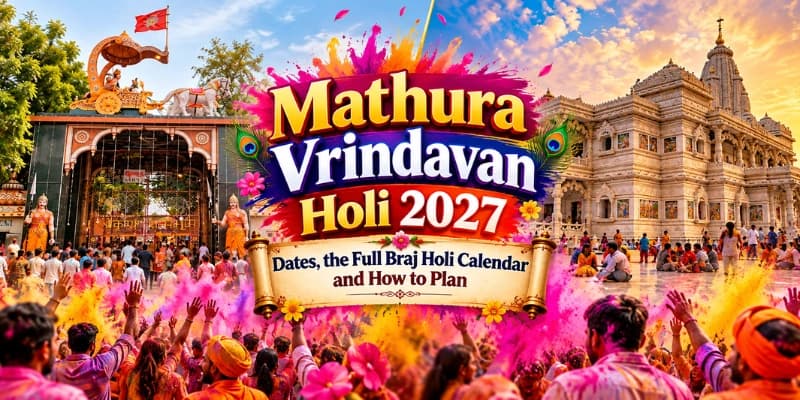
Mathura Vrindavan Holi 2027: Dates, the Full Braj Holi Calendar and How to Plan
By Gurudutt, Experience My India·28 September 2026
Quick Answer
Quick Enquiry
Mathura Vrindavan Holi 2027: the headline dates
Event | Date (2027) |
Braj Holi begins (Laddu Holi, Barsana) | Monday, 15 March 2027 |
Holika Dahan | Sunday, 21 March 2027 (evening) |
Main Holi (Rangwali Holi / Dhulendi) | Monday, 22 March 2027 |
Dauji Huranga finale (Baldeo) | Tuesday, 23 March 2027 |
The full Braj Holi 2027 calendar
The Braj Holi 2027 runs for over a week across the towns of Braj, with a unique Holi in each. Here is the full calendar, with our guide to each event:
Date | Event and place |
Mon, 15 Mar | Laddu Mar Holi at the Shriji temple, Barsana |
Tue, 16 Mar | Lathmar Holi at Barsana (the famous stick Holi) |
Wed, 17 Mar | |
Fri, 19 Mar | Chhadi Mar Holi at Gokul; and the Widow's Holi at the Gopinath temple, Vrindavan |
Sat, 20 Mar | Phoolon Wali Holi (flower Holi) at Banke Bihari, Vrindavan (Rangbharni Ekadashi) |
Sun, 21 Mar | Dwarkadhish temple Holi, Mathura; and Holika Dahan across the region |
Mon, 22 Mar | Main Rangwali Holi / Dhulendi, the day of colour, across Mathura, Vrindavan and all Braj |
Tue, 23 Mar | Dauji Huranga at Baldeo (the wild finale) |
Each event above links to our full guide for that day. As a note, the exact dates of the village temple Holis are traditionally confirmed by the local temple trusts closer to the festival, so it is wise to reconfirm the temple dates as Holi nears; the main Holi on 22 March and Holika Dahan on 21 March are settled. To experience the whole Braj Holi, a mathura vrindavan tour with Experience My India can plan it.
From the ground (Gurudutt): People come to Braj thinking Holi is one day and they are amazed; here it is more than a week, a different Holi in every town, each with its own flavour, from the sticks of Barsana to the flowers of Banke Bihari to the wild Huranga at Baldeo. It is the most joyful, most beautiful, most special Holi in the world and it is my own land. I host guests for the whole of it every year. Come and give it the days it deserves and I will show you the true Holi of Krishna. Radhe Radhe.
Why the Braj Holi is so special
The Holi of Mathura, Vrindavan and Braj is unlike any other in India:
The Holi of Krishna's own land. Braj is the land where Krishna played the first Holi with Radha and the gopis, so here Holi is not just a festival of colour but the living play of Krishna's own leelas; every Holi in Braj re-enacts a part of his love and joy, which is why it is the most beloved Holi in India.
A different Holi in every town. Unlike elsewhere, where Holi is a day, in Braj it is over a week, with a unique Holi in each town, the stick Holi at Barsana and Nandgaon, the flower Holi at Vrindavan, the cane Holi at Gokul, the temple Holis and the wild Huranga at Baldeo, each with its own tradition and flavour.
Devotion and joy together. In Braj, Holi is devotion and joy as one, kirtan and colour, the temples and the streets alive together; to keep Holi in Braj is to feel the festival at its source, in the land of the Lord who gave it its love.
The main Rangwali Holi and Holika Dahan
The heart of the festival, shared with all India, is Holika Dahan and the main Holi. Holika Dahan, the sacred bonfire on the eve, is on Sunday, 21 March 2027, when communities across Braj light the Holika at dusk and pray for the burning away of evil, in memory of the saving of the devotee Prahlad; see our holika dahan 2027 guide for the date, the muhurat and the story. Then the great Rangwali Holi, also called Dhulendi, the main day of colour, is on Monday, 22 March 2027, across Mathura, Vrindavan and all of Braj, when everyone plays with colours and water in joy. In Braj, though, the day of colour is only the shared centre of a much longer festival; the unique Braj Holis run for a week before and a day after.
The unique Holis of Braj, town by town
The glory of the Braj Holi is the unique celebration in each town. Our full guide to each:
Laddu Mar Holi at Barsana, on 15 March, the sweet Holi that opens the festival, when laddus are showered at the Radha Rani temple as the Holi invitation from Nandgaon is accepted.
Lathmar Holi at Barsana, on 16 March, the world-famous stick Holi, when the men of Nandgaon come to Radha's town and the women drive them off with lath and the return the next day at Nandgaon, on 17 March, at Krishna's town.
Chhadi Mar Holi at Gokul, on 19 March, the gentle cane Holi of baby Krishna's town, with the Makhan-Mishri prasad; and on the same day, the moving Widow's Holi at the Gopinath temple in Vrindavan, where the widows of the holy town joyfully play Holi with flowers and colour, a beautiful reclaiming of the festival's joy.
Phoolon Wali Holi at Vrindavan, on 20 March, on Rangbharni Ekadashi, the most beautiful of all, when the priests of the Banke Bihari temple shower the crowd with flower petals.
The Dwarkadhish temple Holi in Mathura, on 21 March, when the great dwarkadhish temple keeps a colourful, joyful Holi, a highlight of the Mathura Holi.
Dauji Huranga at Baldeo, on 23 March, the day after the main Holi, the wild grand finale at the temple of Dauji, Balarama, where the women tear the men's shirts and drench the crowd in colour.
Planning tips: booking, crowds and dates
The Braj Holi is joyful but demanding to plan for; here are the essentials:
Book early. Hotels and guest houses in Mathura, Vrindavan and Barsana fill up two to three months in advance for the Holi, so book your stay very early; Holi is by far the busiest season in Braj.
Mind the crowds and your safety. Events such as the Phoolon Wali Holi at Banke Bihari and the Lathmar Holi at Barsana draw extreme crowds; arrive very early for the morning darshans, secure safer, less congested vantage points, put your safety first and take special care with children and the elderly. Go with a Braj local who knows the safe places.
Reconfirm the village temple dates. The exact dates of the village temple Holis are traditionally confirmed by the local temple trusts closer to the festival, so reconfirm the temple dates as Holi nears; the main Holi on 22 March and Holika Dahan on 21 March are settled, but the local programmes can be finalised near the time.
How many days and a suggested Braj Holi plan
As the Braj Holi runs for over a week, give it as many days as you can; four or five days lets you see the great events and the full week the whole festival. A suggested plan:
The Barsana and Nandgaon days (15 to 17 March). Come for the Laddu Holi and the Lathmar Holi at Barsana and the return at Nandgaon, the famous stick Holis at the heart of the Braj Holi.
The Gokul and Vrindavan days (19 to 20 March). See the gentle Chhadi Mar Holi at Gokul and, above all, the exquisite Phoolon Wali Holi at Banke Bihari in Vrindavan, the most beautiful Holi of all.
The main Holi and the finale (21 to 23 March). Keep the Holika Dahan on the 21st, play the great Rangwali Holi on the 22nd across Mathura and Vrindavan and end with the wild Dauji Huranga at Baldeo on the 23rd.
Our mathura vrindavan tour itinerary helps you plan the days and the braj 84 kos yatra covers the whole of Braj.
How to reach Braj and where to base
Braj is easily reached and a Holi trip takes planning:
Reaching Braj. Mathura and Vrindavan are about 150 km from Delhi and about 60 km from Agra, well connected by road and rail; at Holi the roads and towns are very busy and cars are kept out of the old lanes, so plan transport carefully, take e-rickshaws for the temples and start early each day.
Where to base. Base yourself in Vrindavan or Mathura, central for the whole Braj Holi and make day trips to Barsana, Nandgaon, Gokul and Baldeo for their Holis; book very early, as Holi fills months ahead. Some also base a night or two nearer Barsana for its Holi days.
Go with a Braj local. The Braj Holi is joyful but crowded and complex, spread across many towns and days, with road closures and precise timings; a Braj-born guide, who knows the days, the safe places and the way, makes the difference between chaos and joy.
See our how to commute in vrindavan guide for getting around Braj and the temples of banke bihari temple and radha rani temple barsana, dear year-round.
We host guests for the whole Braj Holi every year, from the Lathmar and flower Holis to the Holika Dahan, the day of colour and the Dauji Huranga finale, with a comfortable vehicle, the safe places to watch and a Braj-born host who welcomes you as family. A shared day tour starts from around ₹1,499 per person, with darshan free and we arrange bespoke Holi trips for the whole festival too. The braj 84 kos yatra covers the whole of Braj, our mathura vrindavan tour the twin cities and our vrindavan tour package Vrindavan in a day; the prem mandir vrindavan and the braj yamuna ghats and leela sites are dear year-round. Message me on WhatsApp at +91-7302265809 to plan your Braj Holi and book early, as Holi fills fast.
Related guides
mathura vrindavan temple timings
agra mathura vrindavan tour package
The key celebrations explained
What each of the main Braj Holis actually is and where to see it. Confirm each day’s timing with the temple locally.
Laddu Mar Holi, Barsana (15 March)
The festival season opens at the barsana radha rani temple (Shriji Temple) with Laddu Mar Holi, when laddus are showered over the crowd as prasad in a joyful, sweet-flinging celebration that formally invites Nandgaon to the next day’s Lathmar Holi.
Lathmar Holi, Barsana and Nandgaon (16 and 17 March)
The most famous Braj Holi. At Barsana on 16 March, the women playfully beat the shield-carrying men of Nandgaon with sticks (lath), re-enacting Radha and the gopis teasing Krishna. The following day, 17 March, the play returns at the nand mahal in nandgaon, Krishna’s village, in the return festival. These two days draw photographers and pilgrims from around the world.
Phoolon Wali Holi, Banke Bihari (17 March)
On Rangbharni Ekadashi, the banke bihari temple in Vrindavan holds the breathtaking Phoolon Wali Holi, when, for a brief window, the priests shower the devotees with fresh flower petals instead of colour. It is short, intensely crowded and unforgettable, so arrive very early for a place.
Widow Holi, Vrindavan (19 March)
At the gopinath temple in Vrindavan, the widows of the City of Widows play Holi with flower petals and herbal colour, a modern celebration of reclaimed dignity. It is deeply moving and should be witnessed with respect, gentle colours, consent before photos and no intrusion.
Temple Holi in Mathura (20 to 22 March)
In Mathura, the dwarkadhish temple hosts grand temple Holi celebrations and the evening Yamuna Aarti at Vishram Ghat is especially beautiful through these days, a calmer, devotional counterpoint to the street play.
Holika Dahan and the main Rangwali Holi (21 and 22 March)
On the night of 21 March, Holika Dahan bonfires are lit across Braj. The next morning, 22 March, is the main Rangwali Holi (Dhulendi), the massive, vibrant day of loose powdered colour across Mathura, Vrindavan and every town, when the whole region turns to colour.
Dauji Huranga, Baldeo (23 March)
The finale is the wild, energetic Dauji Huranga at the dau ji temple in baldeo, the day after the main Holi, where men and women play an exuberant, traditional Holi, a fitting, high-energy close to the Braj Holi season.
The legends behind Braj Holi
Braj does not play Holi simply as a spring festival; it plays the Holi of Krishna himself. By tradition, it was here that the young Krishna, fretting that his own dark complexion was unfair beside Radha’s fair one, was told by his mother Yashoda to colour Radha’s face however he wished and from that playful pastime, the stories say, the whole festival of colour was born. The Lathmar Holi of Barsana and Nandgaon re-enacts another beloved episode, in which Krishna and his friends came from Nandgaon to tease Radha and the gopis of Barsana, who chased them off with sticks in mock battle. These are cherished devotional legends of Braj, retold each year in the play itself.
Alongside the Krishna pastimes runs the pan-Indian story the bonfire remembers. Holika Dahan, lit the night before the main day, recalls the tradition of the demoness Holika and the boy-devotee Prahlad, in which, it is said, devotion was protected while cruelty was consumed by the very fire meant to destroy the faithful. In Braj the two strands sit happily together: the solemn bonfire marking the triumph of devotion over evil and the joyous colour-play of divine love. Understanding both is what turns a wild day of colour into a pilgrimage, which is exactly how Brajwasis experience it.
Photography and etiquette at Braj Holi
Braj Holi is one of the most photographed festivals in India and a little courtesy goes a long way. In the temples the rules are strict: at Banke Bihari in particular, photography of the deity is forbidden and during the intense flower Holi you should keep your phone sealed away and simply be present rather than filming. Protect any camera you do carry in a waterproof housing, because loose colour and water will ruin unguarded equipment within minutes.
The human side matters more than any shot. Always ask before photographing a person close up and never press a lens into the Widow Holi at the Gopinath temple, which is a tender, dignified occasion and not a spectacle for strangers; witness it gently, with soft colours and full consent or simply stand back. Treat the sadhus, the elderly and the women playing with the same respect you would want shown to your own family. A smile, a Radhe Radhe and a willingness to be coloured yourself will open Braj to you far more than any aggressive pursuit of the perfect photograph and it is how the festival is meant to be shared.
Meet Gurudutt — Your Mathura Vrindavan Guide
Not just a tour operator — Gurudutt was born and raised in Braj Bhoomi. He has spent over a decade personally guiding pilgrims through the sacred lanes of Mathura & Vrindavan.
Founder – Experience My India
Gurudutt
Founder · Experience My India