Travel Guide · Travel Guides · Updated October 2026
The Krishna Circuit: Mathura, Vrindavan, Kurukshetra, Dwarka, Ujjain and Puri
By Gurudutt, Experience My India·27 October 2026
Quick Answer
Quick Enquiry
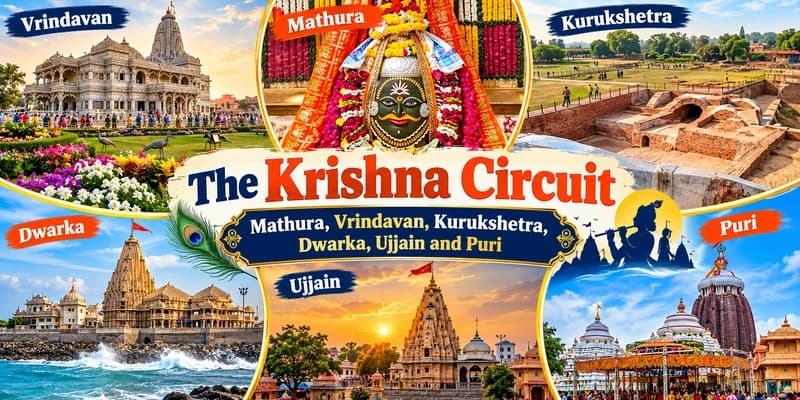
The Krishna Circuit is the whole life of the Lord laid out across India, and it is a beautiful idea for a pilgrimage. It begins here in our Braj, Mathura where he was born, Vrindavan where he played, and then follows him out to Kurukshetra, Dwarka, Ujjain and finally Puri. As a Brajwasi, the first two are my home, and the part I can show you best. Many pilgrims start the circuit here with us in Braj and travel onward from there, and I am always glad to set that beginning right. See our Mathura Vrindavan tour Packages or message WhatsApp +91 7302265809.
The six destinations of the Krishna Circuit
1. Mathura (Uttar Pradesh), the birthplace
Mathura, in the Braj region about 145 km south of Delhi, is where Krishna was born to Devaki and Vasudeva in a prison cell and where, as a young man, he returned to slay the tyrant Kansa and restore dharma. Core temples: the shri krishna janmabhoomi temple (about 5:00 AM to 12:00 PM and 4:00 PM to 8:00 PM, extending later in summer) and the shri dwarkadhish temple (about 6:30 to 10:30 AM and 4:00 to 7:00 PM). See places to visit in mathura.
2. Vrindavan (Uttar Pradesh), the childhood leelas
Just 15 km north of Mathura on the Yamuna, Vrindavan is where Krishna spent his childhood and youth, the epicentre of Bhakti, famous for his pastimes, the lifting of Govardhan hill and the Raas Leela with Radha and the gopis. Core temples: banke bihari temple (about 7:45 AM to 12:00 PM and 5:30 to 9:30 PM, closed midday for the deity’s rest) and prem mandir and the iskcon temple (around 4:30 AM to 12:00 PM and 4:30 to 8:30 PM). See places to visit in vrindavan.
3. Kurukshetra (Haryana), the field of the Gita
In northeastern Haryana, about 150 km north of Delhi on NH-44, Kurukshetra is the battlefield of the Mahabharata. At Jyotisar, Krishna served as Arjuna’s charioteer and delivered the Bhagavad Gita, revealing his cosmic form (Viratswaroop). Jyotisar and the Brahma Sarovar are generally open about 6:00 AM to 8:00 PM, with an evening sound-and-light show.
4. Dwarka (Gujarat), the kingdom
On the westernmost tip of the Saurashtra peninsula, overlooking the Arabian Sea, Dwarka is where Krishna established his grand fortified capital and ruled as Dwarkadhish. It is one of the revered Char Dham sites. The Dwarkadhish Temple (Jagat Mandir) is generally open about 6:30 AM to 1:00 PM and 5:00 to 9:30 PM and the Rukmini Devi Temple about 6:00 AM to 12:00 PM and 1:00 to 8:00 PM. (This is the Dwarka of Gujarat, distinct from Mathura’s own Dwarkadhish temple.)
5. Ujjain (Madhya Pradesh), the place of education
In the Malwa region on the Kshipra River, Ujjain houses the Sandipani Ashram, the school where Krishna, Balarama and Sudama studied under Sage Sandipani and where, by tradition, Krishna mastered 64 arts in 64 days. The Sandipani Ashram and Gopal Mandir are generally open about 6:00 AM to 8:00 PM.
6. Puri (Odisha), the cosmic form
On the Odisha coast by the Bay of Bengal, Puri is where Krishna is worshipped as Lord Jagannath, Lord of the Universe, with his siblings Balabhadra and Subhadra and is globally famous for the annual Rath Yatra. The Jagannath Temple is generally open about 5:00 AM to 11:00 PM, closing briefly for bhog rituals. Note that non-Hindus are not permitted inside and may view from the Raghunandan Library viewpoint outside.
The Swadesh Darshan trail and the thread of Krishna’s life
The Krishna Circuit is one of the themed pilgrimage trails developed under the Government of India’s Swadesh Darshan Scheme, a Ministry of Tourism programme launched to build and promote circuits of related destinations across the country. Under this banner the scattered places associated with Krishna, which pilgrims have in truth connected for centuries, are treated as a single coherent trail, with investment in roads, signage, facilities and promotion meant to make the journey easier. For the traveller, the practical upshot is a recognisable name and a clearer sense that these six places belong together.
What truly binds them, though, is not administration but story. Read in order, the circuit is the biography of an avatar: birth in a Mathura prison, a childhood of miracles and mischief in the groves of Vrindavan, the world-turning counsel of the Bhagavad Gita on the field of Kurukshetra, the building of a shining kingdom at Dwarka, the humble schooldays at Ujjain and finally worship as the cosmic Lord Jagannath at Puri. By tradition these are not merely places he visited but the stages of a divine life, which is why pilgrims have long felt that to travel between them is to walk through the Lord’s own journey.
That narrative is worth holding in mind as you plan, because it gives the circuit a logic beyond geography. You can, of course, visit any one destination on its own and most people do. But those who undertake the fuller trail often describe it as moving from the intimate, tender Krishna of Braj, the baby, the cowherd, the beloved, to the vast, universal Krishna of the Gita and of Jagannath, a shift in scale that the sequence itself seems designed to teach.
Circuit routing overview
Because the six destinations span five states, the circuit is a multi-leg journey. A common routing is:
From | To | Best route strategy |
Mathura / Vrindavan | Kurukshetra | Road or rail via Delhi (the NH-44 corridor) |
Kurukshetra | Ujjain | Rail or flight from Delhi to Indore, then road to Ujjain |
Ujjain | Dwarka | Rail or flight from Indore to Ahmedabad or Rajkot, then road to Dwarka |
Dwarka | Puri | Flight from Ahmedabad (AMD) to Bhubaneswar (BBI) |
The order and legs can be adapted to your time and starting point; many pilgrims from the north begin in Braj and travel onward. Given the distances and the mix of road, rail and air, the full circuit is best done over a longer trip or in stages rather than rushed.
Festivals along the Krishna Circuit
Each node of the circuit has its own great festival and timing a visit to one of them transforms the experience, though always at the cost of far larger crowds. In Braj, Janmashtami (Krishna’s birth, in the monsoon, usually August or September) is celebrated with unmatched fervour in Mathura and Vrindavan, with midnight aartis and night-long kirtan and the 40-day Holi season in spring turns the whole region into colour and song. These are the festivals we know best as Brajwasis.
At Puri, the Jagannath Rath Yatra (the chariot festival, usually June or July) is among the largest religious gatherings on earth, when the three deities are drawn through the streets on giant wooden chariots; it draws immense crowds and needs very careful planning. At Kurukshetra, Gita Jayanti (marking the day the Bhagavad Gita was spoken, usually late November or December) is observed with a major festival at the Brahma Sarovar, with lamps, recitations and cultural programmes. Dwarka and Ujjain also keep Janmashtami grandly and Ujjain, as one of the sites of the Kumbh Mela, sees vast periodic gatherings on the Kshipra.
If a festival is your aim, build the trip around that one date and accept that the destination will be at its most crowded; book transport and rooms far ahead and be ready for restricted vehicle access and long queues. If, instead, you want calm darshan and the freedom to linger, travel between the festivals. All festival dates follow the Hindu lunar calendar and shift from year to year, so confirm them well in advance and nearer the time before you commit to flights or trains.
Best time of year to travel the circuit
Because the circuit crosses five states and several climates, there is no single perfect month, but the broad cool, dry season of roughly October to March is the most comfortable overall for the whole trail. The North Indian legs (Braj and Kurukshetra) are pleasant then and harsh in the May and June summer; coastal Dwarka and Puri are warm and humid much of the year but most agreeable in winter; and Ujjain, inland, follows the northern pattern. Planning the main journey in winter keeps the long days of travel and temple-standing bearable.
The monsoon (roughly July to September) brings its own character: Puri’s Rath Yatra and Braj’s Janmashtami both fall in this window, so pilgrims who want those festivals travel in the rains and simply plan around them. The spring, with the Braj Holi season, is glorious in Mathura and Vrindavan but very crowded. High summer is best avoided for the inland and northern legs unless you have no choice, in which case stick to early-morning and evening darshan and rest through the fierce midday heat.
Because the destinations are so spread out, many pilgrims sensibly split the circuit by season: the North Indian heart in a cool-weather trip, the coastal temples in another and a festival leg timed to whichever celebration matters most to them. However you divide it, confirm seasonal conditions and any festival dates locally before booking, since weather, crowds and temple arrangements all vary from year to year.
A practical timing tip
Most temples on this circuit close entirely between about 12:00 PM and 4:00 PM to offer rest and food (bhog) to the deities. So plan your travel and transfers for the middle of the day and prioritise darshan for the early mornings and evenings when the temples are open. Timings vary with the season and festivals at every destination, so always confirm the current hours locally before planning a day around them. For the Braj leg, our best time to visit guide covers the comfortable months.
Planning the circuit and beginning in Braj
The full Krishna Circuit is a once-in-a-lifetime pilgrimage best planned over a good span of time or tackled in stages, one or two destinations per trip. For most pilgrims, especially from the north, the natural and most rewarding place to begin is Braj: Mathura, where Krishna was born and Vrindavan, where he grew up. These two are close together, richly packed with temples and easy to reach (about 145 km from Delhi), which makes them the ideal, temple-dense start to the whole journey. From Braj, the circuit opens outward to Kurukshetra and beyond. See our mathura vrindavan itinerary and how to reach vrindavan guides to plan the Braj beginning.
Let a Brajwasi set the beginning of your circuit right
The Krishna Circuit spans the country, but its heart, Mathura and Vrindavan, is our home and the leg we can give you most deeply. As Brajwasis, we guide the Braj portion of your Krishna Circuit, the Janmabhoomi, Banke Bihari, the Yamuna ghats and the whole sweep of Krishna’s birth and childhood, tell the stories in the places they happened and help you plan a sensible onward route. A shared Mathura-Vrindavan darshan starts from around 1499 rupees per person; see our mathura vrindavan tour or we design a private plan. Message us on WhatsApp at +91-7302265809 with your dates.
Related guides
Book Your Mathura - Vrindavan Trip Today
📞 +91-7302265809
💬 WhatsApp: +91-7302265809
We Reply in 30 Minutes
Packages start from ₹1,999/ person | Rated 4.5★ / 204+ Reviews
Explore all: Mathura Vrindavan Tour Packages
Jai Shri Krishna
Meet Gurudutt — Your Mathura Vrindavan Guide
Not just a tour operator — Gurudutt was born and raised in Braj Bhoomi. He has spent over a decade personally guiding pilgrims through the sacred lanes of Mathura & Vrindavan.
Founder – Experience My India
Gurudutt
Founder · Experience My India