Travel Guide · Food & Culture · Updated October 2026
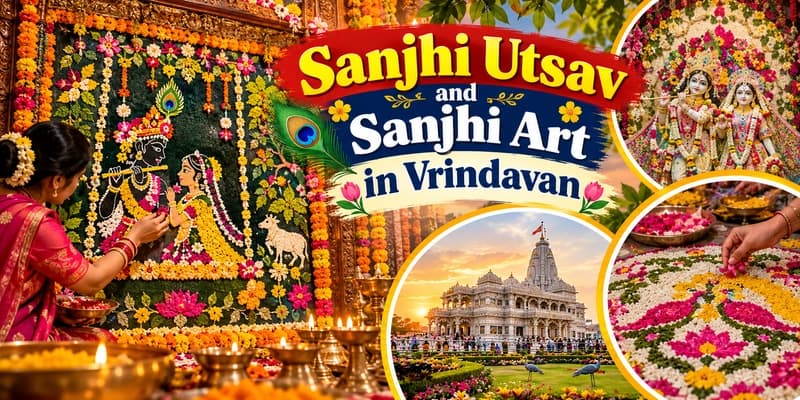
Sanjhi Utsav and Sanjhi Art in Vrindavan
By Gurudutt, Experience My India·27 October 2026
Quick Answer
Quick Enquiry
Sanjhi is one of Braj’s most delicate treasures, so fine that masters cut the paper stencils freehand, with no drawing to follow. During the Sanjhi Utsav, our old temples become living galleries: a breathtaking new design made each evening, worshipped with its own arati, and wiped away by morning for a fresh one. I love taking guests who appreciate art and devotion together, especially to see the Jal Sanjhi, colours floating on still water. It is an endangered art, and witnessing it is a quiet privilege. See our Mathura Vrindavan tour Packages or message WhatsApp +91 7302265809.
The divine origin and folklore
The word Sanjhi is linked to sajja (decoration) and sanjh (dusk), reflecting both its decorative nature and the evening hour when the compositions are traditionally unveiled and worshipped.
By Braj legend, the art was begun by Radha herself: she and her sakhis would gather flowers, leaves and coloured stone dust to make beautiful designs on mud walls and floors, to welcome and charm Krishna when he returned from grazing the cows at twilight. Temple lore even tells that Krishna himself joined Radha in making these designs. Over time, this folk tradition evolved, by the 15th and 16th centuries, into a highly complex temple ritual. It is recounted as cherished Braj folklore and tradition.
The craftsmanship: paper-cutting and stencils
At its heart, Sanjhi demands phenomenal precision. Artists craft an intricate, lace-like paper stencil called a khakha.
Freehand cutting. Masters cut these stencils with specially designed small scissors or fine blades, working entirely freehand, slicing geometric, circular or octagonal patterns straight out of the paper with no prior sketch or outline.
The canvas. The finished khakha is laid over a flat surface, a raised earth mound, temple floor or wall.
The pigments. Dry coloured powders, flower petals, stone dust or gems are gently sifted over the stencil; when it is lifted, it leaves an exquisitely detailed, high-contrast image.
Common motifs draw on the natural world of Vrindavan, peacocks, cows, monkeys, the Yamuna, Kadamba trees and complex floral matrices alongside Mughal-inspired jali (lattice) work. The art’s cultural distinctiveness is recognised with a Geographical Indication (GI) tag.
The Sanjhi Utsav in temples
During the 15 days of the Sanjhi Utsav, held during Pitru Paksha (around September to October; dates follow the Hindu calendar, so confirm locally), certain ancient Vrindavan temples become living visual galleries. Each evening a new Sanjhi is unveiled and ceremonially worshipped with a distinct arati and devotional hymns, then cleared away the next morning to make room for a completely different design, an extraordinary act of daily dedication. For the aartis that accompany it, see our must attend aarti guide.
Historically a guarded discipline passed down through male Brahmin priests and Goswamis, the festival in its modern form has opened up, with women artists and younger generations now actively keeping the heritage alive.
Two distinct canvas traditions exist:
Bhumitgat Sanjhi (earth). Designs laid on a raised platform (vedi) of mud or cow dung.
Jal Sanjhi (water). An elite, breathtaking technique in which dry pigments are balanced to float on still water, creating fluid paintings that seem to hover on the liquid surface.
Where to experience Sanjhi in Vrindavan
Though Sanjhi is considered an endangered art today, it is preserved with great fervour in a few historic temples.
Shri Radha Raman Temple. Famous for an elaborate 15-day Sanjhi Utsav at its raas mandap, with different lilas displayed daily; see the radha raman temple.
Shri Radhavallabh Lal Ji Temple. Celebrates the festival with historic evening darshans set to traditional musical compositions; see the radha vallabh temple.
Bhatta Ji Temple. Widely recognised for stunning displays and deep adherence to historical Sanjhi artistry.
These are among Vrindavan’s great heritage shrines; see our guide to the historical temples of Mathura and Vrindavan and places to visit in vrindavan.
The spiritual meaning of the daily Sanjhi
What moves devotees most about the Sanjhi Utsav is not only the skill but the spirit behind it. A new design is created with painstaking care each evening, worshipped and then swept away the next morning so that a fresh one can be made in its place. By tradition this daily making and unmaking is itself the offering: the beauty is given to Radha and Krishna for a single night and asks nothing in return, a lesson in devotion and in the impermanence of all made things. The twilight hour of its unveiling is deliberate, echoing the legend that Radha and her sakhis decorated the ground at dusk to welcome Krishna home from the cows, so every evening’s Sanjhi is understood as a renewal of that welcome. The themes shift night by night through the pastimes, the seasons and the moods of the divine couple, so that over the fifteen days the display tells a slow, unfolding story. Held during Pitru Paksha, the fortnight devoted to the ancestors, the festival also carries a note of remembrance. Seen this way, the Sanjhi is less a picture to admire than an act of worship in colour and that framing, offered as tradition and belief, is what gives the quiet temple courtyards their charge.
Visitor etiquette and photography
Because Sanjhi is a living act of worship and the designs are fragile, a little care goes a long way. Arrive in the early evening, before the unveiling and wait quietly; the courtyards are often small and fill up, so an early, respectful spot near the front is worth the wait. Keep your voice low, do not touch the stencil work or step onto the platforms and never disturb the loose pigment or the floating Jal Sanjhi, which a single breath can spoil. Photography rules vary from temple to temple and some shrines forbid it entirely, so always ask before raising a camera and never use flash, which both distracts the worshippers and can scatter the powder. Dress modestly, as at any Vrindavan temple and remove footwear where required. Give the artists room to work and the priests room to perform the arati. There is generally no ticket and any offering is a matter of personal devotion. Above all, remember that you are a guest at a nightly ritual rather than a visitor to a gallery and confirm the exact timings, the darshan hours and any photography rules locally on the day, as these shift with the festival calendar.
Planning your visit
To see Sanjhi at its fullest, time your visit for the Sanjhi Utsav during Pitru Paksha (around September to October) and come to the temples in the evening, when the new design is unveiled and worshipped. Confirm the exact dates locally, as Pitru Paksha follows the Hindu calendar and shifts each year. Even outside the Utsav, you can appreciate Sanjhi art and meet its artists in Mathura and Vrindavan, as it is practised and taught year-round by a dedicated few. For the seasons, see best time to visit; for getting to town, how to reach vrindavan.
Let a Brajwasi show you this hidden art
Sanjhi is delicate, endangered and easy to miss without knowing where and when to look. As Brajwasis, we time a Vrindavan visit for the Sanjhi Utsav, take you to the temples displaying it in the evening, explain the khakha craft and the Jal Sanjhi technique, and where possible, connect you with the artists keeping it alive. A shared Vrindavan darshan starts from around 1499 rupees per person; see our vrindavan tour package or we design a private Sanjhi-season visit. Message us on WhatsApp at +91-7302265809 with your dates.
Related guides
Book Your Mathura - Vrindavan Trip Today
📞 +91-7302265809
💬 WhatsApp: +91-7302265809
We Reply in 30 Minutes
Packages start from ₹1,999/ person | Rated 4.5★ / 204+ Reviews
Explore all: Mathura Vrindavan Tour Packages
Jai Shri Krishna
Meet Gurudutt — Your Mathura Vrindavan Guide
Not just a tour operator — Gurudutt was born and raised in Braj Bhoomi. He has spent over a decade personally guiding pilgrims through the sacred lanes of Mathura & Vrindavan.

Founder – Experience My India
Gurudutt
Founder · Experience My India