Travel Guide · Food & Culture · Updated October 2026
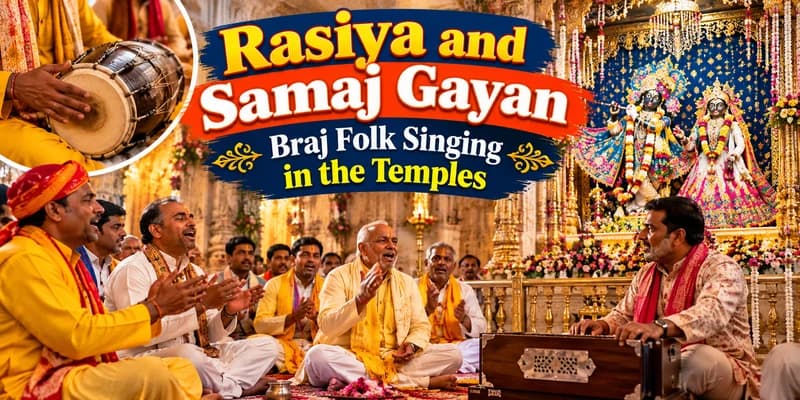
Rasiya and Samaj Gayan: Braj Folk Singing in the Temples
By Gurudutt, Experience My India·27 October 2026
Quick Answer
Quick Enquiry
Braj sings in two voices, and I love them both. Rasiya is the voice of our villages and squares, cheeky, joyful, bursting out at Holi when men and women trade teasing verses called Faag. Samaj Gayan is the voice of our temples, slow, deep, semi-classical, sung by a seated circle of devotees carrying the verses of our old saints. I take guests who care about music to sit in on Samaj Gayan at Radha Raman or Seva Kunj, and to feel Rasiya in the lanes at Holi. Together they are the soundtrack of Braj.See our Mathura Vrindavan tour Packages or message WhatsApp +91 7302265809.
The core differences between Rasiya and Samaj Gayan
Both grow from the same soil of Radha-Krishna devotion, but they differ in setting, style and tone.
Attribute | Rasiya | Samaj Gayan |
Primary context | Rural village gatherings, community squares and seasonal festivals (especially Holi) | Sacred temple courtyards during designated prayer hours or ritual periods |
Musical style | Lively, rhythmic, animated; folk melodies in accessible vernacular | Structured, semi-classical, meditative; influenced by Dhrupad and Hindustani ragas |
Theme and tone | Playful, romantic, celebratory; Krishna’s romance and the gopis’ yearning | Solemn, spiritual community choruses of the Vani (verses) of early rasik saints |
Instruments | Dholak, tabla, harmonium, manjira (cymbals) | Pakhawaj, jhanjh (large cymbals), harmonium, sarangi |
In short, Rasiya is the folk pulse of the community, while Samaj Gayan is the formalised temple choir, two expressions of the same devotion.
Rasiya: the soul of Braj folk life
Rasiya is the living pulse of the Braj community. The name derives from rasa (essence, emotion) and the songs capture the intimate, often witty interactions between the divine couple and the villagers.
Seasonal festivities. Though sung year-round, Rasiya dominates the spring month of Phalgun. During braj ki holi, groups of men and women engage in playful musical dialogues called Faag, trading festive, teasing banter in Rasiya.
Universal themes. The lyrics range from huge communal ecstasies to tender domestic intimacy, such as a song warning the charming child Krishna not to step outside looking too beautiful, lest the neighbourhood gopis cast an evil eye on him.
This warmth and wit are why Rasiya is so beloved and so central to the festive life of the villages, above all at Holi.
Samaj Gayan: the divine temple choir
Samaj Gayan carries the raw emotion of folk life into formalised temple adoration and by the early modern period it became a structural pillar of temple worship.
The liturgical structure. Rather than solo performers, it is a seated assembly: a group of devotees and musicians face each other or the deity and chant the verses written by saints such as Swami Haridas, Shri Hith Harivansh and Narayan Bhatt.
Temple strongholds. Active lines of Samaj Gayan are rigorously preserved at historic institutions, including the radha raman temple, the radha vallabh temple and seva kunj in Vrindavan.
Samaj Gayan’s slow, semi-classical depth, carrying the Vani of the rasik saints, makes it one of the most profound living musical traditions of Vrindavan; see our must attend aarti guide for the temple music context.
Preservation and cultural evolution
Over the centuries, Rasiya and Samaj Gayan overlapped heavily. Rasiya texts were adopted into temple Jhulan (swing-festival) and sankirtan programmes, while the rigorous vocal scales of Samaj Gayan influenced rural folk musicians. Today, heritage groups such as the Anahad Foundation work to archive these fast-evolving oral traditions, so the distinct acoustic soundscapes of Mathura and Vrindavan are not diluted by modern commercial melodies. For visitors, this means the traditions are still living and audible, but increasingly precious, which makes hearing them in their proper setting all the more meaningful.
The saints and poets whose words are sung
Much of this music is not folk invention but the sung poetry of Braj’s devotional masters. Samaj Gayan in particular preserves the Vani, the collected verses, of the rasik saints who shaped Vrindavan’s worship from the sixteenth century onward. Among the most revered are Swami Haridas, the musician-saint whose lineage is tied to the Banke Bihari tradition, Shri Hith Harivansh Mahaprabhu of the Radhavallabh school and Narayan Bhatt, along with the wider circle of poet-devotees who wrote in Braj bhasha, the soft, musical dialect of the region. Their compositions dwell on the moods of Radha and Krishna, the seasons, the pastimes and the longing of the devotee and they are sung in set ragas and talas handed down by word of mouth. Rasiya, by contrast, carries the anonymous voice of the village, verses shaped and reshaped by generations of ordinary singers, yet the two streams constantly borrow from each other. To sit before a Samaj Gayan assembly is therefore to hear poetry that is four or five centuries old, kept alive not in books but in the living memory of singers, which is a large part of why devotees treat the music itself almost as a form of scripture, received and offered rather than merely performed.
The Braj calendar: when the music fills the air
If you want to hear these traditions at their fullest, the time of year matters as much as the place. Rasiya belongs above all to the spring, peaking in the month of Phalgun around Holi, when the villages and lanes of Braj ring with Faag, the teasing festive exchanges sung between groups of men and women. The monsoon brings the swing festival of Jhulan in the month of Shravan, when temples set out decorated swings and sing seasonal verses and the autumn full moon of Sharad Purnima and the month of Kartik that follows are rich with temple singing. Krishna Janmashtami and Radhashtami also draw special programmes. Samaj Gayan, being woven into daily and ritual worship, can be heard year-round at the temples that preserve it, but it too swells during these festivals. The cooler months of October to March are the most comfortable for sitting through long temple sessions. Because every temple follows its own ritual calendar and the festival dates shift each year, confirm the day and the hour locally and come early to find a quiet place near the seated singers rather than arriving mid-session.
Where to hear it and planning
The two traditions are best experienced in different settings. For Samaj Gayan, visit the historic Vrindavan temples that preserve it, Radha Raman, Radhavallabh and Seva Kunj, during their prayer hours or ritual periods and sit quietly with the seated choir. For Rasiya, come during the Holi season (the spring month of Phalgun), when the villages and lanes fill with Faag and Rasiya singing. Samaj Gayan timings follow each temple’s ritual calendar, so confirm locally. For what else to see, places to visit in vrindavan; for seasons and arrival, best time to visit and how to reach vrindavan.
Let a Brajwasi take you to the real sound of Braj
Knowing which temple has Samaj Gayan at which hour and how to sit in respectfully or where to catch authentic Rasiya and Faag at Holi, is exactly where a local helps. As Brajwasis, we take music-loving guests to hear Samaj Gayan at the temples that preserve it, explain the saints and the Vani being sung and bring you into the Rasiya and Faag of a Braj Holi, the real, acoustic sound of our land, not a commercial show. A shared Vrindavan darshan starts from around 1499 rupees per person; see our vrindavan tour package or we design a private music-focused visit. Message us on WhatsApp at +91-7302265809 with your dates.
Related guides
Book Your Mathura - Vrindavan Trip Today
📞 +91-7302265809
💬 WhatsApp: +91-7302265809
We Reply in 30 Minutes
Packages start from ₹1,999/ person | Rated 4.5★ / 204+ Reviews
Explore all: Mathura Vrindavan Tour Packages
Jai Shri Krishna
Meet Gurudutt — Your Mathura Vrindavan Guide
Not just a tour operator — Gurudutt was born and raised in Braj Bhoomi. He has spent over a decade personally guiding pilgrims through the sacred lanes of Mathura & Vrindavan.

Founder – Experience My India
Gurudutt
Founder · Experience My India