Travel Guide · Festivals & Events · Updated September 2026
Sharad Purnima 2026: Date, the Maha Raas and How It Is Celebrated
By Gurudutt, Experience My India·1 September 2026
Quick Answer
Quick Enquiry
Key facts at a glance
Detail | Information |
Date (night observance) | Sunday, October 25, 2026 |
Purnima tithi begins | About 11:55 AM, October 25, 2026 (per panchang) |
Purnima tithi ends | About 09:41 AM, October 26, 2026 (per panchang) |
Moonrise | Around 05:00 PM, October 25 (varies by location) |
Month and paksha | Ashwin Shukla Purnima, the autumn full moon |
In Braj | Raas Purnima, the night of Krishna's Maha Raas |
Also known as | Kojagari Purnima, Kaumudi Purnima, Navanna Purnima |
Sharad Purnima 2026: the date, tithi and moonrise
In 2026, Sharad Purnima falls on the night of Sunday, October 25, the full moon of Ashwin that marks the close of the monsoon and the beginning of the clear autumn. By the panchang, the Purnima tithi begins at about 11:55 AM on October 25 and ends at about 09:41 AM on October 26, with the moon rising around 05:00 PM on October 25. Because the rituals of the night, the moonlight kheer and the Lakshmi vigil, belong to the evening and night of October 25, that is the day of observance, though a few panchangs note October 26 for the tithi that lingers into the next morning. It is, above all, the most luminous full moon of the year and in the land of Krishna it carries a beauty beyond the sky; to spend it in Braj, a mathura vrindavan tour package with Experience My India can bring you to Vrindavan for the night.
From the ground (Gurudutt): There is no night in Braj like Sharad Purnima. We call it Raas Purnima, for this is the night of Krishna's divine Raas with the gopis and the whole of Vrindavan seems to hold its breath under the great white moon. We keep kheer out in the moonlight, sing through the night and the temples glow. If you can come to Vrindavan for this one night, do; sit under that moon, hear the kirtan and you will understand why we say the moonlight here is nectar. Radhe Radhe. See our Mathura Vrindavan tour Package or message WhatsApp +91 7302265809.
Sharad Purnima and Krishna: the Maha Raas
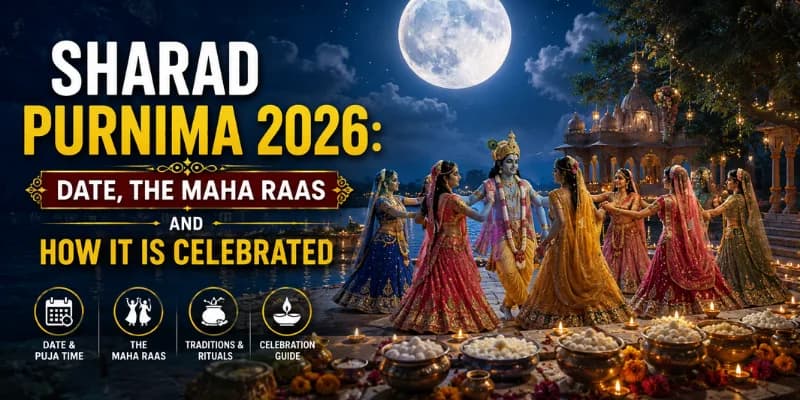
In Braj, Sharad Purnima is Raas Purnima, held to be the very night on which Krishna performed the Maha Raas, the divine dance, with the gopis of Vrindavan. It is among the most sacred and tender of all his leelas and it is understood not as an earthly dance but as the highest expression of divine love, the longing of the soul for God and God's answer to that longing. Tradition tells that Krishna multiplied himself so that each gopi felt he danced with her alone and that the single night stretched into a night of Brahma, an age beyond human reckoning, so timeless is the union it represents. The gopis' love is honoured as the purest devotion, prema, wholly selfless and turned entirely towards the Lord.
This is why Vrindavan holds Sharad Purnima so dear. The groves where the Raas is remembered, among them seva kunj vrindavan and the braj yamuna ghats and leela sites, are revered as the setting of the leela and by long tradition are left undisturbed after dark, when the divine dance is believed to continue unseen. On this night the temples of Vrindavan honour the Raas with special worship and song.
The sixteen kalas and the nectar moon
Sharad Purnima is prized as the one night of the year when the moon shines with all sixteen of its kalas, its divine phases or aspects, complete and undimmed. From this comes the belief that dwells at the heart of the festival:
The moon of full perfection. On this single night the moon is held to be whole in all sixteen kalas, radiant as at no other time, a symbol of completeness and grace.
Moonlight as nectar. The rays of this perfect moon are believed to carry amrit, a healing, life-giving nectar, said to descend gently over the earth through the night.
Why it matters for the rituals. It is this belief that shapes the night's great custom, the placing of kheer beneath the open moon, so that it may drink in the nectar of the rays.
The moonlight kheer ritual
The best-loved custom of Sharad Purnima is the moonlight kheer, simple to keep and rich in meaning. How it is done:
Prepare the kheer. A sweet rice kheer is cooked in milk, the pure white dish thought most fitting to receive the white moon's light.
Place it under the moon. The kheer is set out in the open moonlight for at least three to four hours or through the whole night, covered with a thin mesh cloth so it stays clean while the rays reach it.
Share it as prasad. In the morning the moonlight-touched kheer, believed to have absorbed the moon's healing nectar, is offered and shared as prasad, a taste of the night's blessing.
Kojagara Lakshmi Puja and the night vigil
Across many regions Sharad Purnima is also Kojagari Purnima, the night of the Kojagara Lakshmi Puja, when Goddess Lakshmi is worshipped for prosperity and abundance. The name comes from the words Ko jagarti, meaning who is awake, for it is believed that on this night Lakshmi moves through the world asking that very question and blesses those she finds awake in devotion. And so devotees keep a night vigil, a jagran, singing bhajans, chanting and praying through the hours of the full moon, unwilling to sleep and miss her grace.
Kojagara Lakshmi Puja vidhi, step by step
For those who wish to perform the Kojagara Lakshmi Puja at home on Sharad Purnima, here is a simple step-by-step vidhi. First, the items to gather:
Puja samagri (items): idols of Goddess Lakshmi and Lord Kuber; kheer, lotus or red flowers, betel leaves (paan), nuts, fruits and sweets as offerings; and a wooden platform (chauki), red cloth, ghee lamp (diya), incense (agarbatti), a copper kalash and a coconut.
The procedure:
1. Purification and setup. Clean the puja space and spread a red cloth on the wooden platform. Place the idols of Lakshmi and Kuber facing east or north and set beside them a kalash filled with water, topped with mango leaves and a coconut.
2. Dhyana and sankalpa. Meditate on Goddess Lakshmi, close your eyes and invoke her presence. Take water in your right hand and make a sankalpa, a resolve to perform the puja with devotion.
3. Abhishek and shringar. Sprinkle holy water or panchamrit, the mixture of milk, curd, honey, ghee and sugar, on the idols. Apply kumkum and akshat and offer red or lotus flowers and a garland.
4. Offerings (bhog). Light the ghee lamp and the incense and offer fruits, sweets, paan and the specially prepared rice kheer.
5. Aarti and prayers. Perform the Lakshmi aarti while ringing a small bell and recite the Lakshmi Chalisa or the Sri Suktam to invite wealth and well-being.
6. The moonlight ritual and vigil. Place the kheer under the open moonlight for at least three to four hours or overnight, covered with a thin mesh cloth. Keep the vigil, rising through the night to chant or sing, as Lakshmi is believed to bless those who are awake; share the moonlight kheer as prasad the next morning.
Observances vary by region and family tradition, so follow the practice of your own home and, if you keep a fast or a specific muhurat, confirm the timings with your local panchang.
Sharad Purnima in Vrindavan and Braj
Nowhere is Sharad Purnima felt as it is in Braj, the very land of the Raas. On this night:
The temples celebrate the Raas. The temples of Vrindavan honour the night with special darshan, the deities beautifully adorned and kirtan and raas leela performances that fill the town with song.
A luminous, thronged night. Pilgrims gather in great numbers under the full moon and the mood is one of joy and devotion through the hours of darkness.
A gentle autumn season. Coming at the close of the monsoon, Sharad Purnima falls in a pleasant, clear season, a lovely time to be in Braj beyond the night itself.
On this night the banke bihari temple, the iskcon temple vrindavan and prem mandir vrindavan hold special worship and Radha Rani is remembered at radha rani temple barsana; for the darshan hours, our mathura vrindavan temple timings guide helps, as several temples keep special hours on festival nights.
Tips for observing the night
Prepare a simple rice kheer and set it under the open moon, covered with a thin mesh cloth, for a few hours or overnight.
Keep the vigil if you can, with bhajans, chanting or the Lakshmi aarti, in the spirit of the Kojagara night.
If you visit Vrindavan for the night, plan for large crowds, dress modestly and warmly and keep your belongings close.
Remember the Raas with a reverent heart, for it is honoured as divine love, not an earthly tale.
For a Braj pilgrimage around the festival, book and travel early, as the autumn season and the night draw many pilgrims.
If you would like to spend Sharad Purnima or the gentle autumn season, on pilgrimage in the land of the Raas, we plan journeys through Vrindavan and Braj with a comfortable vehicle, darshan arranged and a Braj-born guide. A shared day tour starts from around ₹1,499 per person, with darshan free. Our vrindavan tour package covers Vrindavan in a day, our mathura vrindavan tour the twin cities and the braj 84 kos yatra the whole of Braj. Our mathura vrindavan tour itinerary shapes the days and for getting around the town our how to commute in vrindavan guide helps; message me on WhatsApp at +91-7302265809.
Related guides
Meet Gurudutt — Your Mathura Vrindavan Guide
Not just a tour operator — Gurudutt was born and raised in Braj Bhoomi. He has spent over a decade personally guiding pilgrims through the sacred lanes of Mathura & Vrindavan.

Founder – Experience My India
Gurudutt
Founder · Experience My India