Travel Guide · Travel Guides · Updated October 2026
How Did Krishna Die? The Mahabharata Account, Sole Not Heel
By Gurudutt, Experience My India·2 October 2026
Quick Answer
Quick Enquiry
Key points at a glance
Detail | Account |
How | Struck by an arrow from the hunter Jara, who mistook his foot for a deer |
Where on the body | The sole of the foot (Sanskrit padatale), not the heel |
Where | A forest at Prabhasa, modern Gujarat, near Dwarka |
When in the story | After the Yadava clan destroyed itself; Balarama had already gone |
Primary source | Mahabharata, Mausala Parva (16th book) |
Also in | Bhagavata Purana (11.30.33, 11.30.39); Vishnu Purana (5.37) |
The departure | Krishna rose upward, filling the sky with light, by his own will |
How did Krishna die: the short answer
The question how did Krishna die has a plain answer and a deep one. The plain answer: a hunter named Jara, taking Krishna's foot for a deer in the forest, loosed an arrow that struck the sole of his foot, and the Lord then left the world. The deep answer is that this was no accident of fate but the Lord's own conscious departure, at his chosen hour, as the age of Dvapara gave way to Kali. This account is drawn faithfully from the scriptures, above all the Mausala Parva of the Mahabharata, with the Bhagavata and Vishnu Puranas. For the land where his life unfolded, see our mathura vrindavan tour.
A note on sources: where this account follows a published translation, it is Kisari Mohan Ganguli (1883 to 1896) for the Mahabharata, and Tagare or Bhaktivedanta for the Bhagavata Purana; the Sanskrit is quoted from the text itself. We present the whole as the cherished belief and tradition, held with faith and recounted with reverence.
From the ground (Gurudutt): People come to this story expecting something tragic, and in one sense it is bleak: the clan gone, Balarama departed, the Lord alone in a forest. But every devotee I know reads it differently. Krishna is not killed; he chooses his moment and leaves, using a frightened hunter's mistake as the door. And there is such tenderness in it, that the arrow finds the very feet we have worshipped for centuries as our refuge. I wanted to tell it carefully, because so much of what is written online gets one detail wrong, the heel, and misses the beauty of what the texts actually say. Read it slowly; it rewards reverence.
The setting: the fall of the Yadavas at Prabhasa
The account in the Mausala Parva is a sombre one. Years after the great Mahabharata war, the Yadava clan, Krishna's own people, destroyed itself in a drunken brawl at Prabhasa, on the coast of modern Gujarat, the culmination of a curse and of long sorrow; brother turned on brother until the clan was gone. Balarama, Krishna's elder brother, had already departed the world. And so Krishna, alone, withdrew into the forest to sit in meditation.
So the stage is set in grief: the people fallen, the brother gone, the Lord alone. So it is into this stillness that the hunter comes. We present the account with the reverence of the tradition, held with faith and recounted with reverence.
The fatal shot: the hunter Jara
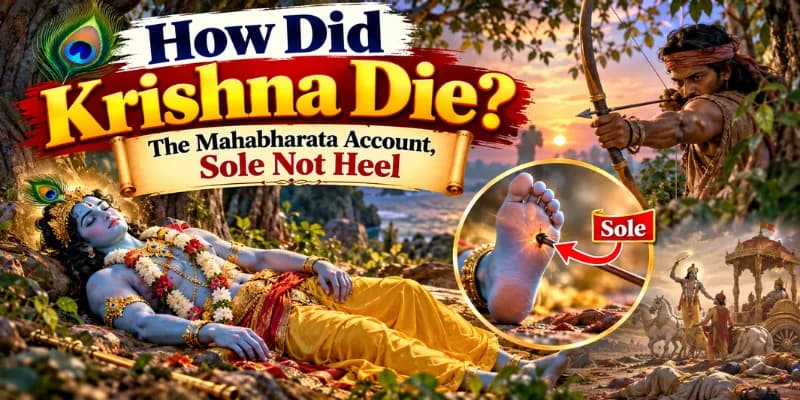
Krishna lay on the ground beneath a tree, deep in yoga, his foot resting so that, through the leaves, a glimpse of it might be mistaken for an animal. A fierce hunter named Jara came through the forest looking for deer. Taking the Lord's foot for a deer, he loosed an arrow and struck him on the sole of the foot. Coming closer, Jara saw what he had done, and was filled with fear and sorrow, and touched the Lord's feet. Krishna comforted him, and then, by the tradition, rose upward in his divine form, filling the whole sky with light.
The Sanskrit: sole of the foot, not heel
The Mahabharata states plainly where the arrow struck. The verse reads:
स केशवं योगयुक्तं शयानं
मृगासक्तो लुब्धकः सायकेन।
जरो'विध्यत्पादतले त्वरावां-
स्तं चाभितस्तज्जिघृक्षुर्जगाम।।
The hunter, intent on a deer, shot the sleeping Krishna;
Jara struck him on the sole of the foot.
Mahabharata, Mausala Parva 5.23. The key word is padatale, which means on the sole of the foot. The Bhagavata Purana agrees, saying the sole (11.30.33), and so does the Vishnu Purana. So the texts are clear and in agreement: it was the sole of the foot. We present the account faithful to the scripture, held with faith and recounted with reverence.
Why the internet says Achilles heel
If the texts say the sole, why does so much of the internet call this Krishna's Achilles heel? The answer is a single word in one English translation. Kisari Mohan Ganguli, whose classic Mahabharata translation (1883 to 1896) is the one most often quoted, rendered the wound as the heel. But the Sanskrit word for heel, parshni, appears nowhere in the Mausala Parva, in either the vulgate or the critical edition; the text says padatale, the sole. So the Achilles heel comparison rests on Ganguli's English, not on the original.
An honest correction: an earlier version of this very account said heel; that was wrong, and we have corrected it to follow the Sanskrit. The texts agree after all. So the sole, not the heel, is what the scripture says. We present it faithful to the source, held with faith and recounted with reverence.
Jara, Vali, and the turning of karma
By the tradition, there is a reason the hunter's arrow found the Lord, and it reaches back an age. In an earlier descent, as Rama, the same Lord had struck down Vali, the monkey king, from hiding. In this age, that hunter Jara was Vali reborn, come to claim that karma, so that the Lord received the arrow he had once sent. Krishna, knowing this, accepted it willingly and comforted the trembling Jara, telling him, by the tradition, that his death was meant to happen. So Jara was Vali, and the shot the turning of a karma the Lord took upon himself. We present this account as the cherished belief and tradition, held with faith and recounted with reverence.
What Krishna said to the hunter
A careful reading finds something surprising: in the Mahabharata itself, Krishna speaks no words to Jara at all. The Mausala Parva says only, in a narrated phrase, that he comforted him. The famous speech, in which Krishna tells the trembling hunter not to be afraid, is genuine, but it belongs to the other scriptures.
In the Bhagavata Purana (11.30.39), Krishna says: My dear Jara, do not fear. Please get up. What has been done is actually My own desire.
In the Vishnu Purana (5.37), he tells the hunter not to be afraid, and by his grace sends him to heaven.
So the Mahabharata narrates only that Krishna comforted Jara, while the Puranas give the beloved words of reassurance and grace. So the tradition, taken together, shows the Lord forgiving and blessing the one who struck him. We present his words as the scriptures record them, held with faith and recounted with reverence.
The lotus feet and the charan paduka
There is a tender irony in where the arrow struck. For centuries, the lotus feet of Krishna have been venerated as the very symbol of refuge and surrender; devotees speak of taking shelter at his feet, and the charan paduka, the sacred sandals or footprints of the Lord, are lovingly kept and worshipped in temples and homes across Braj and beyond. That the arrow found exactly those feet turns the sorrow of the moment into something worshipful, a last reminder of where the soul is to take refuge. Our places to visit in vrindavan guide covers the sacred sites where his feet are honoured.
So the wound on the foot deepens, rather than diminishes, the devotion to his lotus feet. So devotees hold the charan paduka dearer for it. We present this reflection with the reverence of the tradition, held with faith and recounted with reverence.
A divine departure, not a death
For a devotee, it is important to say that Krishna did not die as an ordinary being dies. Being the Supreme Lord, he left the world by his own will and at his chosen hour, using the hunter's arrow only as the outward occasion, and rose upward in his eternal, divine form, filling the sky with light; his departure is said to mark the end of the Dvapara Yuga and the beginning of our own age, the Kali Yuga. His worldly life ended far from Braj, at Prabhasa near Dwarka, where he had reigned as dwarkadhish temple mathura honours him, the king of Dwarka; but his birth at the krishna janmabhoomi temple in Mathura and his childhood in Vrindavan and gokul mandir are where his presence is most lovingly felt.
So Krishna's passing was a conscious, divine departure, not a death, and his eternal presence remains. We present this as the cherished belief and tradition, held with faith and recounted with reverence. To walk the land of his life, we arrange Mathura and Vrindavan darshan with a knowledgeable local guide; a shared day tour starts from around ₹1,499 per person, with darshan free, and our one-day vrindavan mathura tour and two-day mathura vrindavan tour help you plan. Message me on WhatsApp at +91-7302265809 to plan your pilgrimage.
Related guides
Meet Gurudutt — Your Mathura Vrindavan Guide
Not just a tour operator — Gurudutt was born and raised in Braj Bhoomi. He has spent over a decade personally guiding pilgrims through the sacred lanes of Mathura & Vrindavan.
Founder – Experience My India
Gurudutt
Founder · Experience My India