Travel Guide · Travel Guides · Updated October 2026
Who Is Radha's Husband? Ayan, Lord Krishna, and the Secret Marriage of Bhandirvan
By Gurudutt, Experience My India·14 October 2026
Quick Answer
Quick Enquiry
Radha's husband, at a glance
Question | By the tradition |
Who was Radha's worldly husband? | Ayan, also called Abhimanyu, a cowherd of Yavat near Nandgaon |
Who are his family? | His mother Jatila and his sister Kutila, Radha's in-laws at Yavat |
Was the marriage a true union? | A marriage in name and social form only; Radha ever remained pure and untouched |
Who is Radha's eternal consort? | Lord Krishna, her very heart and the Supreme Lord |
Were Radha and Krishna married? | Yes, in a secret celestial ceremony at Bhandirvan, officiated by Lord Brahma |
Where is this recorded? | The Garga Samhita, the Brahma Vaivarta Purana and the devotional tradition |
Who is Radha's husband? The short answer
The question of Radha's husband has, by the tradition of Braj, two answers that belong to two planes of truth. On the worldly, social plane, the scriptures and the medieval devotional poetry relate that Radha was given in marriage to Ayan, also called Abhimanyu, a cowherd of Yavat; yet this was a union in name and social form alone, by which Radha ever remained pure. On the eternal, spiritual plane, Radha is the very heart and eternal consort of Lord Krishna and the scriptures record their secret celestial marriage at Bhandirvan. The one is a matter of worldly form; the other is the eternal truth of the soul. To walk the holy places of Radha and Krishna, a mathura vrindavan tour packages with Experience My India can plan it. We present all this as the cherished tradition of Braj, held with faith and recounted with reverence.
From the ground (Gurudutt): Pilgrims and visitors ask me this often and I always answer gently, because it is easy to hear it as a worldly story and miss the whole point. In Braj we understand that Radha's worldly marriage only deepens the glory of her love for Krishna, a love that asked nothing for itself and kept nothing back. When I take guests to Barsana, to Yavat and to Bhandirvan where the divine couple were wed, this is the truth I try to share: that this is the highest love of the soul for God. We tell it as the cherished tradition of Braj. Radhe Radhe.
Radha's worldly husband: Ayan (Abhimanyu) of Yavat
In the worldly, social sense, the tradition names Radha's husband thus:
Ayan or Abhimanyu. By the tradition and as told in the Puranic and the medieval devotional literature, Radha was given in marriage to a cowherd named Ayan, also known as Abhimanyu and in some accounts as Rayan; he was a gopa of the cowherd community, a man of ordinary, worldly life, representing the conventional order of society, the lokachar.
The village of Yavat. Ayan lived at Yavat, also spelled Javat, a village near Nandgaon in Braj and it was there, at the home of her in-laws, that Radha dwelt in her married days; Yavat is honoured today as the place of Radha's in-laws' house and pilgrims visit it on the Braj circuit.
Jatila and Kutila. In the household at Yavat were Ayan's mother, Jatila, Radha's mother-in-law and his sister, Kutila, Radha's sister-in-law, who in the devotional poetry are remembered for their watchful, often stern presence; their role in the pastimes heightens the tender drama of Radha's hidden devotion to Krishna.
The untouched bride: Yogamaya and the shadow
Though given in marriage in worldly form, Radha, by the tradition, ever remained wholly pure, her heart and her person belonging only to Krishna. The tradition relates that by the power of Yogamaya, the divine power that veils and arranges the Lord's pastimes, Ayan could never truly reach Radha; by one cherished account he could not so much as touch even her shadow and by some traditions it was only a shadow manifestation of Radha, a Chhaya Radha or Maya Radha, that dwelt in the marital home, while the true Radha remained ever with Krishna in spirit. Folklore relates, too, that Ayan had in a former life performed great austerities to win the Goddess, Lakshmi incarnate as Radha and was granted the boon to be wed to her in this age, though the union would remain in name alone, pure and spiritually detached. We present these as the cherished beliefs and traditions of Braj, as they are told, held with faith and recounted with reverence.
Why a worldly marriage? Parakiya-bhava explained
Why, then, does the tradition give the supreme Goddess a worldly husband at all? The answer lies in a deep truth of devotion:
To hide the divine play. By the tradition, the worldly marriage served to keep Radha's divine play, her leela, veiled within the ordinary order of society, so that the sacred love of Radha and Krishna might unfold hidden from the worldly eye; the social form of marriage was the veil over a mystery.
Parakiya-bhava, love beyond worldly bonds. The saints explain that Radha's marriage sets the stage for parakiya-bhava, the mood of a love that transcends worldly rules and social bonds; it is cherished as the most intense and selfless love of all, for it is love given wholly for the beloved's sake, asking and keeping nothing, bound by no claim of possession or duty. In the theology of Braj, this is a figure for the soul's utter love for God, which leaves behind every worldly attachment for the Lord alone.
A spiritual truth, not a worldly model. It is vital to understand that parakiya-bhava is a purely spiritual and devotional concept, a truth of the inner life of the soul and its love for the Divine; the saints are clear that it is never a model or a licence for worldly conduct and is not to be imitated in material life. It is cherished as theology and recounted with reverence, nothing more and nothing less.
Radha's eternal consort: Lord Krishna
Beyond every worldly form, the eternal truth of the tradition is that Radha is the very heart, the hladini shakti, the bliss-power and the eternal consort of Lord Krishna himself. Radha and Krishna are understood by the saints as one single truth in two forms, the Divine and its own dearest love, inseparable for all eternity; Radha is she without whom Krishna is not worshipped and the two are adored together across Braj as the one divine couple, Radha-Krishna. This is the love that the holy places of Braj, Barsana and Vrindavan and Bhandirvan, enshrine; for the aartis of Radha, see the radha rani aarti lyrics and for her town, our radha rani temple barsana guide. We present this as the cherished belief and tradition of Braj, held with faith and recounted with reverence.
The secret marriage at Bhandirvan
The tradition cherishes a beautiful account of the actual, eternal marriage of Radha and Krishna:
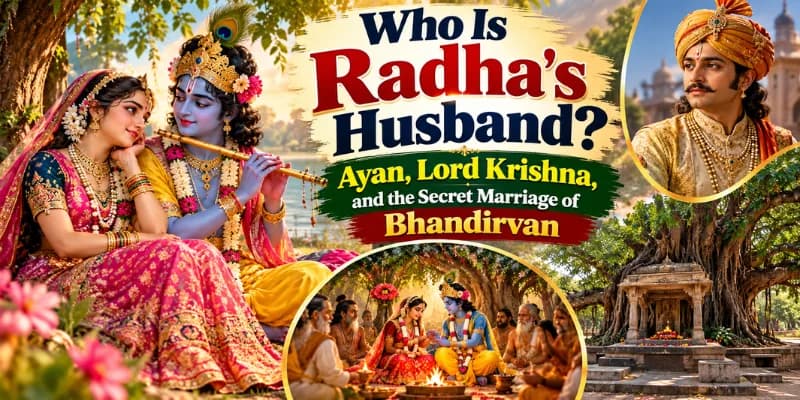
The forest of Bhandirvan. By the tradition and as recorded in the Garga Samhita and the Brahma Vaivarta Purana, the child Krishna was once brought to the ancient forest of Bhandirvan, by the Yamuna in Braj; and there, in that secret grove, the eternal marriage of Radha and Krishna took place.
Brahma as the priest. The scriptures relate that Lord Brahma himself appeared and officiated the wedding as the priest, joining the divine couple in a celestial Gandharva marriage, with the sakhis and the very creatures of the forest as the hidden witnesses; it was a marriage kept secret from the world, the union of the Divine with its own eternal love.
The vivah sthali today. At Bhandirvan today stands the Radha Krishna Vivah Sthali, the marriage-place shrine, with the Radha Bhandir Bihari temple, where Krishna is shown applying the sindoor upon Radha's head in the sacred marriage rite; nearby are the Venu Kup well and the great twin banyan trees under which, by the tradition, the ceremony took place. Each year the wedding is joyfully re-enacted at the Byahula Utsav on Phulera Dooj. We present this as the cherished tradition of Braj.
The deeper meaning and the places to visit
The deepest meaning of it all is a truth of the heart: that the love of Radha and Krishna is the very summit of bhakti, pure devotion, in which the soul gives itself wholly to the Divine, holding back nothing, seeking nothing in return; and before that love, every worldly label, husband, duty, society, is secondary and falls away. This is why the saints cherish Radha's story so: her worldly marriage only magnifies the glory of a love that was all for Krishna. To walk where this love unfolded, see our barsana vs nandgaon guide to the towns of Radha and Krishna, the nandgaon up guide and the seva kunj vrindavan of Vrindavan, a cherished site of the pastimes of the divine couple.
We take guests to the holy places of Radha and Krishna across Braj, Barsana, the town of Radha, with its Ladli Ji temple, Yavat, Nandgaon, the town of Nanda Baba, Vrindavan and Bhandirvan, where the divine couple were wed, in a comfortable vehicle with a Braj-born guide who knows the places and the scriptures. A shared day tour starts from around ₹1,499 per person, with darshan free. The braj 84 kos yatra covers the whole of Braj, including Bhandirvan and Barsana, our mathura vrindavan tour the twin cities and our vrindavan tour package Vrindavan in a day. You can also plan with our mathura vrindavan tour itinerary. Message me on WhatsApp at +91-7302265809 to plan your Braj darshan.
Related guides
Meet Gurudutt — Your Mathura Vrindavan Guide
Not just a tour operator — Gurudutt was born and raised in Braj Bhoomi. He has spent over a decade personally guiding pilgrims through the sacred lanes of Mathura & Vrindavan.
Founder – Experience My India
Gurudutt
Founder · Experience My India