Travel Guide · Festivals & Events · Updated October 2026
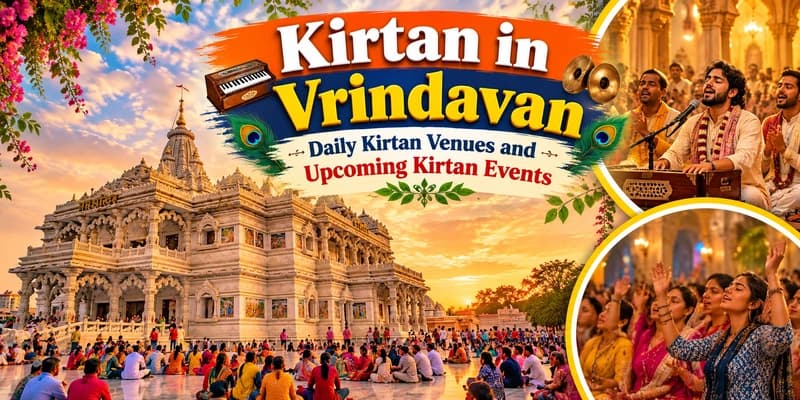
Kirtan in Vrindavan: Daily Kirtan Venues and Upcoming Kirtan Events
By Gurudutt, Experience My India·28 October 2026
Quick Answer
Quick Enquiry
Kirtan is the heartbeat of Vrindavan, you hear it from every lane. I tell visitors there are two ways to feel it: the daily venues, where you can simply walk in, like ISKCON’s 24-hour chanting that has never stopped since 1986 and the great festival windows, above all our 40-day Holi season, when the whole town sings. I help guests find the right kirtan for them, whether it is the pre-dawn satsang of Premanand Maharaj ji or the thunderous Holi kirtans at Banke Bihari. See our Mathura Vrindavan tour Packages or message WhatsApp +91 7302265809.
What is kirtan and why Vrindavan lives by it
Kirtan is congregational devotional singing, the repeated chanting of the names and glories of the divine, usually Radha and Krishna here, carried by voices, hand cymbals (kartal), the two-headed mridanga or dholak drum and often a harmonium. Unlike a concert, it is participatory: the lead singer calls a line and the gathering answers it, again and again, until the words dissolve into pure sound and feeling. In the bhakti traditions that shaped Braj, kirtan is not entertainment but a spiritual practice in its own right, a way to still the mind and remember the divine and by tradition it is held to be the recommended practice for the present age (Kaliyuga).
Vrindavan, more than almost anywhere, lives by this. By tradition it is the land of Krishna’s childhood and of Radha’s love and the saints who settled here over the centuries, the Six Goswamis sent by Chaitanya Mahaprabhu and the founders of the Radhavallabh and other sampradayas, built a whole devotional culture around singing the holy name. That inheritance is why you hear kirtan drifting from temple courtyards, ashram halls, roadside gatherings and private homes at almost any hour and why the town’s rhythm is set by aarti bells and drums rather than by traffic.
For a visitor, this is the single thing that most distinguishes Vrindavan from an ordinary sightseeing destination. You do not so much watch kirtan as get drawn into it; even those who do not follow the Sanskrit or Braj Bhasha words often find the repetition and the swell of many voices deeply moving. Understanding that kirtan is a living, daily practice, rather than a scheduled performance, helps you approach it in the right spirit: come to take part, not merely to observe.
Daily kirtan venues in Vrindavan
Outside the festival dates, these permanent hubs offer immersive daily kirtan, open to all.
Sri Sri Krishna Balaram Mandir (ISKCON Vrindavan)
The iskcon temple is globally renowned for its continuous, non-stop 24-hour Hare Krishna mahamantra kirtan, which has echoed through its marble courtyards daily since 1986. Expect a profoundly peaceful, orderly, soul-soothing atmosphere; devotees sit for hours in the central courtyard or dance during the high-energy evening aarti. See our iskcon vrindavan guide for the full visit.
Shri Hit Radha Keli Kunj
The ashram of the revered saint Pujya Shri Hit Premanand Govind Sharan Maharaj ji features raw, deeply spiritual Radhavallabh-tradition satsangs and melodious kirtans. The daily session runs predominantly in the very early hours, starting around 3:00 to 4:15 AM and floor seating in the austere hall fills almost instantly, so arrive exceptionally early to secure a spot. It is a profound experience for the sincere.
ISKCON Rukmini Vihar
A secondary ISKCON temple in the Rukmini Vihar area, it offers ecstatic, melodious kirtan sessions, vibrant spiritual energy and wholesome organic prasadam, away from the heavier crowds of the old town, making it a calmer alternative.
Vrindavan Radha Krishna Mandir (Raman Reti)
A majestic white-marble temple complex in the historic Raman Reti area, its massive satsang hall hosts daily congregational chants, aartis and rituals, letting thousands of pilgrims immerse comfortably. It pairs well with the other Raman Reti sites.
For the aartis that carry some of the most stirring kirtan, see our must attend aarti guide.
Kinds of kirtan you will hear in Braj
Not all kirtan sounds the same and part of the pleasure of a longer stay is learning to tell the styles apart. The Hare Krishna mahamantra kirtan, most associated with ISKCON, repeats the maha-mantra in rising and falling melodies, building from a slow, meditative pace to an ecstatic, dancing climax; it is the most internationally familiar form and the easiest for a first-timer to join.
In the older temples you will meet samaj gayan, a stately, classical form of group singing rooted in the temple traditions of Vrindavan and Nathdwara, performed by trained singers in a call-and-response between two groups, accompanied by pakhawaj and cymbals. It is more formal and musically intricate, often unfolding slowly across long sessions, especially around festivals. The Radhavallabh and allied traditions, such as the satsang associated with the ashram of Premanand Maharaj ji, emphasise the singing of the saints’ own compositions (vani) and the glories of Radha, in an intimate, intense register.
You will also hear rasiya, the earthy folk singing of Braj that comes into its own at Holi and simple naam kirtan, the plain chanting of the divine names that anyone can follow. During the Holi season the Samaj kirtan at Barsana and Nandgaon becomes a thunderous, crowd-wide affair. You do not need to know the names of these styles to be moved by them, but recognising, say, the difference between a disciplined samaj gayan and a free, dancing Hare Krishna kirtan will deepen what you hear. Ask your hosts or a guide which tradition a particular temple follows and confirm any special session timings locally.
Upcoming kirtan and Holi festival events (2027)
Spiritual events are fluid, but the town erupts into non-stop devotional kirtan during specific festival windows. The defining 2027 windows are below. (Dates follow the Hindu calendar; confirm nearer the time.)
Event | Primary location | 2027 date | What to expect |
Vasant Panchami | All major Braj temples | 11 February 2027 | Opens the 40-day Holi season; Holi songs and kirtans begin in the temples |
Barsana Lathmar Holi | Shriji Temple, Barsana | 16 March 2027 | World-famous traditional stick Holi, with massive crowds chanting Samaj kirtan |
Phoolon Wali Holi | Banke Bihari, Vrindavan | 17 March 2027 | The stunning flower-petal Holi, with soul-stirring devotional music |
Widow Holi | Gopinath Mandir, Vrindavan | 19 March 2027 | Dry colours and flowers shared, breaking old taboos, with devotional chanting |
Holika Dahan | Across Braj | 21 March 2027 | Traditional bonfire rituals marking devotion’s victory over evil |
Main Rangwali Holi | Mathura and Vrindavan | 22 March 2027 | The peak day of colours; ISKCON and Banke Bihari host spectacular congregational singing |
Krishna Janmashtami | ISKCON and local temples | 25 August 2027 | Grand midnight aartis, processions, night vigils and non-stop kirtan marathons |
The 40-day Holi season is the pinnacle of kirtan in Braj. For the full festival, see our mathura vrindavan holi guide; the Barsana Lathmar Holi centres on the shri radha rani temple and the Phoolon Wali and Rangwali Holi on banke bihari temple.
Best time of day and year for kirtan
Kirtan happens around the clock in Vrindavan, but some hours and seasons are especially rewarding. The pre-dawn and early-morning hours, roughly from 3:00 AM through sunrise, carry the most intense satsang and the quietest, most concentrated chanting, which is when the serious ashram sessions (such as the one at Radha Keli Kunj) take place; this is the window for those willing to rise very early. The evening aarti hour at the big temples, when lamps are offered and the kirtan rises to a dancing peak, is the most accessible and atmospheric for most visitors and needs no special effort beyond arriving a little before it begins.
Across the year, the cooler months of roughly October to March are the most comfortable for sitting through long sessions and they coincide with a rich run of festivals. The 40-day Holi season is the undisputed peak, when the whole region sings, but it also brings the heaviest crowds; Janmashtami in the monsoon is the other great kirtan marathon. Ekadashi (the eleventh lunar day, twice a month) and Purnima (full moon) are traditionally charged with extra devotion and many temples hold longer or special kirtans then.
If you want the spectacle and do not mind crowds, aim for a festival; if you want to actually sit, absorb and perhaps learn, an ordinary cool-season weekday, especially early morning or at evening aarti, is ideal. As always, exact session times shift with the season, the temple and the festival calendar, so treat the hours here as a guide and confirm them locally when you arrive.
Essential travel tips for devotees
Book accommodation early. For the peak Holi weeks (around 15 to 23 March 2027) or Janmashtami, secure your stay, such as the ISKCON Vrindavan Guest House, several months ahead; rooms vanish quickly.
Expect vehicle restrictions. During these festivals, outside vehicles are heavily restricted or barred from the major temple zones, so you will rely on local e-rickshaws and walking.
Do not over-pack the day. Avoid trying to cover multiple towns (like Mathura and Barsana) in a single festival day; the crowds and road closures make it unrealistic.
Confirm timings and dates. Kirtan session times and festival dates shift, so check locally; see our best time to visit guide for the seasons.
Planning your kirtan visit
Decide first what you want: the come-anytime immersion of a daily venue like ISKCON’s 24-hour kirtan, the intense pre-dawn satsang of Premanand Maharaj ji’s ashram (arrive very early) or the grand festival kirtans of the Holi season and Janmashtami. Daily venues suit any time of year; for the festival pinnacle, plan well ahead for March 2027 (Holi) or late August 2027 (Janmashtami) and book accommodation early. For getting to town, see how to reach vrindavan and for what else to see, places to visit in vrindavan.
Let a Brajwasi guide your kirtan experience
Finding the right kirtan, getting you seated in time at the popular ashrams and navigating the festival crowds and road closures is exactly where a local makes the difference. As Brajwasis, we plan your kirtan visit, the daily venues at the right hours or a full festival experience during Holi or Janmashtami, arrange stays and local transport and guide the etiquette so you can simply lose yourself in the chanting. A shared Vrindavan darshan starts from around 1499 rupees per person; see our vrindavan tour package or we design a private kirtan or Holi plan. Message us on WhatsApp at +91-7302265809 with your dates.
Related guides
Book Your Mathura - Vrindavan Trip Today
📞 +91-7302265809
💬 WhatsApp: +91-7302265809
We Reply in 30 Minutes
Packages start from ₹1,999/ person | Rated 4.5★ / 204+ Reviews
Explore all: Mathura Vrindavan Tour Packages
Jai Shri Krishna
Meet Gurudutt — Your Mathura Vrindavan Guide
Not just a tour operator — Gurudutt was born and raised in Braj Bhoomi. He has spent over a decade personally guiding pilgrims through the sacred lanes of Mathura & Vrindavan.

Founder – Experience My India
Gurudutt
Founder · Experience My India