Travel Guide · Travel Guides · Updated October 2026
Poshak Seva in Vrindavan: How to Offer a Dress to Thakur Ji
By Gurudutt, Experience My India·17 October 2026
Quick Answer
Quick Enquiry
Of all the sevas I help devotees with, poshak seva is the one that moves families the most. To stand before the curtain knowing that behind it Thakur Ji is being dressed in the clothes you lovingly had stitched and then to see the curtain open and the Lord wearing your poshak, people simply dissolve. As Brajwasis we treat our Thakur ji as a living child and prince, so this is not shopping for a costume; it is dressing someone you love. My only caution is practical: the measurements and maryada are exact, the good karigars are few and the best temples are booked far ahead, so this is a seva to arrange carefully and early, with people you can trust. See our Mathura Vrindavan tour Packages or message WhatsApp +91 7302265809.
What Poshak Seva is
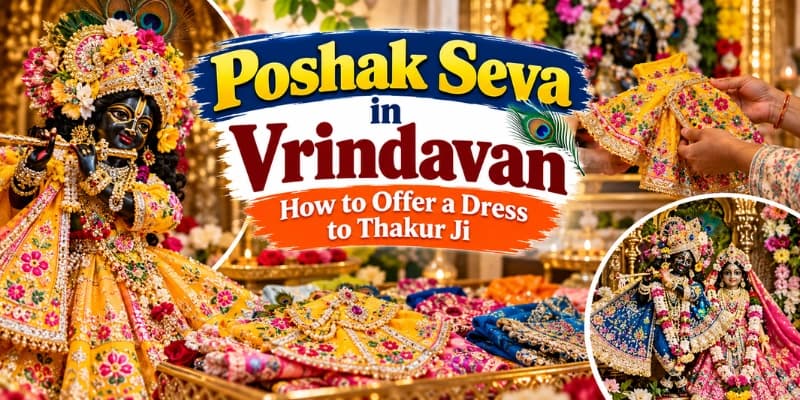
Poshak seva is the offering of fresh, handcrafted attire to the temple deity. In practice it is rarely just a length of cloth; a complete offering usually includes the poshak (the dress itself), the mukut (crown) and matching shringar, the jewellery and accessories that complete the Lord’s adornment. The garments are newly made for the occasion, chosen and tailored with care and offered so that Thakur Ji may be dressed in them for darshan on a chosen day.
What makes it a seva rather than a gift is the spirit behind it. In the Braj tradition the deity is not regarded as a stone idol but as a living presence who is bathed, dressed, fed, rested and entertained like a beloved member of the household. Offering a poshak is therefore an act of personal care, the same tenderness with which a mother dresses her child or a devotee adorns their beloved. For many families it becomes a cherished way to include the Lord in their own happy occasions, dressing him in the finest clothes to mark a birth, a wedding anniversary, a recovery or a prayer fulfilled.
The significance: dressing the Lord as a loved one
The heart of poshak seva lies in two devotional moods that define Braj worship. The first is Vatsalya Bhava, loving God as one’s own child; the second is Madhurya Bhava, the sweet, intimate love of the devotee for the beloved Lord. Both treat the deity as personal and present, which is precisely why clothing him matters so much here. To offer a poshak is to act out that relationship in the most ordinary, human way: by making sure your loved one is beautifully and comfortably dressed.
This is also why poshak seva is considered such a powerful expression of devotion. It asks for effort, planning and love rather than mere money; the devotee thinks about the colour, the season, the occasion and the fit, exactly as they would for a person they cherish. For the one offering it, the reward is not a transaction but a relationship deepened, a feeling that the Lord has accepted their care. Understood this way, poshak seva is less about the cloth and more about the bond it expresses, which is what gives the moment of darshan its extraordinary emotional weight.
Seasonal and colour codes of the poshak
Because Thakur Ji is treated as a living being, the poshak is matched to the season and the calendar and knowing this helps you offer thoughtfully. Through the hot summer the temples dress the deity in light pastels and airy cottons to keep him cool, while in winter the attire turns to rich velvets, silks and woollens for warmth. The same instinct runs through the whole year, so the clothing shifts with the weather just as a loved one’s wardrobe would.
Colour is chosen by the day and the festival too, following cherished conventions. By tradition, red is often offered on Ekadashi, pitambar (a yellow-orange) suits Janmashtami, green belongs to Hariyali Teej in the monsoon and white is offered on Purnima, the full moon. These are widely followed customs rather than rigid rules and individual temples and sampradayas have their own preferences, so it is always worth asking the temple or your seva arranger what colour and style suit the date you have chosen. Aligning your poshak with the season and the day is part of what makes the offering feel right and it is one of the details a knowledgeable local can guide you on.
How to offer a dress to Thakur Ji, step by step
Because major temples follow strict historical protocol (maryada), you cannot simply buy a dress off the shelf and hand it to the priests. The offering follows a defined process.
Express your intent and book. Contact the temple administration, the hereditary priests (sevayats) or a trusted, verified seva arranger well in advance to request a poshak seva.
Select a tithi (date). Book a specific shubh (auspicious) date, often a family milestone such as a birthday or anniversary or a major festival. At prominent temples such as banke bihari temple, demand is so high that slots can be booked months or even years ahead.
Arrange sizing and custom tailoring. Every deity has precise, unique measurements, so the poshak must be made to fit exactly. You either commission a specialised karigar (artisan) in Vrindavan or Mathura who knows the deity’s exact layout or have the temple trust arrange the authentic stitching for you. A full offering usually includes the poshak, the mukut and the matching shringar.
The ritual. On your assigned day, the priests perform the sacred bathing (snan) and adorn Thakur Ji in your offered dress behind closed curtains, away from public view.
Darshan and prasadi. When the curtain opens, you have darshan of Thakur Ji wearing your poshak. You are then given prasadi, which often includes a blessed portion of the offering or dry fruits and sweets.
Timings and auspicious dates depend on the temple and the calendar, so confirm the exact programme with the temple or your arranger rather than assuming.
What a complete offering includes and the karigar tradition
A poshak offering is rarely a single garment. A complete, traditional offering brings together the poshak itself, the mukut (crown) and the matching shringar, the ornaments, garlands, bands and accessories that finish the Lord’s adornment, so that the whole look is harmonious. Depending on the temple and the occasion, there can be further small pieces and the richness of the set is a matter of the devotee’s wish and means rather than a fixed requirement; a simple, lovingly made poshak is as welcome as an elaborate one.
Behind every good poshak stands a karigar, the specialist artisan who knows the exact measurements and the particular style of a given deity. This is skilled, traditional work: the proportions of each temple’s Thakur Ji are precise and unique and an experienced Vrindavan or Mathura karigar carries that knowledge, which is why you cannot simply adapt a ready-made outfit. Many families find that the real craft of poshak seva lies here, in commissioning the right artisan and choosing the fabric, colour and work and it is one of the main reasons the offering is best arranged with local knowledge rather than from a distance.
Where to offer it and darshan timings
Poshak seva is offered at many Vrindavan temples, each with its own protocol and style, including banke bihari temple, the historic radha raman temple, the iskcon temple (Krishna Balaram Mandir), prem mandir and the grand Sri Rangji (Rangnath) temple, among others. While the dress is laid out during the early-morning rituals, your darshan of the poshak happens during the temple’s normal opening hours.
The approximate general timings at some of these temples are below. Treat these as a rough guide only: temple hours shift between the summer and winter schedules, change on festivals and are revised from time to time, so always confirm the current day’s timings locally before you plan around them.
Temple | Summer morning (approx) | Winter evening (approx) |
Shree Radha Raman Temple | 05:00 AM to 12:30 PM | 06:00 PM to 09:00 PM |
ISKCON Krishna Balaram Mandir | 04:10 AM to 12:45 PM | 04:30 PM to 08:30 PM |
Prem Mandir | 07:30 AM to 12:00 PM | 04:30 PM to 08:00 PM |
Sri Rangji Mandir | 05:30 AM to 10:30 AM | 04:00 PM to 09:00 PM |
For the iconic Banke Bihari temple, morning darshan generally runs from about 07:45 AM to 12:00 PM in summer and about 08:45 AM to 01:00 PM in winter, though these too should be confirmed on the day. For a fuller, regularly used reference, see our mathura vrindavan temple timings guide.
Planning your Poshak Seva and letting a Brajwasi arrange it
Because the maryada is strict, the measurements exact and the good slots scarce, poshak seva rewards early, careful planning. Decide your tithi as far ahead as you can, especially for a festival or a high-demand temple; settle the temple and the style of poshak; allow time for the karigar to tailor the attire to the deity’s measurements; and confirm the ritual and darshan arrangements with the temple or your arranger. If you are travelling for it, build your trip around your assigned date and keep the surrounding days for darshan at the other temples; see places to visit in vrindavan and how to reach vrindavan to plan around it.
Let a Brajwasi arrange your poshak seva
This is a seva where local knowledge genuinely matters, knowing the right karigar for a given deity’s measurements, how each temple’s protocol works, which colour suits your date and how to secure a slot at a busy temple. As Brajwasis, we can arrange an authentic poshak seva end to end: commissioning a trusted artisan, coordinating the tithi and the ritual with the temple’s priests, and for devotees who cannot attend, sharing a clear darshan recording of Thakur Ji in your poshak and couriering your prasadi, including the blessed portion of the offering where the temple gives it. Whether you are coming in person or offering from afar, a shared Vrindavan darshan starts from around 1499 rupees per person; see our vrindavan tour package or we design a private poshak-seva arrangement. Message us on WhatsApp at +91-7302265809 with your date and wishes.
Related guides
Book Your Mathura - Vrindavan Trip Today
📞 +91-7302265809
💬 WhatsApp: +91-7302265809
We Reply in 30 Minutes
Packages start from ₹1,999/ person | Rated 4.5★ / 204+ Reviews
Explore all: Mathura Vrindavan Tour Packages
Jai Shri Krishna
Meet Gurudutt — Your Mathura Vrindavan Guide
Not just a tour operator — Gurudutt was born and raised in Braj Bhoomi. He has spent over a decade personally guiding pilgrims through the sacred lanes of Mathura & Vrindavan.
Founder – Experience My India
Gurudutt
Founder · Experience My India