Travel Guide · Krishna Leela & Spirtuality · Updated October 2026
Raas Leela in Vrindavan: Where and When to Watch a Live Performance
By Gurudutt, Experience My India·28 October 2026
Quick Answer
Quick Enquiry
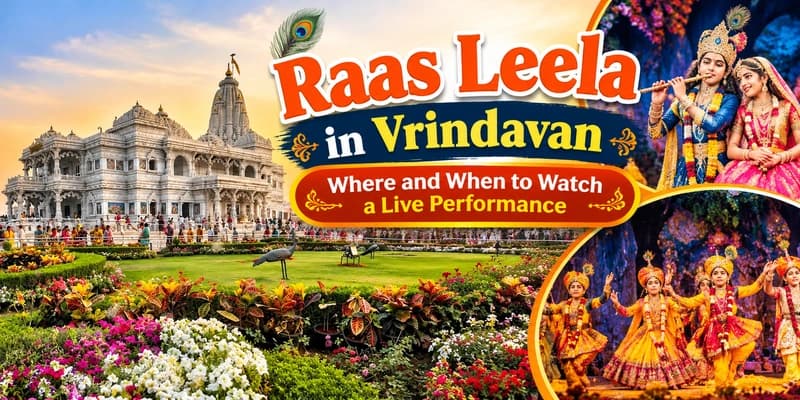
The Raas Leela is the very soul of Vrindavan, Krishna’s dance of divine love. We believe it happens unseen in these groves every night and the human re-enactments by our traditional troupes, often little children playing Radha and Krishna in old Braj dialect, are genuinely moving to watch. I guide guests to the right performance for them: the daily ashram enactment, the grand festival troupes or the Prem Mandir light show if they prefer something visual. And around Sharad Purnima, the whole town breathes the Raas. See our Mathura Vrindavan tour Packages or message WhatsApp +91 7302265809.
Where to watch live traditional performances
These human re-enactments by traditional troupes are the authentic heart of the Raas Leela experience. Entry is generally free.
Shree Hita Ashram
When. Daily, generally about 6:30 PM to 9:00 PM, year-round.
The experience. Managed by the Shri Radha Vallabh Rasleela Sansthan, this ashram offers one of the most consistent, authentic daily enactments, of the Daan Leela and Maha Raas, with local child actors trained in classical Braj dialect portraying the deities.
Entry. Free, first-come first-served.
Shri Hit Raas Mandal
When. Performances and spiritual discourses are organised frequently, especially in peak festival seasons like Sharad Purnima and the month of Kartik.
The experience. On Gandhi Marg, this historic Ras Mandal is tied to the Radhavallabhi saintly tradition; troupes here perform highly emotional scriptural plays with classical music, rich costuming and traditional Braj dialogue.
Swami Ramswaroop Sharma Raasleela Troupe
When. Varies by season; they routinely headline special festival stages at Vrindavan’s major temples during Janmashtami, Radhashtami and Holi.
The experience. For the pinnacle of the art form, look for the family lineage of Padma Shri Swami Ramswaroop Sharma, now led by his grandson Swami Ramvallabh Sharma, credited with raising traditional Raas Leela into a globally respected spiritual art.
Because troupe schedules and timings change with the season and festivals, confirm the current performance locally before planning your evening around a specific one.
Multimedia and mystical sites
Prem Mandir (the light-and-fountain show)
For a modern, highly visual depiction, prem mandir runs a famous musical-fountain and light show that projects and narrates scenes of the Raas Leela with water jets and devotional music, generally about 7:00 PM to 7:30 PM in winter and 7:30 PM to 8:00 PM in summer. The temple’s outer perimeter also has life-sized 3D diorama sculptures of the cosmic dance. Entry is free. Confirm the current show timing locally, as it shifts with the season.
Nidhivan grove (the mystical site)
You cannot watch a live night performance at nidhivan, because by tradition humans, birds and animals are cleared out before sunset: local folklore holds that Krishna and Radha descend to perform the actual cosmic Raas Leela here every midnight. Nidhivan is open only by day, generally about 5:00 AM to 12:00 PM and 4:00 PM to 7:00 PM, closing strictly at dusk. A daytime visit lets you see the unusual down-curved Tulsi trees (believed to be gopis in disguise) and the Rang Mahal, where, by tradition, a bed and offerings are set fresh each evening. For the rasa-lila theme, the nearby seva kunj carries the same tradition.
The scriptural story behind the Raas Leela
To understand why Vrindavan guards this dance so carefully, it helps to know the story it re-enacts. By tradition, the Maha Raas is the great circular dance that Krishna performed with the gopis of Braj on an autumn full-moon night and devotees point to the Rasa Panchadhyayi, the five chapters at the heart of the tenth canto of the Srimad Bhagavatam, as its source. In that account, Krishna is said to have expanded himself so that each gopi felt him dancing at her side, a picture understood in the tradition not as romance but as the soul’s longing for union with the divine. The night is linked above all to Sharad Purnima, the autumn full moon, which is why that date carries such weight here. The performances you watch in Vrindavan’s ashrams and Ras Mandals are devotional dramatisations of these pastimes, staged so that pilgrims can witness and meditate on them. Framed this way, as scripture and tradition rather than documented history, the Raas Leela is less a show than a form of worship and that is the spirit in which it is offered and received in the town.
The living art form and its lineages
Raas Leela is also a distinct performing art with deep roots in Braj. By tradition it was shaped in the sixteenth century by Swami Shri Hariram Vyas and the saint-poets of the region and it has been carried down through family lineages of performers ever since. The troupes you see today blend dance, classical music, devotional song and spoken drama in the old Braj dialect and the roles of Krishna, Radha and the gopis are usually taken by specially trained child actors, whose innocence is felt to suit the sacred parts. Costuming is rich, the crowns and jewellery elaborate and the staging unhurried, built around emotion rather than spectacle. Alongside the full Maha Raas, troupes perform episodes such as the Daan Leela and other pastimes, each a self-contained play. One celebrated lineage, that of Padma Shri Swami Ramswaroop Sharma, now led by his grandson, is credited with carrying the form to wider audiences while keeping its devotional core. Watching with this background in mind, you begin to read the gestures, the music and the dialect as a living inheritance, one that Vrindavan has protected and passed on for centuries and that still draws its performers from the families of Braj.
The best time to watch
The most magical windows for live Raas Leela are during Sharad Purnima, the autumn full-moon night dedicated to the Maha Raas and the month-long Kartik festival calendar that follows. During these, performances are at their most frequent, elaborate and atmospheric across the town’s ashrams and Ras Mandals. See our sharad purnima guide for that night. Janmashtami, Radhashtami and Holi also bring major festival performances by the leading troupes. Outside these, the daily ashram enactments run year-round, so you can see a Raas Leela any time, but the festival windows are the pinnacle. For the comfortable season overall, see best time to visit.
Essential tips for first-time visitors
Dress modestly. Modesty is strictly expected at all performance ashrams and temples. Men should wear full trousers or kurtas, women sarees or salwar suits; avoid shorts, short skirts and sleeveless tops.
Seating etiquette. Traditional performances use floor seating, with men and women typically in separate sections out of respect. Arrive 30 to 45 minutes early to secure a clear spot near the stage.
Beware the monkeys. In the older parts of Vrindavan, near Nidhivan and Shree Hita Ashram, keep spectacles, phones, bags and loose food hidden; the resident monkeys are notorious for aggressive snatching. (See our general Vrindavan tips in places to visit in vrindavan.)
Confirm timings. Performance and show timings change with the season and festivals, so check locally on the day.
Planning your Raas Leela evening
A Raas Leela evening works best planned around an early arrival and the right performance for you, the daily ashram enactment for authenticity, a festival troupe for grandeur or the Prem Mandir show for a visual spectacle, with a daytime Nidhivan visit added for the mystical side. Come in the cooler season if you can and aim for Sharad Purnima or Kartik for the fullest experience. For getting to town, see how to reach vrindavan.
Let a Brajwasi plan your Raas Leela night
Knowing which performance is on, where and getting you seated in good time (and your belongings safe from the monkeys) is exactly where a local helps. As Brajwasis, we plan your Raas Leela evening, find the right live performance for you, time the Prem Mandir show, add a daytime Nidhivan and Seva Kunj visit and guide the dress code and etiquette, so you simply enjoy the dance. A shared Vrindavan darshan starts from around 1499 rupees per person; see our vrindavan tour package or we design a private evening, especially around Sharad Purnima. Message us on WhatsApp at +91-7302265809 with your dates.
Related guides
Book Your Mathura - Vrindavan Trip Today
📞 +91-7302265809
💬 WhatsApp: +91-7302265809
We Reply in 30 Minutes
Packages start from ₹1,999/ person | Rated 4.5★ / 204+ Reviews
Explore all: Mathura Vrindavan Tour Packages
Jai Shri Krishna
Meet Gurudutt — Your Mathura Vrindavan Guide
Not just a tour operator — Gurudutt was born and raised in Braj Bhoomi. He has spent over a decade personally guiding pilgrims through the sacred lanes of Mathura & Vrindavan.
Founder – Experience My India
Gurudutt
Founder · Experience My India