Travel Guide · Travel Guides · Updated October 2026
Braj Raj: What It Is and Whether You Can Take It Home
By Gurudutt, Experience My India·19 October 2026
Quick Answer
Quick Enquiry
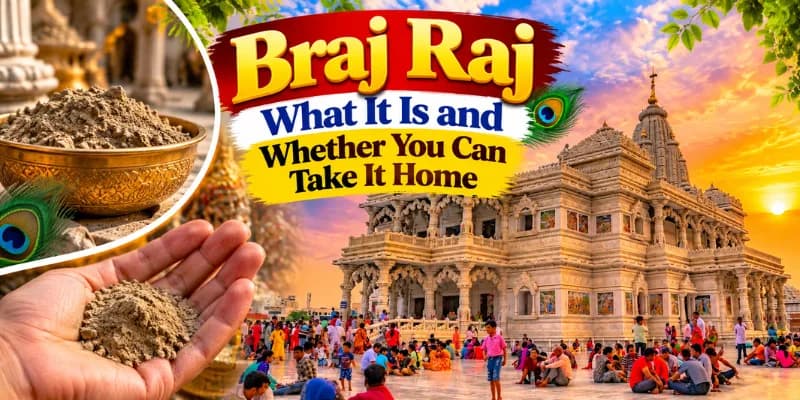
For us Brajwasis, the dust under our feet is not dust at all, it is Braj Raj, touched by the feet of Radha and Krishna and the saints roll in it and press it to their foreheads. People often ask me, “Can I take some home?” and I tell them the honest truth: there are two sincere traditions and I respect both. Many devotees lovingly carry a little home and worship it and that is beautiful. But our strict elders ask that we not dig and pack the soil away and simply receive what clings to us as a gift. Whichever you choose, the one thing that matters is reverence, never treat Braj Raj as a souvenir or a thing to be sold, but as something living and holy. See our Mathura Vrindavan tour Packages or message WhatsApp +91 7302265809.
What Braj Raj is
Braj Raj is the sacred dust or soil of Braj Bhoomi, the holy land around Mathura, Vrindavan, Govardhan and Radha Kund where, by tradition, Krishna and Radha performed their childhood pastimes (leelas). The word simply joins Braj, the region, with raj, meaning dust, so Braj Raj is literally “the dust of Braj”. It goes by several names, Vraj Raj and in everyday speech Vrindavan ki Mitti or Braj ki Mitti, but they all point to the same thing: the earth of this particular, deeply revered land.
What sets it apart in the eyes of devotees is not any physical quality but its origin. In the devotional understanding, this is the very ground the Lord and his companions walked, played and danced upon and which generations of saints have hallowed with their worship. So Braj Raj is received not as mineral soil but as something charged with the presence of the divine, closer in status to a sacred relic or to prasad than to ordinary earth. Understanding this is the key to everything else about it, how it is used, why some hesitate to remove it and why it is always handled with such care.
Why devotees revere it
To a visitor it may look like plain dust, so it helps to understand why devotees treat it as spiritually alive. The heart of it is the belief that Braj is not merely a historical place but an eternally sacred one, where the footprints of Radha, Krishna and the great saints have blessed the very soil. By this understanding the dust carries their touch, so contact with it is contact with their grace. This is why you will see sadhus and devotees reverently taking Braj Raj to their foreheads, rolling in it during parikrama or sprinkling it on themselves.
Because of this, Braj Raj is given the same reverence as prasad, a sanctified offering, rather than being regarded as dirt. The devotional literature of Braj is full of praise for the glory of its dust and many saints have declared the Raj of Braj to be more precious than any worldly treasure. For the devotee, then, revering Braj Raj is not superstition but an expression of love for the land of the Lord and faith in its sanctity. Whether or not one shares the belief, approaching it with that understanding is what respect for the tradition asks.
How devotees use Braj Raj
Among those who keep Braj Raj, it is used in a few cherished ways, always devotional rather than casual. The most common is to place it on the home altar (mandir) alongside the deities and other sacred items, so that a piece of the holy land is present in daily worship. Many devotees also apply it as a tilak on the forehead, sometimes mixing a little with water or rose water, as a mark of blessing and connection to Braj.
Beyond the altar, some keep a small amount in their living space or vehicle, in the belief that the presence of the sacred dust brings protection and blessings. In each case the spirit is the same: Braj Raj is treated as a living link to the dham, handled with clean hands and a reverent heart and never used carelessly or for show. These uses are matters of personal devotion and vary from family to family and tradition to tradition, so there is no single rulebook, only the shared principle that it is used with love and respect, as one would treat anything genuinely holy.
Can you take Braj Raj home? The two traditions
This is the question most pilgrims ask and the honest answer is that there are two sincere traditions, which this guide presents fairly so you can follow your own conscience and guru’s guidance.
The common pilgrim tradition (yes). This widespread view permits taking home small amounts of Braj Raj. Millions of devotees carry a little home for daily worship, keep it on the altar or use it as tilak and pre-packaged Braj Raj is also widely distributed. In this understanding, carrying the dust home spreads the blessing of Braj and keeps the devotee connected to the dham from afar.
The strict local Braj tradition (no). Some regional spiritual authorities advise against deliberately digging out and removing soil from Braj. They hold that countless unseen divine souls reside in the dust and that intentionally packing and taking it away disturbs the sacred ecosystem and may incur a spiritual fault (dosh). In this view the land is to be served and left undisturbed, not carried off.
The universal exception. Both traditions tend to accept one thing: the dust that naturally clings to your body, feet and clothes while you visit is a blessed gift you carry with you anyway, received rather than taken. Even the strict view usually honours this as pure and auspicious.
There is no single official ruling that binds every devotee, so the respectful course is to be aware of both views, follow the guidance of your own spiritual tradition or guru and in all cases act from reverence rather than as a collector of souvenirs. If in doubt, the universal exception, simply honouring the dust that comes with you, satisfies both traditions.
Rules of respect for keeping Braj Raj
Whichever view you follow, if you keep Braj Raj at home every tradition agrees it must be handled with reverence, because it is regarded as sacred and living. A few guidelines are widely shared.
Store it clean and elevated. Keep Braj Raj in a clean container in a raised, respectful place, ideally on or near the home altar, not on the floor or anywhere low.
Never let it be stepped over. It should never be placed where people might walk over or past it carelessly or where it could be treated like ordinary dirt.
Keep it separate from ordinary items. Store it apart from everyday things, handled with clean hands and a devotional attitude, as you would treat prasad or any sacred object.
Do not trade it casually or treat it as a souvenir. It is received and kept as something holy, not a trinket to show off or deal in.
Return it to Braj if you can no longer care for it. If a time comes when you cannot keep it respectfully, the traditional guidance is to return it to the land of Braj rather than discard it.
Following these simple rules keeps the devotion intact and honours the sanctity that gives Braj Raj its meaning in the first place.
Where Braj Raj comes from
Braj Raj is the dust of the whole Braj Bhoomi, but certain places within it are especially associated with its sanctity and devotees often feel the pull of the dust most strongly there. Vrindavan itself, where Krishna is believed to have spent much of his childhood and nearby Mathura, his birthplace, are the heart of it. govardhan hill, which Krishna is said to have lifted, is so sacred that pilgrims revere its very stones and dust and the area around radha kund is among the most hallowed ground in all of Braj.
For many devotees, walking the parikrama routes barefoot is itself the truest way to be touched by Braj Raj, letting the dust of the dham meet the feet with every step. If you are drawn to experience this, see the vrindavan parikrama route and our guide to the places to visit in vrindavan. Wherever in Braj you are, the tradition holds that the ground beneath you is the same blessed Raj, so the question is less where to find it than how reverently to receive it.
A respectful note and how a Brajwasi can help
Braj Raj is one of those subjects where the right guidance is not a sales pitch but a little honesty and reverence and that is how we treat it. As Brajwasis, when we host devotees we are glad to take them to the most sacred spots, Govardhan, Radha Kund, the parikrama paths, where the glory of Braj Raj is most deeply felt, to explain both traditions so you can decide for yourself with awareness and to help you receive and handle the dust respectfully if you choose to keep any. We do not treat sacred soil as a product to be sold and we gently encourage the reverent, undisturbed spirit the land deserves.
If you would like to experience Braj in this deeper way, a shared Vrindavan darshan starts from around 1499 rupees per person; see our vrindavan tour package or we design a private, unhurried pilgrimage. For planning the visit, see best time to visit and how to reach vrindavan. Message us on WhatsApp at +91-7302265809 and above all, come to Braj with an open, reverent heart; that, more than any handful of dust, is how its blessing is truly received.
Related guides
Book Your Mathura - Vrindavan Trip Today
📞 +91-7302265809
💬 WhatsApp: +91-7302265809
We Reply in 30 Minutes
Packages start from ₹1,999/ person | Rated 4.5★ / 204+ Reviews
Explore all: Mathura Vrindavan Tour Packages
Jai Shri Krishna
Meet Gurudutt — Your Mathura Vrindavan Guide
Not just a tour operator — Gurudutt was born and raised in Braj Bhoomi. He has spent over a decade personally guiding pilgrims through the sacred lanes of Mathura & Vrindavan.

Founder – Experience My India
Gurudutt
Founder · Experience My India