Travel Guide · Food & Culture · Updated October 2026
Chhappan Bhog in Vrindavan: How to Sponsor 56 Bhog, with the Full List
By Gurudutt, Experience My India·17 October 2026
Quick Answer
Quick Enquiry
Chhappan Bhog is Braj abundance at its most beautiful, fifty-six dishes laid before Thakur ji in pure ghee, each crowned with a Tulsi leaf. I love explaining to devotees that the number is not random; it is a loving arithmetic of eight meals Krishna missed over seven days under Govardhan, repaid by his people. When families sponsor it, I always tell them the feast is not for us; it is first offered to the Lord and only then does it become prasad that blesses everyone. If you want to sponsor one, do it through the temple or someone local you can trust and give it a little time to arrange properly. See our Mathura Vrindavan tour Packages or message WhatsApp +91 7302265809.
What Chhappan Bhog is and the Govardhan Leela behind it
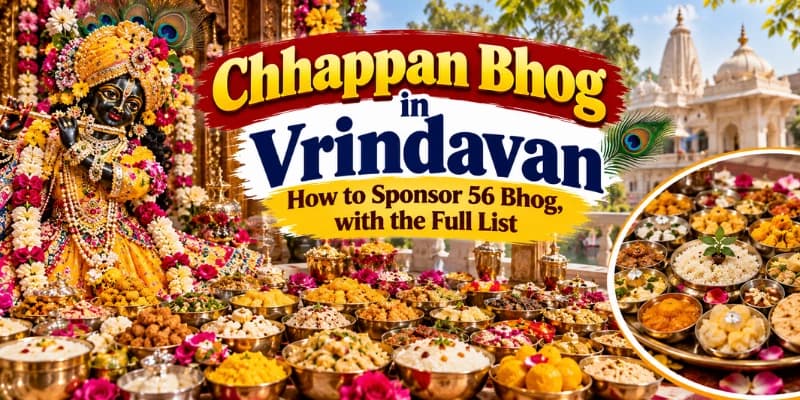
Chhappan Bhog means the offering of fifty-six food items to the deity in a single grand spread. It is one of the most elaborate and joyful forms of bhog (food offering) in the Vaishnava tradition and it is especially at home in Braj, the land of Krishna’s own pastimes. Rather than a single dish, it is a complete, balanced feast, sweets, savouries, grains, dairy, fruits and sacred items, arranged in a traditional order and offered all together.
The number 56 comes from the beloved Govardhan Leela. By tradition, when Indra sent torrential rains to punish the people of Braj, the young Krishna lifted Govardhan Hill on his little finger and held it aloft for seven days to shelter them and through all that time he did not eat. His usual routine was eight meals a day, so for seven days he missed fifty-six meals in all (eight times seven). When the danger passed, the grateful residents of Braj, especially the mothers and gopis who could not bear that their beloved had gone hungry, lovingly prepared fifty-six dishes to make up for every missed meal. That tender story is why the offering carries the number it does and why it is so closely tied to Govardhan worship. For the hill at the heart of the story, see govardhan hill.
Why it is sattvic and the rules of the offering
Chhappan Bhog is not only large, it is prepared according to strict devotional rules and understanding them shows why it is a seva rather than merely cooking. Every item is sattvic, meaning it is pure vegetarian food made without onion or garlic and it is traditionally cooked in pure desi ghee. The food is prepared with cleanliness and devotion, intended first and only for the Lord; in the tradition it becomes prasad, blessed food, only after it has been offered to him.
The crowning rule is the Tulsi leaf. A leaf of the sacred Tulsi (holy basil) is placed on every single dish and by tradition the offering is considered spiritually complete only when each item carries one. This single detail captures the spirit of the whole seva: the feast is vast and beautiful, but it is the Tulsi, offered with love, that makes it acceptable to Krishna. The items themselves can vary a little from temple to temple and from one family tradition to another, so the list that follows is the classic, widely offered spread rather than a rigid fixed menu.
The full Chhappan Bhog list
A traditional Chhappan Bhog is organised into categories so that sweet, savoury and sacred flavours sit in balance. The exact items vary by temple and tradition, but a classic spread looks like this.
1. Sweets and confectioneries (around 18 to 20 items)
Sweets form the largest share of the thali, representing love and abundance.
Makhan Mishri (fresh white butter with rock sugar), the absolute essential
Kheer (creamy rice and milk pudding)
Rabri (condensed, layered milk sweet)
Jalebi (crisp spirals soaked in syrup)
Rasgulla (spongy chhena balls in syrup)
Peda (milk-solids sweet, synonymous with Mathura and Vrindavan)
Malpua (sweet pancakes fried in ghee and soaked in syrup)
Ghevar (disc-shaped honeycomb festival sweet)
Laddoo (such as besan or boondi laddoo)
Mohanbhog (rich semolina-based sweet)
Moong Dal Ka Halwa (rich lentil pudding)
Shakkarpaara (crisp, diamond-shaped sweet snacks)
Murabba (sweet fruit preserves)
with Sandesh, Imarti, Balushahi, Kalakand, Mysore Pak and Soan Papdi completing the selection
2. Savouries and fried snacks (around 12 to 16 items)
Fried items are placed after the milk products in the traditional layout.
Poori (deep-fried puffed flatbread)
Kachori (stuffed crisp fried bread, often with dal or spiced potato)
Pakora (crisp vegetable fritters)
Mathri or Mathi (flaky savoury crackers)
Papad (thin, crisp lentil wafers)
Chila (savoury lentil pancakes)
with Samosa, Bhajia, Gathiya, Sev, Nimki and other namkeens
3. Grains, rice and main meals
Chawal (plain steamed white rice)
Khichdi (a comforting blend of rice and lentils)
Dal (spiced lentil stew)
Kadhi (a tangy yogurt and gram-flour gravy)
Dalia (broken-wheat porridge)
Saag or assorted green vegetable preparations
4. Dairy and refreshments
Dahi (fresh plain yogurt)
Malai (thick clotted cream)
Butter (fresh unsalted white butter)
Mattha or Chaas (spiced buttermilk)
Lassi (sweet, thick yogurt drink)
Doodh (warm sweetened cardamom or saffron milk)
5. Fruits, dry fruits and accompaniments
Fresh fruits, typically about seven varieties such as banana, apple and pomegranate
Dry fruits, typically about seven varieties such as almond, cashew, raisin and pistachio
Chutney and pickles, tangy and spicy condiments to complement the savouries
6. Sacred offerings and digestifs
Panchamrit (the holy mixture of milk, curd, honey, ghee and sugar)
Ghee and honey, offered raw and pure
Mishri and Elaichi (rock sugar and green cardamom), offered at the very end as a digestif
Tulsi leaf, the most crucial element, placed on every single dish so the offering is complete
How to sponsor a Chhappan Bhog seva
Sponsoring a Chhappan Bhog means funding and dedicating the offering, which is then prepared, offered to the deity and shared as prasad. The practical process is straightforward and you should always go through an official or verified channel.
Choose your temple and channel. Decide where you wish to sponsor the seva. Some large, organised temples such as the iskcon temple in Vrindavan let devotees sponsor Chhappan Bhog through their official seva office or portal, in person or online; other temples arrange it through their trust or hereditary priests. Use the temple’s own verified channel or a trusted, accountable local arranger.
Pick sole or co-sponsorship. You can usually either be the sole sponsor of an entire single-day offering or join as a co-sponsor alongside other families and share the seva and its cost. Both are valid; choose what suits your means and wish.
Select a date and occasion. Many families sponsor on a festival such as Govardhan Puja (Annakut) or Janmashtami or on a personal milestone like a birthday or anniversary. Popular dates at prominent temples fill up, so book ahead.
Provide your Sankalp details. As with other sevas, you give your name, family details and often your Gotra and your specific prayer, so the offering is dedicated to you.
Confirm and pay through the official channel. Settle the arrangements and pay through the temple’s or arranger’s secure, documented channel and keep the confirmation.
Fees, inclusions and the exact number and choice of items vary by temple and by whether you sponsor alone or jointly, so confirm the details with the temple or your arranger rather than assuming a fixed figure.
When Chhappan Bhog is offered
While a Chhappan Bhog can be sponsored on many occasions, it is most strongly associated with a few. The grandest is Govardhan Puja, also called Annakut, the day after Diwali, when temples across Braj pile up mountains of food before the deity in direct memory of the Govardhan Leela and Chhappan Bhog is central to the celebration. Janmashtami, Krishna’s appearance day, is another great occasion for the 56 Bhog, as are other major Krishna festivals through the year.
Beyond the festivals, families sponsor Chhappan Bhog on personal occasions too, a birth, a wedding anniversary, a prayer fulfilled or in loving memory of someone, choosing an auspicious date for the offering. If you hope to witness or sponsor it on a specific festival, plan well ahead, because these are the busiest and most sought-after days at the temples. Festival dates follow the Hindu lunar calendar, so confirm the exact day nearer the time. For the wider season of when to visit Braj, see best time to visit.
The darshan, the prasad and what to expect
The heart of sponsoring a Chhappan Bhog is that the feast is first offered to the Lord and only then becomes prasad. On the day, the 56 items are arranged in the traditional order before the deity, each crowned with its Tulsi leaf and offered during the ritual, often behind the curtain, before the darshan opens to devotees. Witnessing the full spread laid before Thakur Ji and the aarti that accompanies it, is a deeply joyful sight, abundance offered purely as love.
Afterwards, the offering is distributed as prasad. As a sponsor you receive prasad from the offering you funded and in many temples the Chhappan Bhog prasad is then shared widely among devotees and visitors, which is part of its spirit of abundance and seva to all. If you cannot attend in person, a trustworthy arranger can share a recording of the offering and darshan and courier a portion of the dry prasad to you. Exactly what a sponsor receives varies by temple, so confirm the arrangements when you book and remember that the real fruit of the seva is the offering itself, not the quantity of prasad returned.
Planning your Chhappan Bhog and letting a Brajwasi arrange it
Because the offering is large, the preparation strict and the best dates in demand, a Chhappan Bhog rewards planning. Decide early whether you want to be a sole or co-sponsor and on which date, settle the temple and allow time to arrange the seva properly, especially around Govardhan Puja and Janmashtami. If you are travelling for it, build your trip around your chosen day and keep the surrounding days for darshan across the town; see places to visit in vrindavan and how to reach vrindavan to plan around it.
Let a Brajwasi arrange your 56 Bhog
Sponsoring a Chhappan Bhog from a distance or even arranging one well on a busy festival day, is far easier with a local, accountable hand. As Brajwasis, we can arrange an authentic Chhappan Bhog seva with a genuine temple, help you choose sole or co-sponsorship and the right date, coordinate the Sankalp and the offering with the priests, and for devotees who cannot attend, share a clear recording of the offering and darshan and courier a portion of the prasad to your home, all transparently and without pressure. If you are visiting in person, a shared Vrindavan darshan starts from around 1499 rupees per person; see our vrindavan tour package or we design a private seva day. Message us on WhatsApp at +91-7302265809 with your date and wishes.
Related guides
Book Your Mathura - Vrindavan Trip Today
📞 +91-7302265809
💬 WhatsApp: +91-7302265809
We Reply in 30 Minutes
Packages start from ₹1,999/ person | Rated 4.5★ / 204+ Reviews
Explore all: Mathura Vrindavan Tour Packages
Jai Shri Krishna
Meet Gurudutt — Your Mathura Vrindavan Guide
Not just a tour operator — Gurudutt was born and raised in Braj Bhoomi. He has spent over a decade personally guiding pilgrims through the sacred lanes of Mathura & Vrindavan.
Founder – Experience My India
Gurudutt
Founder · Experience My India