Travel Guide · Travel Guides · Updated October 2026
Radha Krishna Story: Their Divine Love, Separation and Meaning
By Gurudutt, Experience My India·2 October 2026
Quick Answer
Quick Enquiry
Key points at a glance
Detail | In brief |
Who | Krishna of Nandgaon and Vrindavan; Radha of Barsana, daughter of Vrishabhanu and Kirti |
Where | Braj: Barsana, Nandgaon, Vrindavan, the groves and the Yamuna |
Their love | Divine and selfless, the soul's love for God; never worldly or sensual |
The height | The Raas Leela, the divine dance, on the full-moon night |
The parting | Krishna left for Mathura on his mission; they never married on earth |
The meaning | Radha is Krishna's hladini shakti; one soul in two forms, eternally united |
Named in | Bhagavata as the foremost gopi; by name in the Brahma Vaivarta, Padma Purana, Garga Samhita, and Gita Govinda |
The Radha Krishna story: the short version
The Radha Krishna story is, on its surface, the love of two people of Braj: Krishna, the enchanting cowherd of Nandgaon and Vrindavan, and Radha, the daughter of Vrishabhanu of Barsana. They met as children of neighbouring towns, loved amid the groves and the Yamuna, and their love rose to its height in the Raas Leela, the divine dance of the moonlit night. Then Krishna left Braj for Mathura, to fulfil his mission, and they were parted; they never married in the worldly way. Yet the deeper story is that their love was never worldly at all. It is the love of the soul for God, and Radha and Krishna are held to be one soul in two forms. For the land where it all unfolded, see our mathura vrindavan tour.
A note on sources: this telling draws on the Bhagavata Purana for the life and pastimes of Krishna, and on the later scriptures and poems in which Radha is named and sung, chiefly the Brahma Vaivarta Purana, the Padma Purana, the Garga Samhita, and the Gita Govinda of Jayadeva (twelfth century), together with the living devotion of Braj. We present the whole as the cherished belief and tradition, held with faith and recounted with reverence.
From the ground (Gurudutt): I was born in this land, and I have watched pilgrims weep at Barsana and fall silent at Nidhivan without quite knowing why. The Radha Krishna story is not a romance in the way the word is used today. It is about longing, the kind that turns the heart toward God and will not let go. When you walk Braj and hear Radhe Radhe called from every doorway, you begin to feel it: that her name is placed before his out of love, that the separation the poets sing of is really our own soul calling for the divine. I have tried to tell the story the way my elders told it to me, tenderly and with reverence, and to keep the facts honest, including what the scriptures do and do not say.
Who are Radha and Krishna
Krishna, by the tradition, is the Supreme Lord descended to earth in the age of Dvapara, born in Mathura and raised among the cowherds of Gokul and Vrindavan, the enchanter whose flute drew every heart. Radha is his dearest beloved, the foremost of the gopis, the cowherd maidens of Braj, and far more than that: the tradition understands her as Krishna's own hladini shakti, the power of his divine bliss and love made personal. So she is not separate from him but is his very heart, the joy of God turned toward God.
This is the key to the whole story. Because Radha is the Lord's own power of love, their bond is not two strangers meeting but the one Divine loving itself in two forms. So when devotees worship Radha and Krishna together, they worship God and the love of God as one. So the story of their love is, at its root, a story about the nature of the Divine. We present this with the reverence of the tradition, held with faith and recounted with reverence.
Radha of Barsana: birth and childhood
By the tradition, Radha was the daughter of Vrishabhanu and his wife Kirti, and she grew up in Barsana, the hill town of Braj lovingly called the town of Radha; many accounts name the village of Rawal, near Gokul, as her birthplace, with Barsana as the home of her childhood. To this day Barsana is her town above all others, crowned by the Radha Rani temple on the hill, and the land around it keeps her memory in every festival and song, most famously the Lathmar Holi. Our barsana guide covers her town, and the radha rani temple barsana guide covers the great temple on the hill.
So Radha belongs to Barsana, and Barsana to Radha. So her childhood home is a place of pilgrimage in its own right. We present this as the cherished belief and tradition, held with faith and recounted with reverence.
How they first met: the legends of Braj
The tradition keeps more than one tender legend of their first meeting, and the people of Braj love them all. In the most common, Krishna of Nandgaon and Radha of Barsana, neighbouring towns, met as children amid the pastures and groves, often at the village of Sanket, whose very name means the meeting place. In another beloved telling, when the infant Krishna lay in his cradle he would not open his eyes until the little Radha was brought before him, as though he had come into the world only to behold her, and only her gaze could make him smile.
These are not competing claims so much as different windows onto the same truth the tradition wishes to express: that Radha and Krishna belong to each other from the very beginning, that their meeting was not chance but the reunion of two who were always one. So the legends of their first meeting all point to a love older than the world. We present them as the cherished legends of Braj, held with faith and recounted with reverence.
Their love in Vrindavan: the Raas Leela
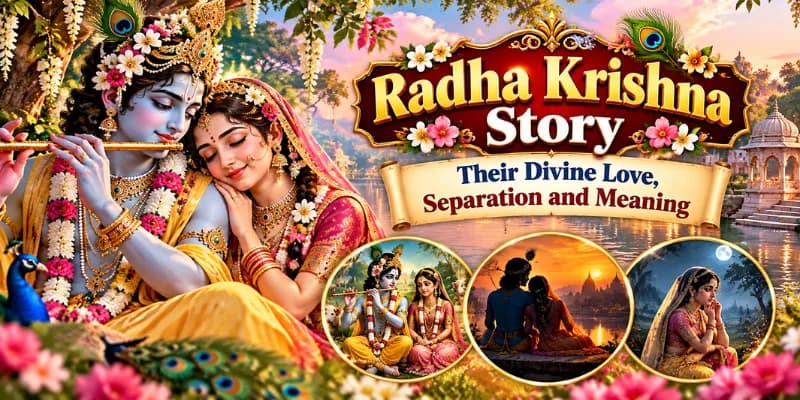
The heart of the Radha Krishna story is their love in Vrindavan: the days among the groves, the banks of the Yamuna, the sound of the flute calling across the pastures. The tradition sings of this love as leela, the divine play of God, pure and full of joy and utterly free of anything worldly. Its height is the Raas Leela, the great circular dance of Krishna with the gopis on the full-moon night of autumn, in which Radha is the dearest and the centre; the tradition holds that Krishna multiplied himself so that each devotee felt him wholly present, an image of God giving himself completely to every soul that loves him. The groves of nidhivan vrindavan and seva kunj are revered to this day as the places of this divine dance.
A devotional line of Braj, sung at every turn, holds their names together:
राधे कृष्ण राधे कृष्ण, कृष्ण कृष्ण राधे राधे
Radhe Krishna, Radhe Krishna; Krishna Krishna, Radhe Radhe
the beloved chant of Braj, placing Radha's name beside the Lord's
So the Raas Leela is the summit of their love, and it is a picture of the Divine loved by, and loving, every soul. So its groves remain holy ground. We present this account with the reverence of the tradition, held with faith and recounted with reverence.
The separation: when Krishna left for Mathura
The turning of the story comes when Krishna leaves Braj. Summoned to Mathura to free the people from the tyrant Kamsa, Krishna departs Vrindavan as a youth, and by the tradition he never returns to live in Braj; his later life unfolds in Mathura and then in distant Dwarka. So Radha and Krishna are parted in the worldly sense. The poets of the tradition dwell on this parting with great tenderness, on Radha's longing for the absent Lord, a longing called viraha. For the gokul mandir and the wider land of his childhood, our Braj guides cover the sites.
Far from treating this separation as merely sad, the tradition treasures it as sacred. Radha's longing for the absent Krishna becomes the very image of the soul yearning for God, a love so complete that distance only deepens it; many saints have held that viraha, love in separation, is the highest and most refined form of love, purer even than union, because it asks for nothing and gives everything. So the parting is not the failure of their love but its deepening. So viraha became a teaching for every seeking soul. We present this with the reverence of the tradition, held with faith and recounted with reverence.
Uddhav and the lesson of love
There is a beloved episode that follows the separation. Krishna, now in Mathura, sends his wise friend and messenger Uddhav to Vrindavan to console the grieving gopis and Radha, carrying a message of philosophy, of the formless and the eternal, meant to ease their sorrow by teaching detachment. But when Uddhav, learned as he was, sees the depth of the gopis' love and of Radha's longing, it is he who is humbled and transformed. He learns that their love, which knows nothing of philosophy, is higher than all his knowledge, and he prays to be born even as a blade of grass in Vrindavan, so that the dust of such devotees might touch him.
So the Uddhav episode turns the usual order upside down: the knower comes to teach and stays to learn. So the tradition holds the love of Radha and the gopis above even the highest wisdom. We present this as the cherished belief and tradition, held with faith and recounted with reverence.
Why they did not marry: the deeper meaning
People often ask why, if their love was so great, Radha and Krishna did not marry. In the worldly sense they did not; Krishna's earthly life led him to Mathura and Dwarka, where he married Rukmini and the other queens. But the tradition does not read this as a love that failed. Rather, it holds that the love of Radha and Krishna is beyond the bonds of worldly marriage altogether, a union of the soul with God that no earthly form could contain or improve. Indeed several traditions, such as the Nimbarka and the Radha Vallabh, worship them as the eternal divine couple, forever united in the spiritual realm of Goloka; the radha vallabh temple of Vrindavan is devoted to Radha's beloved, and radha raman temple keeps their worship together.
So their not marrying on earth is, by the tradition, not a lack but a sign: that their love is of a higher order than the world can hold, selfless and complete in itself. So they are worshipped as eternally one, whatever the worldly story. We present this reflection with the reverence of the tradition, held with faith and recounted with reverence.
Radha Krishna as the love avatar
Here is the deepest meaning the tradition gives to the whole story, and the sense in which people speak of Radha Krishna as the love avatar. Krishna is God, the Supreme; Radha is his hladini shakti, the power of his own divine bliss and love. The tradition teaches that the one Divine became two, Radha and Krishna, so that the Lord might taste and give the sweetness of love, which cannot be known while one remains alone. So the love avatar means the single God appearing as a loving pair, the lover and the beloved, out of the sheer joy of love itself.
The Gaudiya Vaishnava tradition, following Chaitanya Mahaprabhu in the sixteenth century, adds a further turn: that the Lord appeared again as Chaitanya himself, taking the inner mood and the golden radiance of Radha, in order to taste his own sweetness from her side and to teach the world how to love God through the holy name. So in this understanding the love avatar is not one figure but the eternal dance of the divine lover and beloved, appearing again and again to show the way of love. So Radha and Krishna are two forms of a single divine love. We present this as the cherished belief and tradition, held with faith and recounted with reverence.
Where to feel the story in Braj today
The Radha Krishna story is not only read; in Braj it is walked. In Barsana, Radha's own town, the Radha Rani temple crowns the hill, and nearby prem sarovar is remembered as a lake born of their love. In Vrindavan, the groves of Nidhivan and Seva Kunj are held as the places of the Raas Leela, while prem mandir tells their story in carved marble and evening light. Our places to visit in vrindavan guide maps the sacred sites in a sensible order.
So all of Braj is a living retelling of their love, from Barsana to Vrindavan. So a pilgrimage there brings the story to life. To walk this land with someone who knows its stories, we arrange Mathura, Vrindavan and Barsana darshan with a knowledgeable local guide; a shared day tour starts from around ₹1,499 per person, with darshan free, and our one-day vrindavan mathura tour and two-day mathura vrindavan tour help you plan. Message me on WhatsApp at +91-7302265809 to plan your pilgrimage.
Related guides
Meet Gurudutt — Your Mathura Vrindavan Guide
Not just a tour operator — Gurudutt was born and raised in Braj Bhoomi. He has spent over a decade personally guiding pilgrims through the sacred lanes of Mathura & Vrindavan.
Founder – Experience My India
Gurudutt
Founder · Experience My India