Travel Guide · Travel Guides · Updated July 2026
Mathura, Uttar Pradesh: The Birthplace of Krishna, Its Location, History and Layout
By Gurudutt, Experience My India·29 July 2026
Quick Answer
Quick Enquiry
Key facts at a glance
What it is | An ancient sacred city in Mathura district, Uttar Pradesh, on the Yamuna |
Where | About 50 km from Agra, 145 km from Delhi and 13 km from Vrindavan |
PIN code | 281001, in Mathura district, Uttar Pradesh |
Why sacred | The birthplace of Krishna and one of the seven Sapta Puri cities |
The region | The heart of Braj, or Braj Bhoomi, twin city of Vrindavan |
Nickname | Krishnanagri, the city of Lord Krishna |
What and where is Mathura?
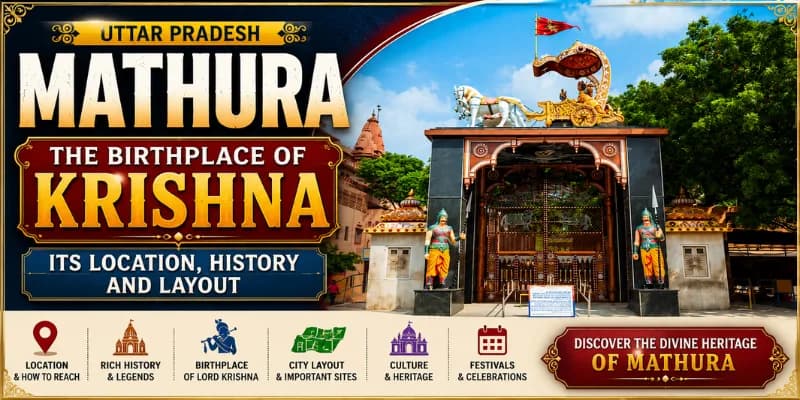
Mathura is one of the most ancient and most sacred cities in India, revered above all as the birthplace of Krishna, who by tradition was born here in a prison to Devaki and Vasudeva and went on to slay the tyrant Kansa. It is a historic city in Uttar Pradesh, the headquarters of Mathura district, set on the west bank of the Yamuna in the Braj region, about 50 km north of Agra, some 145 km south-east of Delhi and only about 13 km from its twin city, Vrindavan. Its PIN code is 281001.
So when people ask where Mathura is, or in which state, the answer is that it is a city in Mathura district, Uttar Pradesh, the sacred heart of the Braj land of Krishna, on the Yamuna. One of the seven holiest cities of Hinduism, a city of great antiquity, temples and ghats and part of the Mathura-Vrindavan Municipal Corporation, it draws millions of pilgrims a year, above all at Janmashtami, Krishna's birth. This guide explains the city, its name, its history, its layout, its temples and its living present in full.
From the ground (Gurudutt): Mathura and Vrindavan are twin cities, 13 km apart and almost always visited together, but they have distinct characters: Mathura is the older, larger, more workaday city, the birthplace, with its Janmabhoomi, its ghats and its bustling bazaars, while Vrindavan is the town of temples and Krishna's childhood. Understanding the two as a pair, each with its own role in Krishna's story, is the key to a Braj visit. See our Mathura Vrindavan tour or message WhatsApp +91 7302265809.
Mathura city: key facts at a glance
Here are the essential facts about Mathura city in one place.
Detail | Information |
City | Mathura, nicknamed Krishnanagri, the city of Krishna |
State | Uttar Pradesh |
District | Mathura (district headquarters), Agra division |
Region | Braj, or Braj Bhoomi |
River | On the west bank of the Yamuna |
Distance from Agra | About 50 km |
Distance from Delhi | About 145 km |
Distance from Vrindavan | About 13 km |
PIN code | 281001 |
Governing body | Mathura-Vrindavan Municipal Corporation |
Population | About 441,000 in the city (2011 census) |
Languages | Hindi, with Urdu and Braj Bhasha |
STD code | 0565; vehicle registration UP-85 |
Known as | The birthplace of Krishna, one of the Sapta Puri |
In one line: Mathura is an ancient sacred city in Mathura district, Uttar Pradesh, on the Yamuna about 50 km from Agra and 13 km from Vrindavan, revered as the birthplace of Krishna and one of the seven holiest cities of Hinduism.
The name Mathura: from Madhuvan
The name Mathura is very old. By tradition, drawn from the Ramayana, the area was once a thickly wooded land called Madhuvan, the forest of Madhu, after a demon named Madhu, whose son Lavanasura was slain here by Shatrughna, brother of Rama, who claimed the land. From Madhuvan the name is said to have become Madhupura and then, in time, Mathura.
So the name carries the memory of an ancient forest and the deep antiquity of the place, reaching back beyond even the age of Krishna in tradition. It is a reminder that Mathura is not only Krishna's birthplace but one of the truly ancient cities of India, its name older than almost any other in the land. We share these traditional origins as they are held.
Why Mathura is sacred
Mathura's supreme sanctity is as the birthplace of Krishna. By tradition, told in the Bhagavata Purana, Krishna was born here at midnight in the prison of the tyrant Kansa, his uncle, who had imprisoned his parents Devaki and Vasudeva and meant to kill the child; the baby was carried across the Yamuna to safety at Gokul and Krishna later returned to Mathura to slay Kansa and free the people. The very spot of his birth is revered as the Shri Krishna Janmabhoomi.
Beyond this, Mathura is held in Hindu tradition to be one of the Sapta Puri, the seven most sacred cities, alongside Ayodhya, Haridwar, Kashi, Kanchipuram, Ujjain and Dwarka, cities revered as granting liberation to those who are devoted there. As the heart of Braj Bhoomi, the land of Krishna's life and the start of the sacred Braj pilgrimage, Mathura holds a place among the holiest cities in India. We share these beliefs as the devotional tradition they are, held with reverence by millions.
A short history of Mathura
Mathura is one of the oldest continuously inhabited cities in India, with a history reaching back well over three thousand years, settled by around 1100 BCE and mentioned in the Ramayana. By the sixth century BCE it was the capital of the Surasena kingdom and it was later ruled by the Maurya empire; the Greek ambassador Megasthenes, around the third century BCE, described it as a great city under the name Methora.
Mathura's golden age came under the Kushan dynasty, around the first to third centuries CE, when it became a great capital and a renowned centre of art. The famous Mathura school of art produced its distinctive reddish sandstone sculpture, including some of the earliest depictions of the Buddha in human form and Mathura was a flourishing centre of Hindu, Buddhist and Jain culture alike, as the Buddhist remains and the Jain art of Kankali Tila attest.
In later centuries, its wealth and its temples made it a target: the city was sacked and its temples destroyed by Mahmud of Ghazni in 1018, again by Sikandar Lodi around 1500 and its great Keshav Dev temple at Krishna's birthplace was demolished under the Mughal emperor Aurangzeb, who built the Shahi Idgah mosque on the site in the seventeenth century. Through conquest, destruction and rebuilding, Mathura's identity as Krishna's birthplace has endured unbroken. We attribute the ancient tradition to belief and this later history to record.
The Krishna Janmabhoomi
At the heart of Mathura stands the Shri Krishna Janmabhoomi, the Janmasthan, revered as the exact site of Krishna's birth, at Katra Keshav Dev. The temple complex here, including the Keshav Dev temple, the Garbha Griha shrine marking the prison cell of his birth and the Bhagavata Bhavan, is the most important pilgrimage site in Mathura and one of the holiest in the Krishna tradition, thronged above all at Janmashtami.
Adjacent to the temple stands the Shahi Idgah mosque, built in the seventeenth century during Aurangzeb's reign and the site is the subject of a long-standing dispute, with Hindu tradition holding that the mosque stands over the demolished temple at Krishna's birthplace. It is an ongoing legal and religious matter. We report the situation factually and neutrally, as a matter of belief and of ongoing dispute, without adjudicating it and note that the Janmasthan remains among the most revered and most visited sites in all of Braj.
Understanding the layout: a Mathura city map in words
Mathura can feel like a dense, busy city to a first-time visitor, so a simple mental map helps. Picture the Yamuna running along the eastern edge, lined with the city's twenty-five ghats, chief among them Vishram Ghat, the sacred and lively heart of the riverfront. The old city, a knot of narrow bazaar lanes, spreads back from the ghats and holds the Dwarkadhish temple, the markets around Holi Gate and Chowk Bazaar and the descent to the river.
A little to the west, set slightly apart, is the Shri Krishna Janmabhoomi complex at Katra Keshav Dev, the city's spiritual centre. The Mathura Junction and Mathura Cantt railway stations lie to the south and south-west, with the cantonment area nearby, while newer colonies such as Krishna Nagar and the approaches spread outward and the great Mathura oil refinery stands to the north. The roads out lead to Vrindavan by the Bhuteshwar side, to Govardhan, to Agra and to Delhi. Here is the layout in brief.
Area or landmark | Where it is | Known for |
Vishram Ghat and the ghats | The eastern edge, on the Yamuna | The chief ghat, the riverfront and the evening aarti |
Dwarkadhish temple and old city | Near the ghats | The main city temple and the bazaar lanes |
Holi Gate and Chowk Bazaar | The old city heart | The historic gateway and the main markets |
Shri Krishna Janmabhoomi | Katra Keshav Dev, west of the old city | The birthplace of Krishna, the holiest site |
Mathura Junction and Cantt | South and south-west | The main railway stations and cantonment |
Government Museum | Dampier Nagar area | The famous Mathura school of art sculpture |
Mathura Refinery | To the north | The large oil refinery, a modern landmark |
The roads out | Edges of the city | To Vrindavan, Govardhan, Agra and Delhi |
With that picture, ghats and Vishram Ghat to the east, old city and Dwarkadhish at the centre, the Janmabhoomi just west, stations to the south, the city becomes far easier to navigate. For the temples and sites in detail, see our places to visit in mathura hub.
The temples and ghats of Mathura
Mathura is a city of temples and ghats, its whole life turning on the worship of Krishna. Beyond the Janmabhoomi, the essential sites are a handful of great temples and the sacred riverfront.
The Shri Krishna Janmabhoomi, the birthplace, the holiest site, covered above.
The Dwarkadhish temple, the principal and grandest temple of the city, built in 1814 near the ghats, a focus of daily worship and festivals.
Vishram Ghat, the chief of the twenty-five ghats, where by tradition Krishna rested after slaying Kansa, with its beautiful evening Yamuna aarti.
The Gita Mandir, or Birla Mandir, a serene modern temple with the Gita inscribed on its pillars, on the Vrindavan road.
The Government Museum, home to the world-famous Mathura school sculpture and sites such as Kans Qila, Potara Kund and the Jain mound of Kankali Tila.
Many pilgrims also walk the Mathura parikrama, the roughly fourteen-kilometre circumambulation of the city's sacred sites, which begins at Vishram Ghat. We cover the temples, the ghats and the sites in full, with timings and detail, in our places to visit in mathura hub and the great birthplace and city temples in our krishna janmabhoomi temple and dwarkadhish temple mathura guides.
The Yamuna and Vishram Ghat
Mathura sits on the west bank of the Yamuna, the sacred river of every Krishna story and its twenty-five ghats are the soul of the city. Chief among them is Vishram Ghat, the ghat of rest, where by tradition Krishna rested after killing the tyrant Kansa and which is the religious heart of the riverfront and the starting point of the Mathura parikrama. Its evening aarti, when rows of lamps are offered to the Yamuna and set afloat on the water, is one of the most beautiful and moving sights in Mathura.
As at Vrindavan, honesty is due about the river: the Yamuna's water quality in this stretch is poor, so revere the river and enjoy the ghats and the aarti without treating the water as clean for bathing. The ghats, the boats, the temples along the riverfront and the aarti at dusk remain among the great experiences of a Mathura visit. Our vishram ghat mathura guide covers the ghat, its timings and the aarti in full.
Mathura today: the living city
Mathura today is a busy, working city of over four hundred thousand people and its district over two and a half million, at once an ancient pilgrimage centre and a modern town with its markets, its traffic, its colleges and the great Mathura oil refinery that anchors its economy. Its lanes throng with pilgrims, sadhus, cows and vendors around the temples and ghats, while the wider city goes about its ordinary life. It is livelier and more workaday than temple-focused Vrindavan.
With Vrindavan, its twin city 13 km away, Mathura forms the core of the Braj pilgrimage and the two are governed together as the Mathura-Vrindavan Municipal Corporation and almost always visited together. Like many Indian cities, Mathura balances its immense sacred heritage with the pressures of modern growth, traffic and the crowds of its own pilgrims. We describe its present honestly, because a full picture of Mathura includes the living city, not only its ancient glory.
Festivals in Mathura
Mathura's greatest festival is, fittingly, Janmashtami, the birth of Krishna, for this is the very city of his birth and it is celebrated here with unmatched fervour, above all at the Janmabhoomi, drawing enormous crowds through the night of his midnight birth. There is no more significant place on earth to witness Janmashtami than Mathura.
Holi, too, is extraordinary in Mathura and the wider Braj, celebrated with world-famous intensity and length and Radhashtami, the Yamuna aartis, Guru Purnima and the Kartik season all mark the year, along with Yam Dwitiya at Vishram Ghat. These occasions are magnificent but extremely crowded. For the dates, which follow the lunar calendar and for choosing when to come, see our best time to visit vrindavan mathura guide.
How to reach and get around Mathura
Mathura is very well connected. By road it is about 50 km from Agra, 145 km from Delhi via the Yamuna Expressway and only 13 km from Vrindavan; Mathura Junction is a major railway station on the Delhi-Mumbai and Delhi-Agra lines, superbly connected across India, with Mathura Cantt a second station and the nearest airports are Agra, around 60 km and Delhi, roughly 145 km. Our how to reach vrindavan guide covers the routes into the region and our mathura to vrindavan distance guide the short hop to the twin city.
Within Mathura, autos, e-rickshaws and cycle-rickshaws cover the city, though the old bazaar lanes around the temples and ghats are best explored on foot. It is busier and more spread out than Vrindavan, so plan your temple visits around the distances and the midday closures. To plan the whole trip, see our how to plan a vrindavan mathura trip guide. We arrange complete Mathura and Braj visits, with the darshan, timings and transport handled; a shared day tour starts from around ₹1,499 per person, darshan free throughout and our vrindavan tour package covers the twin cities. Message me on WhatsApp at +91-7302265809 with your dates to plan it.
Related guides
Meet Gurudutt — Your Mathura Vrindavan Guide
Not just a tour operator — Gurudutt was born and raised in Braj Bhoomi. He has spent over a decade personally guiding pilgrims through the sacred lanes of Mathura & Vrindavan.
Founder – Experience My India
Gurudutt
Founder · Experience My India