Travel Guide · Travel Guides · Updated August 2026
Government Museum Mathura: Timings, Entry Fee and Guide
By Gurudutt, Experience My India·17 August 2026
Quick Answer
Quick Enquiry
Key facts at a glance
Detail | Information |
What it is | Mathura's government archaeological museum (the Mathura Museum) |
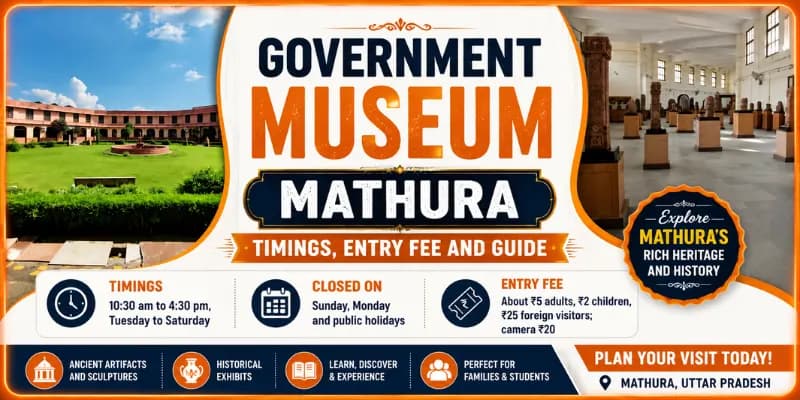
Timings | 10:30 am to 4:30 pm, Tuesday to Saturday |
Closed | Sunday, Monday and public holidays |
Entry fee | About ₹5 adults, ₹2 children, ₹25 foreign visitors; camera ₹20 |
Address | Dampier Nagar, Choubey Para, Mathura, Uttar Pradesh 281001 |
Founded | 1874, by F. S. Growse, then collector of Mathura |
Famous for | The Mathura school of art (Kushan and Gupta sculpture) |
Time needed | About 2 to 3 hours |
Best time | October to mid-April |
Nearest railhead | Mathura Junction, about 2 to 3 km |
Government Museum Mathura: an overview
Mathura is a city of temples, of bells and crowds and the ceaseless call of the divine, yet a few steps from that noise stands something quieter and just as remarkable: the Government Museum Mathura, where the whole ancient story of the land is kept in stone. This is not a temple and it asks for no darshan; it is a scholar's treasure house, gathered from the mounds and fields in and around Mathura over a century and a half and it holds some of the most important early sculpture anywhere in India. For anyone who has come to Mathura for shri krishna janmabhoomi temple and the temples, an hour or two in the museum sets the whole city in its true and very old context. This guide gives the full timings, entry fee, address, history and a room-by-room sense of the collection, then how to reach it and what lies nearby.
From the ground (Gurudutt): Most pilgrims walk straight past the museum and that is the honest mistake I see most; they come for the temples and never learn that Mathura gave the world some of its first images of the Buddha and the finest Kushan sculpture in the country. I always send my guests in for at least two hours. The one thing to get right is the day: the museum is closed on Sunday and Monday and many people arrive on exactly those days and find the gate shut. Go on a weekday, early, when it is cool and quiet, keep a little cash for the small ticket and the camera fee and give the standing Buddha and the headless Kanishka statue the time they deserve. And since the museum sits close to the great Mathura temples, it folds neatly into a morning of city sightseeing. See our Mathura Vrindavan tour Package or message WhatsApp +91 7302265809.
Government Museum Mathura timings
The Government Museum Mathura is open through the working week and closed at the weekend, on the pattern of the state archaeological museums. Its timings are given below.
Day | Timing |
Monday | Closed / holiday |
Tuesday | 10:30 am to 4:30 pm |
Wednesday | 10:30 am to 4:30 pm |
Thursday | 10:30 am to 4:30 pm |
Friday | 10:30 am to 4:30 pm |
Saturday | 10:30 am to 4:30 pm |
Sunday | Closed / holiday |
Note: the Government Museum Mathura stays closed on Sunday, Monday and public holidays, so plan a Tuesday to Saturday visit; timings can shift on gazetted holidays and special occasions, so it is wise to confirm locally on the day. So the museum is a weekday visit. So arrive after 10:30 am and allow to finish by 4:30 pm. So keep Sunday and Monday for the temples instead.
Government Museum Mathura entry fee
The Government Museum Mathura charges a small entry fee, kept low as a public state museum, with a separate charge for photography. The fees are given below.
Visitor | Entry fee |
Adult (Indian) | About ₹5 per person |
Child | About ₹2 per person |
Foreign visitor | About ₹25 per person |
Camera fee | About ₹20 |
Note: these are modest, government-set fees and may be revised, so confirm the current rate at the ticket counter; the entry ticket is quite separate from the camera charge and this small, official fee should not be confused with any touts asking for extra money. So entry is inexpensive. So carry a little cash for the ticket and the camera. So there is nothing more to pay inside beyond these posted fees.
The museum at a glance
Detail | Information |
Also known as | Mathura Museum; earlier the Curzon Museum of Archaeology |
Type | Archaeological and art museum |
Founded | 1874, by F. S. Growse |
Building | Octagonal edifice of red sandstone, with sculptures set around the lawns |
Chief draw | The Mathura school of art, 3rd century BCE to 12th century CE |
Signature piece | The headless statue of the Kushan emperor Kanishka |
Time to explore | About 2 to 3 hours |
In one line: the Government Museum Mathura is a 150-year-old red-sandstone treasury of the Mathura school of art, open 10:30 am to 4:30 pm on weekdays for a few rupees and among the most rewarding non-temple hours in the city.
History of the Government Museum Mathura
The museum's story begins in 1874, when F. S. Growse, the district collector and a devoted student of Mathura's antiquities, gathered the sculptures then coming out of the local mounds into a single collection. It was first known as the Curzon Museum of Archaeology, later the Archaeology Museum, Mathura and at last the Government Museum, Mathura. Over the following decades the collection grew with the finds of the great colonial archaeologists who worked the region, among them Alexander Cunningham and Fuhrer and it became one of the leading museums of Uttar Pradesh. So important had it become that the Government of India issued a commemorative postage stamp on 9 October 1974 to mark its centenary. The building itself is part of the pleasure: an octagonal edifice of warm red sandstone, with hand-chiselled sculptures and Buddha figures set out along its lawns. The nearby dwarkadhish temple mathura and the old city grew up in the same quarter, so the museum sits in the historic heart of Mathura.
The Mathura school of art: why this museum matters
To understand why this museum draws scholars from across the world, you have to know the Mathura school of art. Between roughly the 3rd century BCE and the 12th century CE and above all under the Kushan and Gupta emperors, Mathura became one of the two great centres of early Indian sculpture, working almost always in the region's distinctive mottled red sandstone. It was here, in the Kushan age, that artists began to carve the Buddha in fully human form, a turning point in Indian and indeed world art; the Gupta age then refined that vision into the serene, softly modelled figures that became the classical ideal. The reach of the Mathura workshops was enormous and their sculpture and its influence travelled to distant sites such as Sarnath, Sanchi, Bodh Gaya and beyond. So the Government Museum Mathura is not merely a local collection; it is the home ground of a school of art that shaped how the Buddha, the Jain tirthankaras and the Hindu gods were shown for a thousand years. We present the sacred images it holds with the reverence they are due, as the living faith of many traditions, recounted with respect.
The galleries and the collection
The collection is very large, often numbered at several thousand pieces in all: thousands of stone sculptures, tens of thousands of coins, thousands of terracotta figures, hundreds of metal images and many more paintings and objects, arranged through a series of galleries and along the garden. What follows is a sense of what you will find, not an exhaustive list.
Kushan and Gupta sculpture. The heart of the museum: red-sandstone Buddhas, Bodhisattvas and Hindu deities of the Kushan and Gupta ages, from the powerful early figures to the serene classical masterpieces, including a celebrated standing Buddha of the Gupta period.
The yakshas and yakshis. Among the oldest and most striking pieces are the colossal yaksha guardians, such as the Parkham Yaksha and the Mudgarpani Yaksha and the sensuously carved yakshi bracket-figures once set on railings, images of nature spirits that predate and inform the later temple art.
Jain art. Mathura was a major Jain centre and the museum is rich in Jain sculpture: standing and seated tirthankaras, the four-fold chaumukha images, the ornate ayagapata votive tablets of the Kushan age and rarities such as Naigamesha, associated with childbirth.
The Kanishka statue. The single most famous object is the headless standing statue of the Kushan emperor Kanishka, shown in a Central Asian tunic and heavy boots, one hand on a great mace and the other on a sword; an emperor's portrait in stone and unlike almost anything else in Indian art.
Terracottas and coins. A fine run of terracotta figures, from archaic mother goddesses to the lively plaques of the Shunga period and a large cabinet of gold, silver and copper coins that trace the dynasties who ruled Mathura.
Bronzes, paintings and curiosities. Later metal images and bronzes, among them a charming Baby Krishna with a ball and a figure of Balarama, alongside paintings and colonial-era pieces such as a statue of Queen Victoria and a remarkable copper anthropomorphic figure thousands of years old found in the region.
The kunds, ghats and leela-sites of the old city that these sculptures once adorned are gathered in our braj yamuna ghats and leela sites guide, which sets the museum's stones back into their living landscape.
Must-see highlights
If your time is short, these are the pieces to seek out first:
The headless Kanishka statue, the museum's signature image of a Kushan emperor
The great standing Buddha of the Gupta age, a masterpiece of classical Indian sculpture
The colossal Parkham and Mudgarpani yakshas, among the earliest Indian stone figures
The Bhutesvara yakshi bracket-figures, celebrated in the history of Indian art
The Jain ayagapata tablets and chaumukha tirthankara images of the Kushan age
The archaic terracotta mother goddesses and the coin cabinet
How to reach the Government Museum Mathura
The museum stands at Dampier Nagar, Choubey Para, on Museum Road in the old quarter of Mathura, close to the Dwarkadhish temple, Dhruv Tila and the Yamuna ghats. It is easy to reach by any local transport.
By train: the museum is only about 2 to 3 km from Mathura Junction, the city's main railhead, a short ride of well under fifteen minutes; Mathura Junction is well connected to Delhi, Agra and the wider network, so most visitors arrive here.
By bus: the New Bus Stand and the old bus stand are both close, roughly a kilometre or two away, with autos waiting; state and private buses link Mathura to Delhi, Agra and Vrindavan.
By air: there is no airport at Mathura itself; the nearest major airport is Delhi (Indira Gandhi International), about 150 km away, while the new Noida International Airport at Jewar is closer at roughly 70 to 80 km and Agra airport, about 60 km, has limited flights. So most air travellers land at Delhi and drive down.
Locally: from anywhere in Mathura, a cycle-rickshaw, e-rickshaw, auto or taxi will bring you to the museum in minutes; our how to commute in vrindavan guide covers getting around the Braj towns and the mathura vrindavan temple timings guide helps you slot the museum around the temple hours.
Places to visit near the museum
The museum sits in the middle of old Mathura, so the city's chief sights are all within a short ride. A few steps and short drives away are the kans qila, the riverside fort linked to the tyrant Kansa and the birla mandir, the Gita Mandir with its pillar of verses. The great keshav dev temple mathura at the Krishna Janmasthan and the potra kund beside it, the sacred tank of Krishna's first bath, are close by, as is the guardian bhuteshwar mahadev. So a single morning can take in the museum and the heart of Krishna's city together.
Tips for your visit and the best time to go
Go on a weekday: the museum is closed on Sunday, Monday and public holidays, so plan Tuesday to Saturday.
Arrive early after opening, when it is cool and uncrowded and allow about 2 to 3 hours to see the galleries and the garden without rushing.
Carry a little cash for the small entry ticket and the camera fee and note that photography rules may vary by gallery, so check at the counter.
The best season is October to mid-April, when Mathura's weather is pleasant for sightseeing on foot.
Pair the museum with the nearby temples for a full, unhurried morning of Mathura city sightseeing.
Plan your visit
The Government Museum Mathura fits beautifully into a day of Mathura city sightseeing, alongside the Janmabhoomi and Dwarkadhish and our mathura vrindavan tour itinerary helps you shape the days so the museum falls on an open weekday and the temples on their darshan hours.
We arrange guided Mathura and Vrindavan tours with a comfortable vehicle, a Braj-born guide and pick-up from your hotel or the station and we are glad to build the Government Museum into a Mathura sightseeing day. A shared day tour starts from around ₹1,499 per person, with darshan free at the temples, though the museum keeps its own small entry ticket; our mathura vrindavan tour covers the twin cities and their temples, while the agra mathura vrindavan tour package adds Agra and the Taj Mahal. Message me on WhatsApp at +91-7302265809 to plan a Mathura day that includes the museum.
Related guides
Meet Gurudutt — Your Mathura Vrindavan Guide
Not just a tour operator — Gurudutt was born and raised in Braj Bhoomi. He has spent over a decade personally guiding pilgrims through the sacred lanes of Mathura & Vrindavan.
Founder – Experience My India
Gurudutt
Founder · Experience My India