Who is Varaha?
Varaha is the third of the ten avatars (Dashavatara) of Vishnu - the great boar, with a boar's head and a mighty human body, who incarnated to rescue the Earth. The story is one of the grandest in the Puranas: the demon Hiranyaksha, drunk on power, seized the Earth-goddess Bhudevi and dragged her down into the depths of the cosmic ocean.
To save her, Vishnu took the form of Varaha, plunged into the waters, fought and slew Hiranyaksha in a tremendous battle and lifted the Earth back to safety upon his tusk. Varaha thus signifies strength, determination and the restoration of cosmic order (dharma) - the Lord who rescues the world itself when it is dragged into darkness.
(A point worth getting right: Varaha slew the demon Hiranyaksha. His brother Hiranyakashipu was slain by a different avatar - Narasimha, the man-lion. The two brothers and their two slayers should not be confused.)
The red deity - Lal Varaha
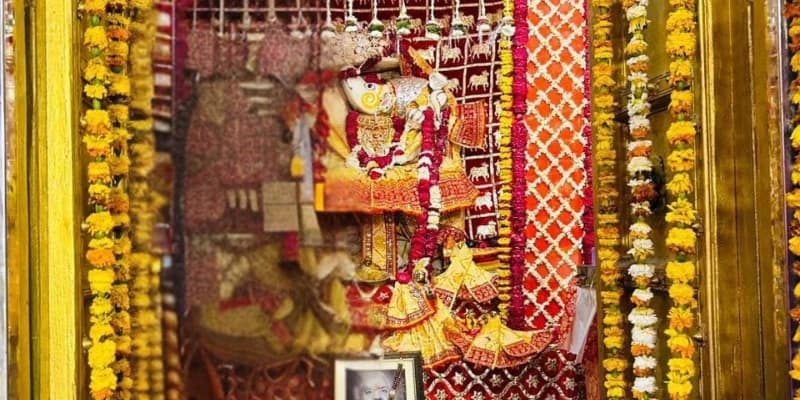
What makes this temple's deity unusual is its colour. Most images of Varaha are dark; here, the deity is red - and so is lovingly called "Lal Varaha." The word lal means red, but in the local usage it also carries the sense of "little" or "small" - and indeed the idol is small in form yet immense in reverence, radiating, devotees say, an undeniable spiritual power despite its modest size.
The temple's walls bear murals depicting Varaha's battle with the demon, telling the epic in pictures around the red boar-Lord at the heart of the shrine. It is an intimate, atmospheric place, beloved especially by the locals of old Mathura.
How the idol came to Mathura
Tradition tells a striking story of how the deity came to rest here. In the age of the Ramayana, the demon Lavanasura terrorised the Mathura region; Maharaj Shatrughna, the youngest brother of Lord Rama, defeated and slew him and in doing so re-established the city of Mathura. By tradition, it was Shatrughna who brought the Varaha idol to Mathura and enshrined it here.
The lore adds further marvels: that Indra, king of the gods, was so mesmerised by the idol that he tried to carry it off to heaven; and that the sage Kapila Muni was among Varaha's devoted worshippers. These tales weave the temple into the deep, layered past of Mathura - older than the Krishna age, reaching back to the time of Rama and beyond.
The three Varaha forms
The temple honours not one but three forms of Varaha, each with its own meaning:
Adi / Lal Varaha - the original red deity at the heart of the temple.
Krishna Varaha - said to have emerged during the Brahmakalpa, holding the Earth upon his tusk to maintain cosmic balance.
Shvet Varaha (also Nar Varaha) - the form that incarnated to slay the demon Hiranyaksha.
Together they honour the boar-Lord in his different cosmic roles - the rescuer, the upholder, the slayer of the demon - a fuller worship of Varaha than almost anywhere else in Braj.
One of Mathura's oldest - an honest note
This is among the oldest temples in Mathura - but, as ever, let me be honest about what that means. The deity and the site are ancient: some hold the worship here to reach back around 1,500 years or more and excavations near the temple have unearthed remains of an older Varaha shrine that once stood on the spot. But the present structure is relatively recent (rebuilt in modern times, by some accounts in the early 20th century).
So the honest picture is a familiar one in Braj: an ancient seat of worship with a more recent building over it. The sanctity is old; the visible structure is newer. Confirm any specific dating locally and treat single-figure age claims with the usual caution.
What devotees seek
Because Varaha is the avatar of strength, courage and the rescue of the Earth from darkness, devotees come to the Adi Varaha Temple seeking exactly those gifts. They pray for strength to overcome challenges, courage in adversity and the power to lift themselves out of difficulty - inspired by the Lord who lifted the whole Earth from the depths.
There is a tender resonance, too, in the leela's heart: Varaha rescued Bhudevi, the Earth-Mother. To honour him is, in a sense, to honour the Earth he saved - a quiet reminder, for our own age, of the care the world is owed. Come for the boar-Lord's strength and leave with a little of his resolve.
How to visit
A few honest pointers:
Location - in old Mathura, very close to Mathura Junction, about 270 m down the street from the Dwarkadhish Temple - so it pairs perfectly with a Dwarkadhish visit.
Easily reached - on foot from Dwarkadhish or by auto from Mathura Junction; most Mathura visitors pass close by.
It's small - an intimate shrine, not a grand complex; take darshan calmly and notice the wall-murals of the leela.
Dress modestly and remove footwear before the sanctum.
Festivals - Varaha Jayanti
Festival | What's special | When |
Varaha Jayanti | The appearance day of the Varaha avatar | Bhadrapada Shukla Tritiya |
Krishna Janmashtami | Mathura's supreme festival fills the old city | Bhadrapada Krishna Ashtami |
Holi | Mathura's famous, fervent Holi | Phalguna |
Varaha Jayanti - the appearance day of the boar - Lord - is the temple's special day, when Lal Varaha is honoured with particular devotion. Festival dates are tithi-based and move yearly.
Temples to combine nearby
The Adi Varaha Temple sits in the heart of old Mathura, perfectly combined with:
Shri Dwarkadhish Temple - just 270 m away; the natural pairing
Shri Krishna Janmabhoomi - the birthplace
Vishram Ghat & the Yamuna leela-sites - the holy ghat nearby
Krishna Kubja Temple - another old-city shrine
Browse all at the Famous Temples of Mathura Vrindavan hub.
Author's tips from Gurudutt - what only a local knows
Pair it with Dwarkadhish - it's barely 270 metres away; almost no out-of-town visitor knows to step across to it.
Look for the red - Lal Varaha is unusual; most Varaha idols are dark. The red form is the temple's distinction.
Read the murals - the walls tell the Earth-rescue leela in pictures around the deity.
Come for strength - this is the Lord who lifted the Earth from the depths; pray here for courage and resolve.
It's small - that's the charm - an intimate, ancient shrine away from the crush, beloved by old-Mathura locals.
Everyone in Mathura goes to Dwarkadhish and then walks straight past one of our oldest temples without knowing it. Step a little down the lane and you'll find Lal Varaha - the red boar-Lord, small as a child's toy and old as the city itself. This is Vishnu as the boar who dived into the black ocean and carried the whole Earth up on his tusk. When your own life feels like it's sinking, come to the Lord who lifts up worlds. He knows how to carry a heavy load. - Gurudutt