Travel Guide · Travel Guides · Updated July 2026
Mathura Chaurasi Digamber Jain Temple: The Nirvana Site of Jambu Swami, a Complete Guide
By Gurudutt, Experience My India·30 July 2026
Quick Answer
Quick Enquiry
Key facts at a glance
What it is | A revered Digambar Jain temple and siddha kshetra in Mathura |
Marks | The nirvana site of Jambu Swami, the last Kevali |
Why Chaurasi | Chaurasi means 84, associated with Jambu Swami |
Main deity | Ajitnath, the second Tirthankara |
Timings | Daily, roughly 5:00 am to 9:00 pm; no entry fee |
Where | Krishna Nagar, Mathura, on the Delhi-Mathura highway |
Mathura Chaurasi Digamber Jain Temple: an overview
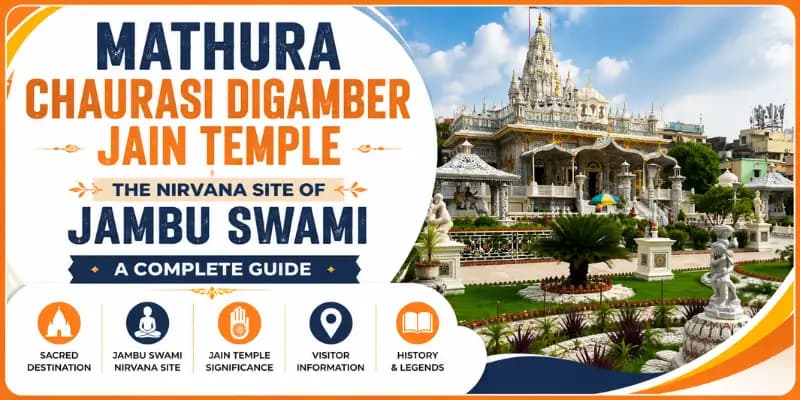
The Mathura Chaurasi Digamber Jain Temple is one of the most important Jain places of worship in Mathura and a reminder that this ancient city is sacred not only to Hindus but to Jains as well. Formally known as the Antim Kevali Shri 1008 Jambu Swami Nirvan Sthal Digambar Jain Mandir, it was built by the Mathura Jain community in memory of Jambu Swami, the last Kevali, the last omniscient being, of this age in the Jain tradition, who is believed to have attained nirvana here.
Set on a wide expanse of land on the outskirts of Mathura, near the Yamuna, the temple is a serene and beautiful place, its main deity the Tirthankara Ajitnath and it is revered as a siddha kshetra, a place of liberation. This guide covers its name and history, the story of Jambu Swami, the deity and shrines, what to see, its significance for Jains and how to visit, with timings, entry and how to reach. For the wider city, see our places to visit in mathura guide.
From the ground (Gurudutt): This temple is a rewarding and peaceful stop for anyone interested in Mathura's fuller sacred story, beyond the Krishna pilgrimage. It is quiet, beautiful and uncrowded compared with the great Krishna temples, set in gardens on the edge of the city and it opens a window onto Mathura's deep and ancient Jain heritage. Come in a respectful spirit, take in the serene deities and the Jain art and you will see a side of the holy city that most visitors miss. See our Mathura Vrindavan tour or message WhatsApp +91 7302265809.
The temple at a glance
Here are the essentials of the Mathura Chaurasi Digamber Jain Temple in one place.
Detail | Information |
Full name | Antim Kevali Shri 1008 Jambu Swami Nirvan Sthal Digambar Jain Mandir |
What it marks | The nirvana site of Jambu Swami, the last Kevali |
Main deity | Ajitnath, the second Tirthankara |
Tradition | Digambar Jain; a siddha kshetra, a place of liberation |
Location | Krishna Nagar, on the Delhi-Mathura highway, Mathura 281001 |
Timings | Daily, roughly 5:00 am to 9:00 pm; general access about 6:00 am to 9:30 pm |
Entry fee | None; free to visit |
Best time | The cool season, October to March |
In one line: The Mathura Chaurasi Digamber Jain Temple marks the nirvana site of Jambu Swami, the last Kevali; its main deity is Ajitnath, the second Tirthankara; it is a Jain siddha kshetra in Krishna Nagar, Mathura, open daily with no entry fee.
The name: why Chaurasi?
The temple's popular name, Chaurasi, comes from the Hindi word for eighty-four and it is associated with Jambu Swami, in whose memory the temple was built and who is believed to have attained nirvana here. By the tradition, the number eighty-four, chaurasi, is linked to him and to this sacred spot and so the temple became widely known as the Mathura Chaurasi Jain Mandir.
So while its formal name honours Jambu Swami as the last Kevali and marks this as his nirvana site, in everyday speech it is the Chaurasi temple, the temple of the eighty-four, a name that has become its identity in Mathura. We present the meaning of the name as it is given in the tradition of the temple and its community.
Jambu Swami, the last Kevali
At the heart of the temple's significance is Jambu Swami, revered in the Jain tradition as the last Kevali, the last being of this age to attain kevala jnana, perfect omniscience and thereafter moksha, liberation. In the tradition, he came after Mahavira, the twenty-fourth and last Tirthankara, in the line of enlightened teachers and is honoured as the final person of this era to reach the highest spiritual goal, complete liberation from the cycle of birth and death.
By the tradition, Jambu Swami attained nirvana here at Mathura and it is to mark and honour this that the temple was built by the Mathura Jain community. This is why the temple is revered as a siddha kshetra, a place of liberation, a site sanctified by the attainment of moksha, among the holiest kinds of place in Jain pilgrimage. We recount these as the beliefs and teachings of the Jain tradition, with respect, rather than asserting them as documented history.
The deity Ajitnath and the shrines
The main deity of the temple is Ajitnath, the second of the twenty-four Tirthankaras of the Jain tradition, whose idol here is carved of white stone, said to have been discovered during a land excavation. Alongside the deity, the charan, the sacred footprints, of Jambu Swami are enshrined, honouring the last Kevali at the site of his nirvana. Together, the deity of Ajitnath and the charan of Jambu Swami form the spiritual heart of the temple.
Beyond these, the temple holds shrines and images of other revered figures of the Jain tradition, including the Tirthankaras Neminath, Parshvanath and Mahavira and images of Bahubali, honoured as among the first to attain liberation in this age and of Jambu Swami himself, the last Kevali. So the temple gathers, in one sacred place, the memory of the great liberated beings of the Jain tradition, from the early to the last, around the nirvana site of Jambu Swami. We describe these figures respectfully as they are revered in the Jain tradition.
What to see inside the temple
The temple is spacious, serene and beautiful and there is much to take in.
The white-stone idol of Ajitnath, the second Tirthankara, the main deity and the charan, the sacred footprints, of Jambu Swami enshrined alongside.
The shrines and images of Neminath, Parshvanath and Mahavira and the images of Bahubali and Jambu Swami, gathering the great liberated beings of the tradition.
The temple walls, adorned with colourful paintings and inscriptions of Jain culture and art, depicting the tradition's stories and teachings.
The large hall, able to hold many hundreds of devotees during rituals and gatherings and the beautiful garden surrounding the temple.
The overall atmosphere is calm, spacious and devotional, set in gardens on the edge of the city near the Yamuna, quite different from the bustle of Mathura's great Krishna temples. Taking time with the serene Digambar deities, the Jain art and the peaceful grounds is the heart of a visit, a quiet and contemplative experience.
Mathura's ancient Jain heritage
The Chaurasi temple is part of a much older story, for Mathura was one of the great centres of Jainism in ancient India, over two thousand years ago. The famous archaeological mound of Kankali Tila in Mathura yielded a wealth of ancient Jain sculptures, inscriptions and the remains of an ancient Jain stupa, among the most important early Jain finds in India, now treasures of Mathura's museum and beyond.
So the presence of a revered Jain temple in Mathura is no accident: it reflects the city's deep and ancient Jain roots, alongside its fame as the birthplace of Krishna. The Mathura school of art, celebrated for its early Hindu and Buddhist sculpture, produced remarkable Jain art too. For the visitor, the Chaurasi temple, together with the Jain antiquities in the city's museum, opens a window onto this rich and often overlooked heritage. Our places to visit in mathura guide covers the city's sights, including its museum.
The significance of the temple for Jains
For Jains, the Mathura Chaurasi temple is deeply significant as a siddha kshetra, a place of liberation, sanctified by the nirvana of Jambu Swami, the last Kevali. Siddha kshetras, sites where great souls attained moksha, are among the holiest places of Jain pilgrimage and this temple, marking the liberation of the final omniscient being of this age, holds a special place among them.
To visit is, for a Jain pilgrim, to honour Jambu Swami and the ideal of liberation he embodies and to take darshan of the Tirthankara Ajitnath and the other revered figures enshrined here. For visitors of any background, it is a place to encounter the Jain tradition, its serene art, its teachers and its profound ideals of non-violence, self-discipline and liberation, in the heart of the holy city of Mathura. We present its significance as the Jain tradition holds it, with respect.
Timings, entry fee and the best time to visit
The Mathura Chaurasi Digamber Jain Temple is open every day, generally from around 5:00 am to 9:00 pm, with general visitor access through roughly 6:00 am to 9:30 pm, so you can visit at any convenient time of day and spend a peaceful hour or two there. There is no entry fee; the temple is free to visit.
The best time to visit is the cool season, from around October to March, when Mathura's weather is pleasant for sightseeing, avoiding the fierce summer heat; the deep-winter months of December and January can be quite cold, so pack warm layers if you come then. As the temple is calm and rarely crowded, any time in the cool season is comfortable. Our best time to visit vrindavan mathura guide covers the seasons for a Mathura visit in full.
How to reach the temple
The temple is on the outskirts of Mathura, in Krishna Nagar, on the Delhi-Mathura highway and is easily reached.
It is about 3 km from the Mathura bus stand and about 5 km from Mathura Junction railway station, the nearest major station.
The nearest airports are Agra, about 60 km and Delhi, about 170 km.
By auto or e-rickshaw, it is a short ride from the city centre, only a few minutes.
By bus toward Vrindavan, alight on the highway near Govardhan Chauraha, about 1 km from the temple and take an auto or taxi.
A taxi or a hired cab for the day is the most comfortable way to visit, letting you combine the temple with Mathura's other sights. Being on the main highway on the edge of the city, it is easy to find. Our how to reach vrindavan guide covers the routes into Mathura and the region and our mathura vrindavan local sightseeing guide how to plan a day of sightseeing in the city.
Facilities and nearby places
The temple has good facilities for pilgrims and visitors and sits within easy reach of Mathura's main sights.
Accommodation: the temple complex offers rest rooms and a place to stay, with modern amenities, for pilgrims, a common feature of Jain temple trusts; enquire with the temple for current arrangements.
The large hall and gardens for rituals, gatherings and a peaceful visit.
Nearby, Mathura's great sights: the krishna janmabhoomi temple, the birthplace of Krishna and the grand dwarkadhish temple, both a short drive away.
The Government Museum of Mathura, with its famous collection of the Mathura school of art, including Jain antiquities from Kankali Tila.
We can include the Chaurasi Jain temple in a custom Mathura sightseeing day for those who wish to see this side of the city, alongside the Krishna sights, with the transport, the timing and a knowledgeable local companion handled. A shared Mathura and Vrindavan day tour starts from around ₹1,499 per person and our two-day mathura vrindavan tour and one-day vrindavan tour package can be tailored to include it on request. Message me on WhatsApp at +91-7302265809 with your interests and dates to plan a Mathura visit.
Related guides
Meet Gurudutt — Your Mathura Vrindavan Guide
Not just a tour operator — Gurudutt was born and raised in Braj Bhoomi. He has spent over a decade personally guiding pilgrims through the sacred lanes of Mathura & Vrindavan.

Founder – Experience My India
Gurudutt
Founder · Experience My India