Travel Guide · Travel Guides · Updated October 2026
Kansa Vadh: How Krishna Slew Kansa at the Rangbhoomi in Mathura
By Gurudutt, Experience My India·13 October 2026
Quick Answer
Quick Enquiry
Kansa Vadh and the Rangbhoomi at a glance
Detail | Information |
What it is | Kansa Vadh: the slaying of King Kansa by Krishna, at the Rangbhoomi arena |
The site | Rangbhoomi, also Kansa Vadh Sthal or Kans Tila, an open-air site in Mathura |
Where | Opposite the Main Post Office, near the Rangeshwar Mahadev temple, Mathura, by the Yamuna |
The story | Krishna slew the elephant, the wrestlers and Kansa at Kansa's own festival |
Annual festival | The Kansa Vadh Mela, on Kartik Dashami, before Dev-uthani Ekadashi |
Nearby | The Krishna Janmabhoomi and Vishram Ghat, the ghat of rest |
What is the Rangbhoomi, the Kansa Vadh Sthal?
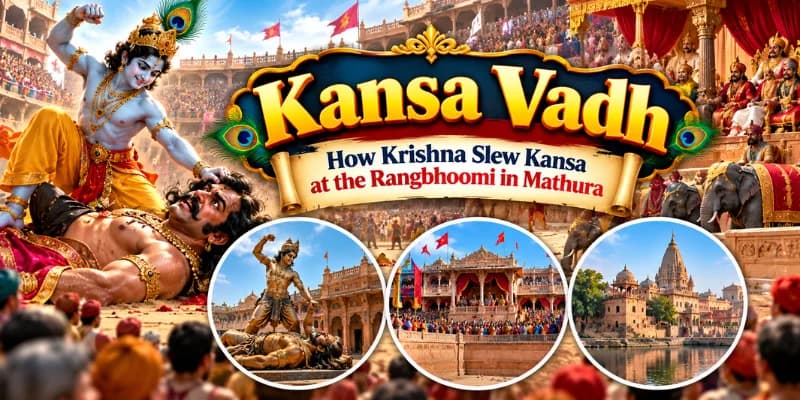
The Rangbhoomi, also popularly called the Kansa Vadh Sthal or the Kans Tila, the mound of Kansa, is one of the most significant open-air sacred sites of Mathura. It is revered as the very ancient wrestling arena where Lord Krishna brought an end to the tyrannical rule of his maternal uncle, King Kansa. It stands opposite the Main Post Office, near the Rangeshwar Mahadev temple, close to the banks of the Yamuna, a short distance from the Shri Krishna Janmabhoomi and Vishram Ghat; it is an open site rather than a temple, revered for the great event it witnessed. For the city of Krishna's birth, see our mathura up guide and to visit the sacred sites of Mathura, amathura vrindavan tour packages with Experience My India can plan it.
From the ground (Gurudutt): Every child of Braj grows up on this story: how our Krishna, still a boy, walked into the tyrant Kansa's own arena, where every trap was laid for him and still brought the cruel king down and set Mathura free. The Rangbhoomi is where it happened and once a year, at the Kansa Vadh Mela, the whole city comes out and we slay Kansa all over again, with a great effigy and the old Chaturvedi sticks; it is a sight to see. I always bring my guests here and tell the tale on the spot. We tell it as the cherished tradition of Braj. Jai Shri Krishna, Radhe Radhe.
The story of Kansa Vadh
The slaying of Kansa, from the Srimad Bhagavatam, is one of the great pastimes of Krishna:
The trap of the wrestling festival. King Kansa, who had long sought to kill Krishna, having been foretold that a son of his sister Devaki would destroy him, organised a grand wrestling festival and a bow sacrifice, the Dhanur Yajna, at Mathura, as a deliberate trap to assassinate the young brothers Krishna and Balarama; he set his most formidable royal wrestlers, Chanura and Mushtika and a maddened war elephant, Kuvalayapida, to crush them.
Krishna in the arena. But at the very gate of the arena, Krishna slew the maddened elephant Kuvalayapida; and entering the Rangbhoomi, the young Krishna fought and overcame the champion wrestler Chanura, while Balarama at the same time overpowered Mushtika, so that the tyrant's chosen warriors fell one by one before the divine brothers, to the wonder of all who watched.
The end of the tyrant. Seeing his warriors fall, a panicked Kansa called for the brothers to be driven out and tried to intervene; but Lord Krishna leapt upon the royal dais, seized the tyrant, dragged him by his hair from his throne down onto the arena floor and dealt him the final blow, ending the long reign of terror of Kansa over Mathura. So the prophecy that had brought the Lord to earth was fulfilled.
Krishna's birth in Kansa's prison is honoured at the krishna janmabhoomi and his childhood in gokul. We present this as the cherished belief and tradition of Braj, held with faith and recounted with reverence.
After the victory: freeing Devaki and restoring Ugrasena
The slaying of Kansa did not end with the tyrant's fall, but with the setting right of all he had wronged. Directly after the duel at the Rangbhoomi, Lord Krishna hastened to the dungeons of Mathura and freed his own parents, Devaki and Vasudeva, whom Kansa had kept imprisoned for years, bowing to them as their son; and he released his grandfather, the righteous King Ugrasena, Kansa's own father, whom Kansa had deposed and reinstated him upon the throne of Mathura, restoring just and righteous rule to the city. So the Kansa Vadh was not only the fall of a tyrant but the liberation of the innocent and the return of dharma to the land; the dwarkadhish temple and the Yamuna ghats of Mathura hold the memory of these days.
Vishram Ghat, the ghat of rest
A tender local tradition joins the Rangbhoomi to the most famous ghat of Mathura. It is told that after the exhausting battle and the final slaying of Kansa at the Rangbhoomi, Lord Krishna walked down to the bank of the Yamuna to sit and rest; and from that rest, vishram, the ghat came to be called Vishram Ghat, the ghat of rest, the chief and holiest of Mathura's riverside ghats, where pilgrims begin their Mathura parikrama and take the evening Yamuna aarti. So the Rangbhoomi and Vishram Ghat together tell the whole arc of the Kansa Vadh, the battle and the rest that followed. See the braj yamuna ghats and leela sites guide for Vishram Ghat and the ghats of Mathura. We present this as the cherished belief and tradition of Braj.
The meaning of Kansa Vadh: Dharma over Adharma
The Kansa Vadh is cherished not only as a story but as a truth about the world:
The triumph of good over evil. The Rangbhoomi stands as a living testament to the triumph of good over evil, of dharma over adharma, of righteousness over tyranny; the slaying of the cruel Kansa by the Lord is held up across the ages as the assurance that, however long a tyrant may rule, the divine will in the end bring him down and set the righteous free.
The fulfilment of the Lord's descent. By the tradition, it was the very tyranny of Kansa and the prophecy of his doom, that brought Lord Krishna to descend to the earth; so the Kansa Vadh is the fulfilment of the purpose of the Lord's avatar, the completion of the task for which he took birth in Mathura and a central event of the whole Krishna story.
The liberation of the innocent. And the Kansa Vadh is cherished as the liberation of the innocent, the freeing of Devaki and Vasudeva and of all Mathura from a cruel king; so it is a story of mercy and of justice as much as of victory, dear to the people of Braj. We present this as the cherished belief and tradition of Braj.
The annual Kansa Vadh Mela
Every year, the great victory is kept at the Rangbhoomi with a vivid and ancient festival, the Kansa Vadh Mela:
When it is kept. The Kansa Vadh Mela is held every year on Kartik Dashami, the tenth day of the bright fortnight of Kartik, the day before Dev-uthani or Prabodhini, Ekadashi, usually in November; it is a cherished tradition of Mathura, kept by the local Mathur Chaturvedi community through the Chaturvedi Parishad, who carry sticks handed down through the generations.
The effigy and the procession. A giant effigy of Kansa, by accounts up to some fifty feet tall, is made and paraded in a grand procession through the streets of old Mathura, from Hanuman Gali towards the Yamuna; the crowds strike the effigy with the traditional wooden sticks, re-enacting the fall of the tyrant and finally the effigy is dismembered and immersed in the Yamuna, as Kansa is slain once more.
Vishram Ghat and the aarti. The procession is tied to Vishram Ghat, where images of Krishna and Balarama are honoured on a stage, as the deliverers of Mathura; and by the local custom, on this day the evening Yamuna aarti is delayed, for the river goddess is said to await the return of Krishna from his victory. It is a joyful, thronged, deeply traditional day in Mathura.
The same Chaturvedi community keeps the mahavidya devi mandir mathura as their Kuladevi; we present the mela as the cherished tradition of Braj.
The ancient site and how to reach and visit
The Rangbhoomi is an ancient and storied site at the heart of old Mathura:
A site of great antiquity. Mathura is among the most ancient cities of India, its urban importance traced by archaeology back many centuries before the common era, when it was a great centre of trade and of faith; over the ages the city and its surroundings were a flourishing centre of Buddhist and Jain and Hindu life in turn, famed for the Mathura school of ancient sculpture, before the worship of Krishna's sacred sites, the Rangbhoomi among them, came again to the fore. We present the traditional and historical accounts with faith and note that the precise history is a matter for scholars.
Where it is. The Rangbhoomi is opposite the Main Post Office, near the Rangeshwar Mahadev temple, in old Mathura, close to the Yamuna and a short distance from the Krishna Janmabhoomi and Vishram Ghat; it is easily reached within the city by auto or taxi. Mathura Junction is the nearest major railway station and Mathura is about 150 km from Delhi and 60 km from Agra.
Visiting. As an open-air site at the heart of the old city, the Rangbhoomi is best seen with the nearby Krishna Janmabhoomi and Vishram Ghat and with a Braj guide who can tell the story of the Kansa Vadh on the spot; if you can, come for the Kansa Vadh Mela on Kartik Dashami, a sight unlike any other, though the old city is then very crowded. The nearby Rangeshwar Mahadev is one of the four guardian Shiva temples of Mathura.
See the gokarneshwar mahadev mandir mathura guide for the guardian Shiva temples of Mathura, our how to commute in vrindavan guide for getting around and the mathura vrindavan temple timings guide for the Mathura temples' hours.
We take guests to the Rangbhoomi and the sacred sites of Mathura, the Krishna Janmabhoomi, Vishram Ghat, the Dwarkadhish temple and the whole of Braj and for the Kansa Vadh Mela too, in a comfortable vehicle with a Braj-born guide who knows the sites, the stories and the festivals. A shared day tour starts from around ₹1,499 per person, with darshan free. The braj 84 kos yatra covers the whole of Braj, our mathura vrindavan tour the twin cities of Mathura and Vrindavan and our vrindavan tour package Vrindavan in a day; the banke bihari temple of Vrindavan is dear too. Message me on WhatsApp at +91-7302265809 to plan your Mathura darshan.
Related guides
Meet Gurudutt — Your Mathura Vrindavan Guide
Not just a tour operator — Gurudutt was born and raised in Braj Bhoomi. He has spent over a decade personally guiding pilgrims through the sacred lanes of Mathura & Vrindavan.
Founder – Experience My India
Gurudutt
Founder · Experience My India