Travel Guide · Food & Culture · Updated October 2026
Charkula Dance of Braj: What It Is and Where to See It
By Gurudutt, Experience My India·29 October 2026
Quick Answer
Quick Enquiry
Charkula is one of the most breathtaking sights in all of Braj, a woman gliding and spinning with a tower of fifty-odd lamps balanced on her head, veiled, never spilling a flame. It is pure Braj: the skill, the devotion, the “hill of fire” glowing in the dusk. The real magic is at Mukhrai village, just after our Holi, when it marks Radha’s birth. I love bringing guests who come for Holi to stay the extra day and witness Charkula; most visitors never even know it happens. See our Mathura Vrindavan tour Packages or message WhatsApp +91 7302265809.
What is Charkula dance?
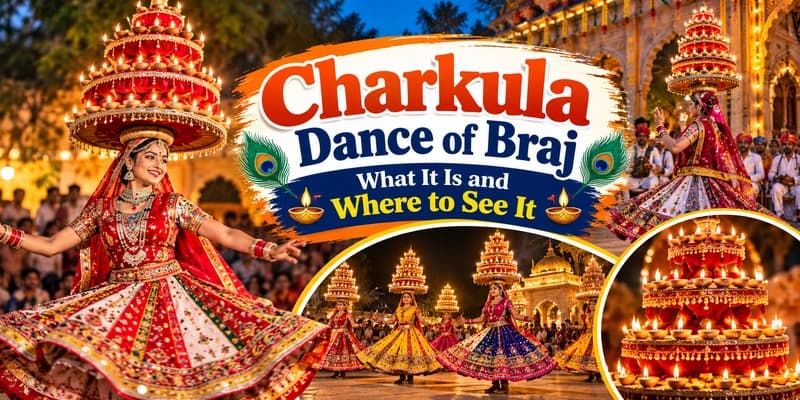
The dance is named after the charkula, a large, multi-tiered circular wooden pyramid or wheel-like column and the whole performance centres on balancing it.
The balancing act. Veiled female dancers balance this massive structure, which can weigh up to 50 kg, directly on their heads while they dance, a feat of extraordinary strength, balance and grace.
The hill of fire. The wooden tower holds between 51 and 108 lit earthen oil lamps (diyas) arranged in a spiral. As the dancers glide, whirl and bend, the glowing tower creates a stunning “hill of fire” effect.
Music and rhythm. Performers move gracefully to the beat of Bumb drums and traditional Rasiya songs, devotional folk songs dedicated to the divine love of Radha and Krishna.
The combination of physical endurance, the fire-lit tower and the devotional Rasiya music makes Charkula one of the most mesmerising folk arts of Braj.
It helps to picture the scene. A performance usually begins quietly: the tower is assembled and the lamps are lit away from the dancer, then lifted onto her padded head-ring while helpers steady it. Only when it is balanced does she begin to move, slowly at first, then with growing confidence, dipping and turning so the flames trace circles in the dark. Because the dancer’s face is veiled and her hands are often busy with graceful mudras rather than holding the tower, the illusion is that the hill of fire floats of its own accord. Set against the night and the drums, it is less a stage act than a vision, which is exactly how Braj intends its devotional arts to feel.
The charkula tower and the hill of fire
The object at the heart of the dance deserves a closer look, because its making is an art in itself. The charkula is a tall wooden frame, part pyramid and part wheel, built up in tiers around a central pole. Each tier carries a ring of small earthen lamps, so that from base to crown the whole structure can hold anywhere from fifty-one to over a hundred diyas, arranged in a rising spiral. Filled with oil, lit and raised, it is heavy, awkward and alive with flame all at once, which is why Braj speaks of it in the same breath as a feat of devotion.
The lamps are ordinary village diyas, the same clay cups used in every Braj home, which keeps the dance rooted in the ordinary materials of the land rather than in anything grand or imported. The number carried is itself meaningful: counts such as fifty-one and one hundred and eight recur across Hindu worship as auspicious figures and the dancers and their families take care over them. Preparing the tower, trimming the wicks, filling the oil and lighting each lamp in order is a shared village task that begins hours before the performance and watching that preparation is part of the experience if you arrive early. When the finished tower is finally lifted and the first turn is taken, the effect that gives the dance its nickname, the hill of fire, is unmistakable even to a first-time visitor.
Origins and legends
The dance is steeped in Braj folklore and carries deep symbolic meaning. These are told as local legend and tradition.
Radha’s birth. By Braj legend, when Radha was born, her maternal grandmother, Mukhra Devi, was so overjoyed that she placed a chariot wheel lit with lamps on her head and danced to announce the news, the origin of the Charkula.
The Govardhan Leela. Another tradition holds that the dance re-enacts the Govardhan Leela, the lamp-laden tower symbolising the great Mount Govardhan that Krishna lifted on his finger to shelter the people of Braj from Indra’s torrential rains; see govardhan hill significance.
The Radha-birth story is why the dance is so closely tied to Mukhrai village and to Radha’s birth anniversary just after Holi, linking Charkula to Radha’s own Barsana, see the shri radha rani temple.
The music: Bumb drums and Rasiya songs
Charkula is never danced in silence. Its heartbeat is the Bumb, a large barrel drum whose deep, rolling pulse sets the pace for the dancer and carries across an open village ground and around it cluster other folk percussion and the voices of the singers. The sound is meant to be felt as much as heard and it is what lifts the dance from a display of balance into an act of worship.
Over that rhythm come the Rasiya, the devotional folk songs of Braj that sing of the love of Radha and Krishna. Rasiya singing is a tradition in its own right across the region, especially around Holi, full of teasing, longing and celebration and it supplies both the words and the mood of the Charkula. The lyrics recall Krishna’s pastimes, Radha’s beauty and the joy of the gopis, so that the whirling tower of flame becomes a visible echo of what the singers are describing. For a visitor, understanding even a little of what the Rasiya are saying deepens the dance considerably, because the music is not a backdrop to the spectacle, it is the devotional story that the spectacle is dancing out.
Where and when to see Charkula
Because Charkula is a living folk culture tied to specific seasonal festivities, timing your visit is crucial to witnessing an authentic performance.
Mukhrai village (Mathura district). Considered the birthplace of Charkula (named after Radha’s grandmother, Mukhra Devi), where the rural communities strictly preserve the tradition. This is the place to see it at its most authentic.
The best time: post-Holi. The absolute prime time is the third day after Holi, marking Radha’s birth anniversary, when Charkula is the grand climax of the world-famous, multi-day Braj Holi celebrations. See our mathura vrindavan holi guide.
Other occasions. Outside Holi, Charkula is occasionally performed around Radha Ashtami and at government-sponsored cultural programmes across the state, managed by the Uttar Pradesh Department of Culture.
Dates follow the Hindu calendar and the Holi schedule, so confirm the Mukhrai Charkula timing locally before planning around it.
How Charkula fits the Braj festival calendar
Charkula is best understood as one bright thread in the long festival weave of Braj rather than a standalone show. Its great moment comes in the days immediately after Holi, when the region is already alive with colour, Rasiya singing and the famous Lathmar play at Barsana and Nandgaon. On the third day after Holi, by tradition the anniversary of Radha’s birth, the celebration moves to Mukhrai and the Charkula becomes the fiery crown of the whole Holi season.
Beyond this peak, the dance surfaces at other Radha-centred occasions, most notably around Radha Ashtami in the late monsoon, Radha’s main birth festival, when devotion to her is at its height across Braj. It also appears at state and district cultural programmes through the year, where it represents the folk heritage of the Braj belt. For a traveller, the lesson is simple: the dance follows the devotional calendar of Radha and the rhythm of Holi, not a fixed tourist timetable, so the richest way to catch it is to come for a Braj festival and let the Charkula find you as part of a much larger celebration.
What to expect when you watch
A Charkula evening is a village event, not a ticketed theatre, so set your expectations accordingly and you will enjoy it far more. The performance usually takes place on open ground or a temple courtyard, often after dark so the lamps show at their best and it draws a large, pressing and joyful crowd. There is rarely fixed seating, so arrive early if you want a clear view and be ready to stand and shift with the throng.
The lamps are real flame, so give the dancers space and keep children and loose clothing well back; the performers and organisers manage the risk carefully and visitors should simply not crowd the dancing area. For photography, the low light and constant movement are a challenge and a steady hand or a phone braced against something will serve you better than a flash, which washes out the very glow you came to capture. Dress modestly, as you would for any village temple occasion and carry water and a little patience, because folk timings are flexible and the main performance may start later than announced. Above all, treat it as the act of devotion it is: a quiet word of thanks to the performers afterwards is always welcome and warmly received.
Planning your visit
The best way to experience Charkula is to build it into a Braj Holi trip: stay on for the third day after Holi and head to Mukhrai village for the performance, the fiery climax of the festivities. Because Mukhrai is a village and the event is seasonal, local knowledge and transport help a great deal and Holi-week travel means heavy crowds and road restrictions, so plan ahead. Mukhrai lies in the western Braj area near Barsana and Nandgaon; see places to visit in barsana and places to visit near mathura. For the seasons and arrival, see best time to visit and how to reach vrindavan.
Let a Brajwasi take you to the hill of fire
Charkula at Mukhrai is a hidden gem most Holi visitors never see and reaching the right village at the right time takes local know-how. As Brajwasis, we build the Mukhrai Charkula into a Braj Holi trip, time it for the third day after Holi, arrange transport to the village through the festival crowds and tell you the Radha-birth story behind the hill of fire. See our govardhan barsana tour for the western-Braj area; a shared Braj day starts from around 1499 rupees per person or we design a private Holi-and-Charkula plan. Message us on WhatsApp at +91-7302265809 with your dates.
Related guides
Book Your Mathura - Vrindavan Trip Today
📞 +91-7302265809
💬 WhatsApp: +91-7302265809
We Reply in 30 Minutes
Packages start from ₹1,999/ person | Rated 4.5★ / 204+ Reviews
Explore all: Mathura Vrindavan Tour Packages
Jai Shri Krishna
Meet Gurudutt — Your Mathura Vrindavan Guide
Not just a tour operator — Gurudutt was born and raised in Braj Bhoomi. He has spent over a decade personally guiding pilgrims through the sacred lanes of Mathura & Vrindavan.
Founder – Experience My India
Gurudutt
Founder · Experience My India