Travel Guide · Sacred Places & Nature · Updated November 2026
Lohvan: The Braj Forest Where Krishna Slew Lohasura
By Gurudutt, Experience My India·4 November 2026
Quick Answer
Quick Enquiry
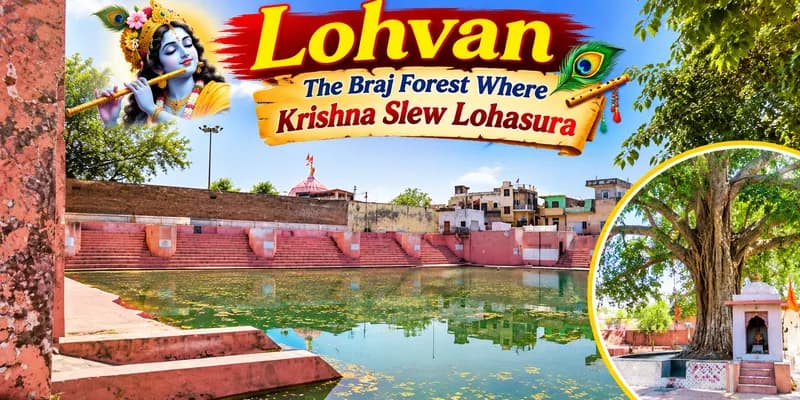
Lohvan is one of our twelve forests and it has a strong, dramatic story, by tradition it is where Krishna killed the iron-demon Lohasura while out grazing the cows and the forest is named for it. It lies just across the Yamuna from Mathura, over towards Gokul and Mahavan, so it is a peaceful, green, rural site, not a busy temple town. There is a Gopinath Ji temple here, the Krishna Kund where the boating pastimes are remembered, the Lohasura temple and an old cave and a lovely local custom of donating iron. It is mostly pilgrims on the Chaurasi Kos Yatra and Gokul-side visitors who come. Let me take you across the river and tell you the stories on the spot. Radhe Radhe. See our Mathura Vrindavan tour Packages or message WhatsApp +91 7302265809.
What Lohvan is
Lohvan, also written Lohavan or Lohjanghvan, is one of the twelve principal sacred forests of Braj, the Dwadash Vana. Each of the twelve forests is tied to particular pastimes of Krishna and his companions and together they form a key part of the region’s sacred geography and the traditional Braj Chaurasi Kos Yatra, the great 84-kos circuit.
Lohvan’s distinctive character comes from its powerful demon-slaying legend and its riverside setting. It lies directly across the Yamuna from Mathura, over towards the Gokul and Mahavan region in Mat Tehsil, so it is a quiet, green, natural grove and temple site rather than a commercialised urban complex. This puts it on the eastern, Gokul side of the river, the same side where Krishna spent his early childhood, which is why Lohvan is often taken in alongside a Gokul visit. It is visited mainly by pilgrims walking the twelve forests and by those exploring the deeper leela-sites of Braj. The sections below cover the Lohasura legend and the forest’s name, the boating pastimes, its temples and shrines, the well-known iron-donation custom, its timings and location and how to reach it and combine it with a wider Braj plan.
The Lohasura legend and the name
Lohvan’s name and fame come from one of Krishna’s demon-slaying pastimes. By Puranic and Braj tradition, it was here, while Krishna was pasturing his cows, that he killed the demon Lohasura, also called Lohjanghasur, who is described as having an iron-like body, iron thighs or an iron torso (loha meaning iron). The forest takes its name from this event: Loha-vana, the forest of the iron-demon, or Lohjangha-vana. So where Bhadravan belongs to Balarama and Talavan to the palm groves, Lohvan is marked above all by this victory over Lohasura.
The site is also chronicled in tradition as a place connected with Krishna and Balarama’s repeated defeats of the king Jarasandha, who, in the epics, attacked Mathura many times. These are devotional and scriptural traditions, held dear by the faithful and recounted here in that spirit, part of the larger cycle of Krishna’s pastimes as the protector of Braj who rid the land of demons and tyrants. Understanding the Lohasura story is the key to Lohvan: it explains the forest’s name, its Lohasura temple and the distinctive iron-donation custom that still marks the site today.
The boating pastimes at Krishna Kund
Alongside the Lohasura legend, Lohvan holds a gentler and much-loved pastime. Tradition notes that near the local Krishna Kund, Lord Krishna performed Naukavihar, the boating pastimes, in which, by the lore, he disguised himself as a boatman and took the Gopis across the water, a famous and playful episode of the Braj leela. So the same forest that remembers the fierce slaying of an iron-demon also remembers one of Krishna’s tender, teasing water-pastimes with the Gopis, which is very much the character of Braj, where the mighty and the sweet sit side by side.
The Krishna Kund is therefore one of the devotional focal points of Lohvan, tied to this Naukavihar tradition. As with the boating-pastime and ghat sites elsewhere along the river, it connects Lohvan to the wider Yamuna leela of Braj; see our braj yamuna ghats and leela sites guide. These are cherished devotional traditions, recounted in that spirit rather than as literal history and they give a visit to the kund its meaning.
Temples and shrines at Lohvan
For a quiet forest, Lohvan holds several important sites.
Gopinath Ji temple. The historic central temple of the forest, housing Krishna as Gopinath, traditionally attributed to Vajranabh, Krishna’s great-grandson, who is credited in Braj tradition with establishing many of the region’s ancient temples. (Note that this is Lohvan’s own Gopinath Ji temple across the Yamuna, distinct from the famous Gopinath temple of Vrindavan.)
Krishna Kund. The sacred kund tied to the Naukavihar (boating) pastime, a devotional focal point of the forest, where pilgrims offer prayers (as at any kund, if you go down to the water, step carefully and stay in shallow, safe water).
Lohasura temple. A shrine connected to the Lohasura legend that gives the forest its name, where the iron-donation custom is centred.
Lohajangha Gufa. A subterranean cave associated with the Lohjangha tradition, an unusual and atmospheric feature of the site.
Together these make up the sacred core of Lohvan, a small but layered pilgrimage site. The Gopinath Ji temple, Krishna Kund, Lohasura temple and Lohajangha cave are all local shrines of this forest; a local guide can point out each one and tell you its place in the forest’s story, which is helpful since Lohvan is a rural grove rather than a signposted complex.
The iron-donation custom and its significance
Lohvan’s most distinctive living custom flows directly from the Lohasura legend. Devotees here traditionally donate iron items (loha), a practice tied, in local belief, to pacifying the legacy or soul of the demon Lohasura. In the local tradition, this iron-donation is also associated with seeking relief from planetary or Saturnine afflictions, often linked locally with beliefs around Shanideva (Saturn), since iron is the metal associated with Shani. So pilgrims may bring and offer iron at the Lohasura temple as part of their visit.
This should be understood as a local devotional and folk custom, held dear by those who observe it and described here in that spirit, rather than as any assured remedy; whether or not a visitor shares the astrological belief, it is part of what makes Lohvan a distinctive stop. Beyond this specific custom, Lohvan carries the general significance of all the twelve forests: it is a key stop for pilgrims undertaking the wider Braj Chaurasi Kos Yatra and passing through it is part of completing that great circuit. The combination, a demon-slaying site, a boating-pastime kund and a distinctive iron-donation custom, gives Lohvan a character unlike any of the other forests. It is a cherished part of the Braj tradition.
Timings, location and best time to visit
Lohvan is an open, outdoor sacred grove and temple site and visiting it is straightforward.
General hours: generally accessible daily from early morning (around 5:00 AM) to evening (around 7:00 PM). Entry is free.
Location: across the Yamuna from Mathura, near the Gokul and Mahavan region, in Mat Tehsil, Mathura district, Uttar Pradesh (roughly 27.5056 degrees N, 77.7275 degrees E).
Best time: daylight hours are recommended, since this is a quiet, natural forest setting rather than a commercialised urban complex and the cool months of October to March, in the morning, are the most pleasant.
Please treat the hours as indicative, since this is a natural grove and village temple site rather than a large managed complex and local and temple timings can vary, so confirm on the day. Lohvan is accessible year-round, with no special calendar-restricted entry date. Because it is across the river and off the main Mathura-Vrindavan tourist route, it rewards a planned visit; see our how to reach vrindavan guide for the region, where to stay in vrindavan for a base and best time to visit for the season.
How to reach, Holi 2027 and combining with Braj
Lohvan is across the Yamuna from Mathura, near Gokul and Mahavan, in Mat Tehsil. It is reached by private taxi or vehicle crossing to the eastern, Gokul side of the river; because it is off the usual tourist route, a local who knows the way is genuinely helpful in finding it. See our mathura to vrindavan distance guide for a sense of the region’s layout.
Being on the Gokul side, Lohvan is best combined with a Gokul and Mahavan visit, the land of Krishna’s infancy; the nearby gokulnath temple is a natural pairing. It is primarily taken in as one of the twelve forests on the braj chaurasi kos yatra and fits into a wider exploration of the sites around Mathura; see our places to visit near mathura guide.
On 2027 dates, Lohvan has no special calendar-restricted entry and can be visited any time of year. The one thing to note is that the big regional festivals of the Mathura-Braj belt draw heightened pilgrim numbers to all the sacred forests, Lohvan included. In particular, Holi 2027, with Rangwali Holi expected on 22 March 2027, brings crowds across Braj through March; see our mathura vrindavan holi guide and treat the date as expected per the panchang and reconfirm nearer the time. A ready-made plan helps you fit a quieter, across-the-river forest like Lohvan into your trip; see our mathura vrindavan tour plan.
Let a Brajwasi plan your visit
Across-the-river forests like Lohvan, over towards Gokul and rarely signposted, are exactly where a local guide makes the difference, both to reach them and to understand their stories. As Brajwasis running Experience My India, we can include Lohvan in your Braj plan, take you across the Yamuna to the Gopinath Ji temple, Krishna Kund, Lohasura temple and the Lohajangha cave, tell you the Lohasura legend and the Naukavihar boating pastime on the spot, explain the iron-donation custom, pair it with Gokul and Mahavan or fit it into the Chaurasi Kos Yatra and arrange private transport and a local guide so the quieter forests are not missed. A shared Mathura and Vrindavan darshan starts from around 1,499 rupees per person; see our mathura vrindavan tour, or, for the Gokul side specifically, our gokul mathura vrindavan tour. Message us on WhatsApp at +91-7302265809 with your plans.
Related guides
Book Your Mathura - Vrindavan Trip Today
📞 +91-7302265809
💬 WhatsApp: +91-7302265809
We Reply in 30 Minutes
Packages start from ₹1,999/ person | Rated 4.5★ / 204+ Reviews
Explore all: Mathura Vrindavan Tour Packages
Jai Shri Krishna
Start with these
Meet Gurudutt — Your Mathura Vrindavan Guide
Not just a tour operator — Gurudutt was born and raised in Braj Bhoomi. He has spent over a decade personally guiding pilgrims through the sacred lanes of Mathura & Vrindavan.
Founder – Experience My India
Gurudutt
Founder · Experience My India