Travel Guide · Travel Guides · Updated October 2026
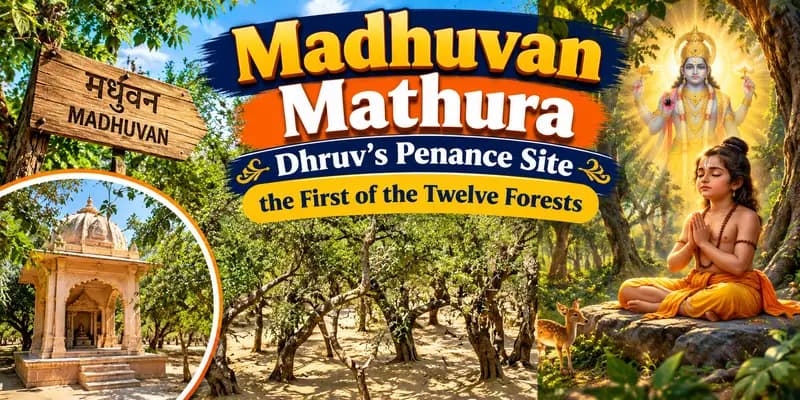
Madhuvan Mathura: Dhruv’s Penance Site, the First of the Twelve Forests
By Gurudutt, Experience My India·28 October 2026
Quick Answer
Quick Enquiry
Madhuvan is special to me because it is the first of our twelve forests and because of little Dhruva, a five-year-old whose devotion was so complete that the Lord Himself appeared to him here. I bring devotees to Dhruva Tila and tell that story and it moves even the children in the group. It is just southwest of Mathura, quiet and green, yet the tradition says the Lord acted here in all four ages. For anyone who wants the deeper Braj, Madhuvan is a beautiful first step. See our Mathura Vrindavan tour Packages or message WhatsApp +91 7302265809.
The penance of child-devotee Dhruva
Madhuvan is most famously revered as the place where, in the Satya Yuga, the five-year-old prince Dhruva Maharaja performed rigorous, unwavering austerities (tapasya) to please the Lord. The story is told in the Puranas as follows.
The divine mantra. Guided by the sage Narada, the young child chanted the sacred mantra at this very spot, with complete concentration.
The vision. Pleased by his absolute devotion, the Lord is said to have appeared before him in His four-armed form as Lord Prishnigarbha.
The boon. The Lord granted him sovereignty over the Earth for 36,000 years and afterward the permanent rulership of Dhruvalok, the Pole Star, an imperishable spiritual abode.
Today this pastime is commemorated at Dhruva Tila, a sacred mound on the eastern side of Maholi village, housing the beautiful deities of child Dhruva and four-armed Lord Narayan. It is recounted as Puranic tradition and it is the heart of Madhuvan’s fame as a place of a child’s perfect devotion.
Pastimes across the four cosmic ages
By tradition, Madhuvan’s sanctity spans all four yugas, which is part of why it is so revered among the twelve forests.
Yuga (age) | Divine aspect | Pastime (as told in tradition) |
Satya Yuga | Madhusudana / Prishnigarbha | The Lord defeated the tyrant demon Madhu, giving the forest its name and blessed the penances of Dhruva and King Ambarisha |
Treta Yuga | Shatrughna | Rama’s youngest brother slew the demon Lavanasura (son of Madhu) and is said to have founded the city of Mathura on this soil |
Dvapara Yuga | Krishna and Balarama | Krishna grazed his cows in Madhuvan’s meadows, played with his cowherd friends, and by tradition, began the Rasa Leela with the gopis here |
Kali Yuga | Chaitanya Mahaprabhu | The golden avatar visited Madhuvan on his Braj pilgrimage and bathed in the local Krishna Kund |
These accounts are given as scripture and tradition rather than documented history and together they make Madhuvan a forest where, in the devotional imagination, all four ages meet. The Shatrughna connection also ties Madhuvan directly to the founding of nearby Mathura; see our places to visit in mathura.
The name Madhuvan, the demon Madhu and Lord Madhav
By tradition the name Madhuvan carries a double meaning that devotees love to dwell on. “Madhu” is the Sanskrit word for honey and for sweetness, so Madhuvan is literally the Honey Forest, described in the Padma and Adi Varaha Puranas as a place of a special, nectar-like spiritual sweetness among the twelve forests of Braj. At the same time, the name is said to recall the demon Madhu, a tyrant who, in the Satya Yuga, is remembered in the Puranas as troubling this region. By tradition the Lord subdued him here and from that act comes one of His best-loved names, Madhusudana, which means the slayer of Madhu.
The presiding deity of the forest, in the traditional reckoning of the Dwadash Van, is Lord Madhav and pilgrims walking the parikrama greet Him with the invocation preserved for this van. For devotees, the layered name ties together the sweetness of Krishna’s own land, the memory of a demon overcome and the presence of the Lord who guards the forest, all in a single word. It is worth pausing on, because the name itself is a small lesson in how Braj remembers its stories: a place is rarely named for one thing alone, but holds its scripture, its legend and its mood together. This is why many pilgrims feel that simply arriving in Madhuvan and saying its name with attention, is already a kind of darshan.
Key sacred sites and the parikrama
If you are doing a parikrama (circumambulation) of Madhuvan, the traditional route runs about 5 km and takes in these key points.
Dhruva Tila and temple. The elevated mound with the deities of child Dhruva and Lord Narayan, a profoundly peaceful spot for meditation and prayer and the heart of the Dhruva story.
Shatrughna Temple. A rare, ancient temple dedicated to Lord Shatrughna, celebrating the forest’s liberation from Lavanasura, one of very few temples anywhere to this brother of Rama.
Krishna Kund. A holy water tank where pilgrims perform achamana (purifying sips) and bathe, honouring the pastimes of Krishna and the bath of Chaitanya Mahaprabhu.
Devotees doing the parikrama here traditionally chant the invocation to the forest’s presiding deity, Lord Madhav: “Om Hram Hrim Madhuvana-adhipataye Madhavaya Namah Svaha”. As the first of the twelve forests, Madhuvan is a natural starting point for the fuller braj chaurasi kos yatra, the 84-kos pilgrimage of the Dwadash Van.
The best time to visit Madhuvan
Madhuvan rewards an unhurried visit, so both the season and the hour matter. The most comfortable months are from around October to March, when the Braj air is cool and the walk between Dhruva Tila, the Shatrughna Temple and Krishna Kund is pleasant rather than tiring. April to June can be very hot in this part of Uttar Pradesh and the monsoon months bring greenery but also muddy village paths, so the winter window is the easy choice for most pilgrims. Exact conditions vary year to year, so it is sensible to confirm locally before you plan a long parikrama.
For the time of day, early morning is the loveliest. The light is soft, the mound at Dhruva Tila is quiet and you can sit and hear the story of little Dhruva without the midday heat. A morning visit also leaves the rest of the day free for Mathura, since Madhuvan sits so close to the city. If you can, avoid the harsh middle of the day in summer and plan any walking for the cooler early hours or the late afternoon. Festival days can be busier and the local temples may keep different hours, so for those it is best to confirm timings nearer the time rather than relying on a fixed schedule.
Visitor tips, etiquette and what to combine nearby
Madhuvan is a working village (Maholi) rather than a polished monument and part of its charm is that quiet, rural character. A few simple things make the visit smoother. Wear comfortable shoes you can slip off easily at the temples, since you will remove footwear at Dhruva Tila and the Shatrughna shrine. Dress modestly, as you would at any Braj temple and carry a little drinking water, especially if you intend to walk the parikrama. A local driver or guide is genuinely useful here, because the key sites are spread along the path and are not always obvious to a first-time visitor.
As at all holy sites, treat the kunds and shrines with care: the water of Krishna Kund is sacred to pilgrims, so avoid using soap or leaving any litter. Photography is usually welcome outdoors, but check before photographing inside a sanctum and never while an aarti is in progress. Because Madhuvan sits just southwest of Mathura, it combines beautifully with a city darshan of the Krishna Janmabhoomi, Dwarkadhish and Vishram Ghat and it makes a natural first stop for anyone setting out on the longer twelve-forests pilgrimage. Many visitors give Madhuvan a calm morning and then turn to the Mathura temples for the rest of the day, which keeps the pace gentle and the stories fresh.
Where it is, how to reach it and planning
Madhuvan (Maholi village) is just southwest of Mathura, which makes it one of the most accessible of the twelve forests, easily added to a Mathura visit.
From Mathura. It is a short drive southwest of the city, reachable by taxi or auto; being so close to Mathura, it pairs naturally with the city’s darshan, see our places to visit near mathura guide.
By train. The nearest major railhead is Mathura Junction, with a short onward road trip to Maholi.
By air. The nearest major airport is Delhi, via the Yamuna Expressway to Mathura and onward.
Allow an hour or two for Dhruva Tila, the Shatrughna Temple and Krishna Kund, longer if you walk the 5 km parikrama. For timing, see best time to visit; the cooler October-to-March months are ideal and for arrival into the region, how to reach vrindavan.
Let a Brajwasi begin your twelve-forests journey
Madhuvan is the first of the twelve forests and a lovely place to begin the deeper Braj with a local who knows the stories. As Brajwasis, we bring you to Dhruva Tila and tell the story of little Dhruva where it happened, cover the Shatrughna Temple and Krishna Kund and can begin a fuller twelve-forests or Mathura journey from here. See our mathura vrindavan tour; a shared Mathura-Vrindavan darshan starts from around 1499 rupees per person or we design a private plan. Message us on WhatsApp at +91-7302265809 with your dates.
Related guides
Book Your Mathura - Vrindavan Trip Today
📞 +91-7302265809
💬 WhatsApp: +91-7302265809
We Reply in 30 Minutes
Packages start from ₹1,999/ person | Rated 4.5★ / 204+ Reviews
Explore all: Mathura Vrindavan Tour Packages
Jai Shri Krishna
Start with these
Meet Gurudutt — Your Mathura Vrindavan Guide
Not just a tour operator — Gurudutt was born and raised in Braj Bhoomi. He has spent over a decade personally guiding pilgrims through the sacred lanes of Mathura & Vrindavan.
Founder – Experience My India
Gurudutt
Founder · Experience My India