Travel Guide · Temple Guides · Updated October 2026
Belvan (Bilvavan): Lakshmi Temple, Story and How to Visit
By Gurudutt, Experience My India·30 October 2026

Quick Answer
Quick Enquiry
Belvan is one of the most touching stories in all of Braj. Even Lakshmi, the goddess of all wealth, could not simply enter Krishna’s Rasa, because here in Vrindavan what counts is not majesty but pure, humble love. So she sits across the Yamuna doing penance, still today. I love taking devotees to her Mahalaxmi temple, the only big one in Braj and especially during the Paush khichdi mela, when the fields fill with little fires cooking khichdi for Ma Lakshmi. It is Braj at its sweetest. See our Mathura Vrindavan tour Packages or message WhatsApp +91 7302265809.
The divine story of Belvan
The lore of Belvan blends the majesty of Goddess Lakshmi with the intimate, sweet devotion (Madhurya Rasa) that is unique to Vrindavan. It is told as scripture and tradition.
The longing for the Rasa
By the scriptures, the sage Narada once visited Vaikuntha and described to Goddess Lakshmi the sweetness of Krishna’s Rasa Leela and the great spiritual fortune of the gopis. Captivated, a deep desire arose in Lakshmi’s heart to behold and join that dance.
Denied entry by the gopis
Lakshmi descended and approached the Rasa arena, but the gopis and Lalita Sakhi gently stopped her at the forest’s border. They explained that entry into the Rasa Leela requires unconditional, pure surrender and a gopi-like mood of selfless love, whereas Lakshmi embodies Aishwarya, regal wealth, majesty and opulence, which does not match the intimate sweetness of Vrindavan.
The penance facing Vrindavan
Unwilling to return to Vaikuntha without witnessing the Leela, Lakshmi stayed in this forest, then thick with sacred bilva (bael) trees and sat facing across the Yamuna toward Vrindavan, beginning thousands of years of intense austerity (tapasya) to qualify for the dance. Local tradition holds that she meditates there still, waiting for admission into the inner circle of devotion.
The tradition of the khichdi
By tradition, when a tired, hungry Krishna finished his Rasa Leela he crossed over to Belvan. Seeing him, Lakshmi wanted to cook for him but had no fire, so in her devotion she lit the edge of her own royal saree to cook a simple pot of khichdi. Touched by her loving service, Krishna ate it and blessed her with a permanent home in Braj. This is the story behind Belvan’s beloved khichdi tradition.
The name and its deeper meaning
Belvan takes its name from bilva (the sacred bael or wood-apple tree) and van (forest). In the Dvapara Yuga, by tradition, this was a thick grove of bael trees where Krishna, Balarama and their cowherd friends grazed cows, played and feasted on ripe, sweet bael fruit.
Spiritually, Belvan marks a boundary: between the inner sweetness (Madhurya) of Vrindavan and the outer majestic opulence (Aishwarya) of the cosmic world. This is why devotees come to Belvan to pray for humility and the pure, selfless devotion needed to realise the higher states of spiritual love, the very quality Lakshmi herself, in the story, came here to cultivate.
There is a quiet poetry in the geography too. The bael tree, whose leaves are offered above all to Lord Shiva, gives the forest its name and in the older Braj the grove would have been dense with these trees and their hard, fragrant fruit. By tradition the young Krishna and Balarama grazed their cows and played here, so the same forest that later became the seat of Lakshmi’s longing was once simply a boy’s playground. That layering, a cowherd’s grove, a goddess’s penance ground and the far bank from which one gazes at Vrindavan, is what gives Belvan its particular, wistful atmosphere and why those who know the story find it so affecting to stand there.
The Mahalaxmi Temple and the Khichdi Mela
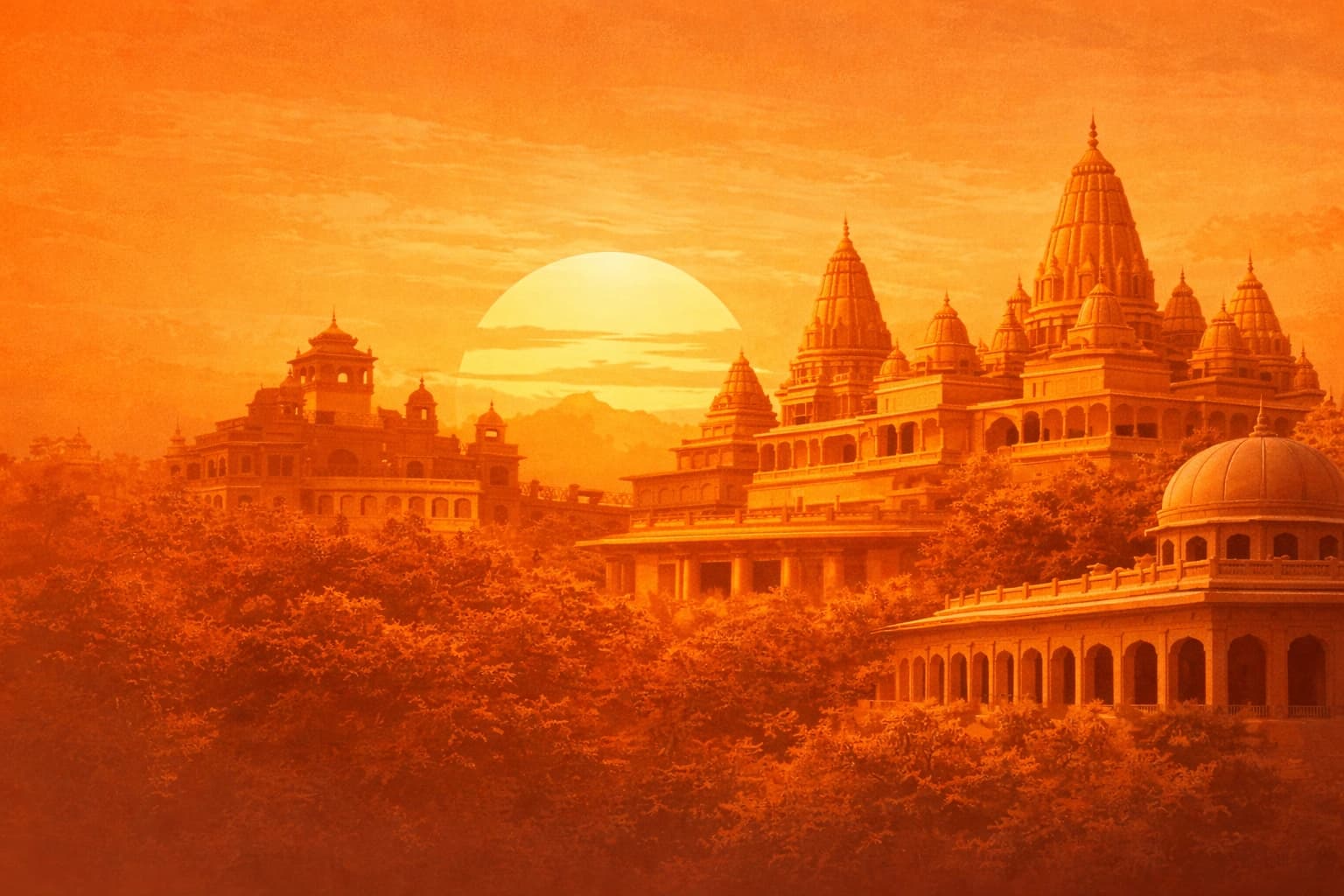
The Shri Mahalaxmi Temple at Belvan is, by repute, the only prominent temple dedicated entirely to Goddess Lakshmi in the whole Braj region, which, in a land overwhelmingly devoted to Radha and Krishna, makes it quite unique. It sits peacefully away from the central Vrindavan crowds, in a rural, serene setting on the Yamuna’s eastern bank.
The grand Khichdi Mela. The most special time to visit is during the Hindu month of Paush (typically December to January). On every Thursday of Paush, a massive fair, the Belvan Mela, takes place: thousands of pilgrims gather in the fields around the temple, set up small clay stoves, cook khichdi over open wood fires, offer it to Ma Lakshmi and distribute it as prasad, re-enacting the loving service of the goddess herself. It is one of the most atmospheric melas in Braj.
What makes the mela so moving is that the pilgrims do not merely watch a ritual, they perform the goddess’s own act of devotion with their own hands. Families carry rice, lentils, ghee and firewood across the river or down the road, scoop out a little hollow in the winter fields and tend their own small fire until the khichdi is done. The smoke of hundreds of these fires drifts over the fields in the cold Paush air, the smell of cooking khichdi is everywhere and the whole gathering shares what it has cooked. It is humble food cooked in a humble way, exactly the point of the story and offering it here is understood as a prayer for Lakshmi’s grace in the coming year. Many families come annually, treating the Belvan khichdi as a vow kept.
Outside the mela season the temple is a quiet, almost sleepy place. On an ordinary day you may have the Mahalaxmi shrine and the riverside largely to yourself, which suits the contemplative mood of Lakshmi’s penance. For a devotee of the goddess, simply sitting here on the far bank, looking across the Yamuna toward Vrindavan as she is said to have done, is the heart of the visit, with or without the fair.
The twelve forests of Braj and Belvan’s place
Belvan is counted among the Dwadash Van, the twelve principal forests of Braj, the devotional map of groves through which Krishna’s childhood pastimes are remembered and the great pilgrim circuit threads. Each forest, by tradition, carries its own character and story: some recall Krishna’s play with the cowherds, some a saint’s austerity and Belvan, uniquely, the penance of Goddess Lakshmi and the teaching of humble love over majesty. Among a dozen forests almost all tied to Radha and Krishna, Belvan stands slightly apart as the one where the great goddess of fortune herself comes as a seeker, which is a large part of why pilgrims make the effort to include it.
Traditionally the forests are visited in sequence on the Braj parikrama, the long circumambulation of the whole dham, so Belvan is usually experienced as one stop within a much larger sacred landscape rather than in isolation. For travellers drawn to that fuller journey across the region, the braj chaurasi kos yatra is the circuit that links all twelve forests together and Belvan, across the water from Vrindavan, is one of its more reflective waypoints.
Even for a visitor with no intention of walking the whole circuit, holding this context in mind deepens the visit. You are not seeing an isolated temple but one bead on a long devotional thread, in a land where almost every village, pond and grove carries a name and a story from Krishna’s life. Belvan’s particular contribution to that thread, that even Lakshmi must learn the way of the gopis, is one of the most quietly profound lessons the twelve forests hold.
How to visit and location
The temple is in Jehangirpur village (Post Dangauli, Mant Tehsil), Mathura district, on the eastern bank of the Yamuna, directly opposite central Vrindavan.
By road (easiest). Hire a taxi or auto from Vrindavan or Mathura. The route takes the Pani Gaon Road / Chhatikara-Vrindavan route over the main Yamuna bridge and heads toward Mant, roughly 30 to 45 minutes from central Vrindavan. See our chhatikara road guide for that side of town.
The seasonal bridge route. In winter and the dry season, a temporary pontoon bridge or riverbed path sometimes operates straight across from areas like Banshivata or Dhir Samir in Vrindavan, a quick shortcut to Belvan. This route is seasonal and weather-dependent, so confirm locally whether it is open before relying on it; otherwise use the road bridge.
By train or air. The nearest railhead is Mathura Junction and the nearest airport is Delhi, both with onward road travel via Vrindavan.
For arrival into the wider region, see how to reach vrindavan; from Vrindavan itself, Belvan is a short onward hop by road or the seasonal crossing.
Best time to visit
The most comfortable season for Belvan is the cooler, drier stretch from roughly October to March, when the riverside is pleasant and the walking around the temple and fields is easy (confirm seasonal conditions locally). This season also happens to contain the site’s most special time, the Paush khichdi mela, so a winter visit can give you both gentle weather and on a Paush Thursday, the great fair. The summer months of April to June are hot and better avoided for a rural, open-air site like this, while the monsoon raises the Yamuna, which is precisely when the seasonal river crossing becomes unreliable. For a fuller view of the region’s seasons, see our guide to the best time to visit Vrindavan and Mathura.
The single most significant window is the Hindu month of Paush, usually December to January and in particular its Thursdays, when the Khichdi Mela fills the fields (confirm the exact Paush dates nearer the time, as they shift with the Hindu calendar). Come then for the atmosphere and the shared devotion, but expect large, happy crowds and busy approaches. If instead you want the still, contemplative Belvan, the forest of Lakshmi’s quiet penance, choose an ordinary weekday in the cool season, ideally in the morning, when the Mahalaxmi temple and the riverbank are at their most peaceful.
Planning your visit
Belvan is a serene, rural half-day from Vrindavan, give it a couple of hours for the Mahalaxmi temple and the riverside calm or plan a Paush Thursday if you want the Khichdi Mela. Because it lies just across the Yamuna, it pairs naturally with a Vrindavan trip; see places to visit in vrindavan. For those drawn to the Rasa-Leela sites, it complements the Vrindavan rasa-lila spots such as seva kunj, the inner sweetness Lakshmi’s story is all about.
Let a Brajwasi take you across the river
Belvan is off the usual circuit, across the Yamuna with a seasonal crossing, so a local who knows the routes and the story makes all the difference. As Brajwasis, we take you to the Mahalaxmi temple, tell Lakshmi’s penance and the khichdi story on the banks facing Vrindavan, time a visit for the Paush mela if you wish and arrange the road or seasonal crossing safely. See our vrindavan tour package; a shared Vrindavan darshan starts from around 1499 rupees per person or we design a private plan. Message us on WhatsApp at +91-7302265809 with your dates.
Related guides
Book Your Mathura - Vrindavan Trip Today
📞 +91-7302265809
💬 WhatsApp: +91-7302265809
We Reply in 30 Minutes
Packages start from ₹1,999/ person | Rated 4.5★ / 204+ Reviews
Explore all: Mathura Vrindavan Tour Packages
Jai Shri Krishna
Start with these
Meet Gurudutt — Your Mathura Vrindavan Guide
Not just a tour operator — Gurudutt was born and raised in Braj Bhoomi. He has spent over a decade personally guiding pilgrims through the sacred lanes of Mathura & Vrindavan.

Founder – Experience My India
Gurudutt
Founder · Experience My India