Travel Guide · Sacred Places & Nature · Updated November 2026
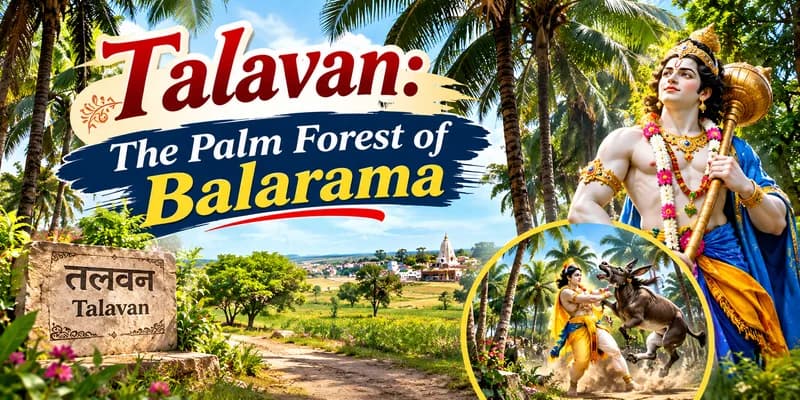
Talavan: The Palm Forest of Balarama
By Gurudutt, Experience My India·3 November 2026
Quick Answer
Quick Enquiry
Talavan is one of Braj’s twelve sacred forests and it belongs above all to Balarama ji, Krishna’s elder brother, our Dauji. This is the palm forest where, by our scriptures, Balarama ji destroyed the demon Dhenukasura and freed the sweet tal fruits for the cowherd boys, a story of his great strength. The forest is a village now, but the Dauji temple and the Sankarshana Kund, which Balarama is said to have dug with his plough, are still there, quiet and lovely. It is a little off the usual tourist route, about 9 km west of Mathura, so a local really helps you find and understand it. Come in the cool morning and let me tell you the story on the spot. See our Mathura Vrindavan tour Packages or message WhatsApp +91 7302265809.
What Talavan is
Talavan, also written Talvan and historically known as Talavana, is one of the twelve sacred forests (the Dwadasha Vana) of Braj Bhoomi, the land of Krishna and specifically the second of those twelve. It lies near the village of Tarsi, roughly 9 km west of Mathura and is revered as a divine playground of Lord Krishna and his elder brother Lord Balarama, celebrated above all as the site of one of Balarama’s great feats of strength.
The twelve forests of Braj are a cherished set of sacred woodlands, each tied to particular pastimes of Krishna and his companions and together they form a key part of the region’s sacred geography and the traditional Braj parikrama. Talavan is distinctive as a forest belonging especially to Balarama, which is less common, as most Braj sites centre on Krishna, so it holds a special place for devotees of Balarama (lovingly called Dauji in Braj). Though the ancient dense palm forest has, over the millennia, become a rural village, the sacred core remains, with its temple, its holy pond and a few symbolic palm trees. The sections below cover the meaning of its name, the Dhenukasura story, its spiritual symbolism, its key sites, timings and festivals.
The name and the slaying of Dhenukasura
The name Talavana translates directly as “the forest of palm trees”, from the Tal (palmyra) palms that once blanketed the area, heavy with sweet, nectar-like fruit. And it is around those palms that its great story turns.
By the Srimad Bhagavatam, this sweet-scented palm forest was seized and occupied by the fierce ass-demon Dhenukasura and his cohort, who terrorised the local cowherd boys and prevented anyone from eating the delicious palm fruits. At the request of his friends, who longed for the fruit, Lord Balarama entered the grove and shook the trees to bring the fruits down. When the enraged Dhenukasura charged at him, Balarama seized the demon by his hind legs, swirled him around and hurled him into the treetops, destroying him and liberating the forest from evil, so that the cowherds could at last enjoy the sweet fruits in peace. It is one of the celebrated demonstrations of Balarama’s immense strength and it is why Talavan is so closely associated with him. These are cherished devotional and scriptural traditions, held dear by the faithful and recounted here in that spirit.
The spiritual symbolism
Beyond the dramatic story, Talavan’s pastime carries a deeper meaning that devotees cherish. In the Gaudiya Vaishnava tradition, the demon Dhenukasura is understood to represent the psychological and spiritual obstacles that block a devotee’s path, ignorance, bad habits and material attachment, the inner “demons” that keep us from the sweetness of devotion, just as Dhenukasura kept the cowherds from the sweet palm fruits.
So Lord Balarama’s act of cleansing the forest, destroying the demon and freeing the sweet fruit, is understood as a symbol of the clearing of spiritual blocks from a devotee’s heart, so that the sweetness of divine love can be tasted. Balarama, as the Lord’s own strength (and, in theology, the first expansion of the Supreme), is the one who gives the devotee the spiritual strength to overcome these inner obstacles. This is why a visit to Talavan is not only a visit to a site of lore, but a reminder of the inner work of devotion, the removal of the ignorance and bad habits that stand between us and the divine. It is this layer of meaning that gives the quiet palm-forest village its enduring spiritual pull. These are devotional interpretations held dear in the tradition.
Key sites at Talavan
Though the ancient dense palm forest is now a rural village, the sacred heart of Talavan remains, with a few symbolic Tal trees still flanking the main religious spots. Two sites are central.
Shri Dauji Mandir. A peaceful temple housing beautiful, historic deities (about 3 feet tall) of Lord Balarama, as Dauji, alongside his eternal consort Srimati Revati Devi. As a temple centred on Balarama, it is relatively special in Braj and it is the devotional focus of a Talavan visit. (This is Talavan’s own Dauji temple; the great and separate Dauji temple at Baldeo, east of Mathura, is a different famous Balarama shrine.)
Sankarshana Kund. A sacred lake right next to the temple. By scriptural tradition, Balarama carved out this kund using his divine weapon, the plough (hala), to quench the thirst of the cowherd boys after the battle with Dhenukasura. (Sankarshana is one of Balarama’s names.) As at any kund, if you go down to the water, step carefully on the ghats and stay in shallow, safe water.
Together, the Dauji temple and the Sankarshana Kund make the core of the site, a temple to the hero of the forest and the pond he is said to have dug, set among the last of the palms. A local guide can tell you the story standing right where it is said to have unfolded, which brings the quiet village vividly to life.
Timings, parikrama and best time to visit
Talavan is a modest, rural sacred site, so visiting it is simple.
Operating hours: generally 6:00 AM to 6:00 PM daily (indicative, as local and temple timings can vary, so confirm on the day).
Time required: about 1 to 2 hours to visit the central Dauji temple and the Sankarshana Kund. For traditional pilgrims, a full parikrama of about 6 km (3 miles) encompasses the holy perimeter of the forest.
Best time to visit: the cool months of October to March offer the most pleasant weather for exploring and mornings are particularly serene and less crowded.
Please treat the hours as a general guide, since this is a village site rather than a large managed temple complex and confirm locally if you are coming for a specific darshan or festival. The early morning in the cool season is genuinely the loveliest time, quiet, gentle and uncrowded, which suits the reflective character of the place. In the summer the midday heat is best avoided. For the wider season, see our best time to visit guide and because Talavan is a little off the main route, it rewards a planned visit rather than a rushed one.
Important 2027 festivals
If you wish to time your visit with a celebration, keep these 2027 dates in mind, noting that they follow the traditional lunar calendar.
Balarama Jayanti (Baldev Chhath): expected 23 August 2027. This is the primary birth-anniversary celebration of Lord Balarama across North India and Braj and the main festival at Talavan, with major festivities, abhishekam (holy baths) of the deities and cultural events. It is the most charged and crowded time at the Dauji temple.
An alternative Balarama observance: around 5 September 2027. Some regional almanacs observe a secondary, harvest-and-strength festival linked to Balarama’s birth, falling about two days before Krishna Janmashtami.
The Bhadra forest festival: in the bright half of the lunar month of Bhadra (typically late August or early September). An annual celebration featuring local reenactments of the Dhenukasura pastime, bringing the forest’s own story to life.
Because these festivals follow the Hindu lunar calendar, the dates are expected and set by the panchang and can vary between regional almanacs (hence the two Balarama dates), so treat them as approximate and reconfirm nearer the time. If you come for Balarama Jayanti, expect the Dauji temple at its most festive and busy; for a quiet, reflective visit, come on an ordinary cool-season morning.
How to reach and combining with Mathura and Braj
Talavan is near the village of Tarsi, about 9 km west of Mathura, so it is an easy excursion from the city, though a little off the usual tourist route, which is part of its quiet appeal. Taxis and autos are available from Mathura; see our how to reach vrindavan guide for reaching the region and where to stay in vrindavan for basing yourself.
Because it is a lesser-visited forest, Talavan is best combined with a wider Braj plan rather than visited alone. Devotees of Balarama often pair it with the great and separate dauji temple at baldeo (east of Mathura), the most famous Balarama shrine in Braj, for a Balarama-focused circuit. Pilgrims walking the traditional Braj Chaurasi Kos Yatra take in Talavan as one of the twelve forests along the way; see our braj chaurasi kos yatra guide. You can also simply add Talavan to a Mathura day alongside the city’s main sites; see our places to visit near mathura guide. A ready-made plan helps you fit a quieter forest like Talavan into your trip; see our mathura vrindavan tour plan.
Let a Brajwasi plan your visit
Lesser-known forests like Talavan are exactly where a local guide makes the difference, both to find them, since they are off the tourist route and to understand their stories. As Brajwasis running Experience My India, we can include Talavan in your Braj plan, guide you to the Dauji temple and the Sankarshana Kund near Tarsi, tell you the Dhenukasura story and its meaning on the spot, pair it with Baldeo’s great Dauji temple for a Balarama circuit or fit it into the Chaurasi Kos Yatra and arrange private transport and a local guide so the quieter gems are not missed. A shared Mathura and Vrindavan darshan starts from around 1,499 rupees per person; see our mathura vrindavan tour, or we design a private Braj-forests or Balarama-focused visit. Message us on WhatsApp at +91-7302265809 with your plans.
Related guides
Book Your Mathura - Vrindavan Trip Today
📞 +91-7302265809
💬 WhatsApp: +91-7302265809
We Reply in 30 Minutes
Packages start from ₹1,999/ person | Rated 4.5★ / 204+ Reviews
Explore all: Mathura Vrindavan Tour Packages
Jai Shri Krishna
Meet Gurudutt — Your Mathura Vrindavan Guide
Not just a tour operator — Gurudutt was born and raised in Braj Bhoomi. He has spent over a decade personally guiding pilgrims through the sacred lanes of Mathura & Vrindavan.
Founder – Experience My India
Gurudutt
Founder · Experience My India