Travel Guide · Sacred Places & Nature · Updated October 2026
Bahulavan: The Story of the Cow Bahula and Its Temple
By Gurudutt, Experience My India·30 October 2026
Quick Answer
Quick Enquiry
Bahulavan is a story we Brajwasis tell our children, the cow Bahula who would not lie even to a tiger, who went back to feed her calf and then returned to keep her word, ready to die. Her truth was so pure that Krishna himself appeared to save her. The little temple here shows the whole scene in stone, Krishna, the cow, the calf, the brahmana, even the tiger. It sits near Radha Kund, quiet and off the usual circuit and it moves everyone who hears the story where it happened. See our Mathura Vrindavan tour Packages or message WhatsApp +91 7302265809.
The story of the cow Bahula
By scripture and local lore, a devoted cow named Bahula, belonging to a local brahmana, was grazing peacefully near a pond when a fierce tiger suddenly ambushed her. What followed is one of Braj’s most beloved stories of truth and sacrifice.
The promise
Facing certain death, Bahula did not beg for her life out of fear. Instead she truthfully asked the tiger for a brief reprieve, promising to return to her hungry newborn calf one last time, to feed it and say goodbye. Moved by her absolute sincerity, the tiger agreed and waited.
The mutual sacrifice
Bahula rushed home, fed her calf and told it of her pact. Refusing to let her die alone, the calf insisted on coming with her, taking no more milk. Her master, the brahmana, was equally devastated and offered to give himself to the tiger instead, so the cow and calf could live.
The divine intervention
Unable to dissuade one another, all three, the cow, the calf and the brahmana, walked back to the pond to offer themselves. Touched by their ultimate display of truthfulness (satya), selflessness and love, Lord Krishna, by tradition, manifested at once. Some accounts say the tiger was Yamaraja, the lord of dharma, testing their integrity. Krishna pacified the tiger, transformed its heart, saved the three and blessed the forest, naming it Bahulavan in the cow’s honour. It is told as scripture and devotional tradition.
What Bahula’s truth means and why Braj reveres the cow
On the surface this is a simple tale of a cow and a tiger, but Brajwasis hear in it a teaching about dharma that goes very deep. Bahula does not try to escape or trick her way out. She tells the truth, makes a promise and keeps it even when keeping it should cost her life. In the tradition, that unwavering adherence to satya, truth, is held to be a force in itself, strong enough to bend even death, which is why some versions make the tiger Yamaraja, the lord of dharma, come to see whether such truth is real. The lesson pilgrims take away is that integrity is not weakness and honesty is not naivety; they are, in this story, the very things that call the Lord down to earth.
The second thread is vatsalya, the tenderness between parent and child and the readiness of each one, the calf for its mother, the mother for her calf, the brahmana for both, to die in the other’s place. By tradition it is this selfless love, even more than the keeping of the promise, that moves Krishna. For a region whose whole devotional culture turns on love freely given and nothing demanded in return, the story is a parable of Braj itself: here, love that asks nothing is the highest thing there is and it is answered.
It is no accident that the central figure is a cow. In Braj, the land of the cowherd Krishna, the cow (gau mata) is honoured as a mother and as a symbol of selfless giving and Krishna’s own childhood as a gopa, a cowherd, is inseparable from them. A story in which a cow’s virtue draws Krishna to appear sits perfectly at the heart of this cow-herding country and it is one reason the honouring of cows features so strongly at the Bahulastami festival in the same corner of Braj. Hearing the story on the spot, with cattle still grazing the nearby fields, you feel why it has lasted.
The Bahula Bihari temple and Sankarshana Kunda
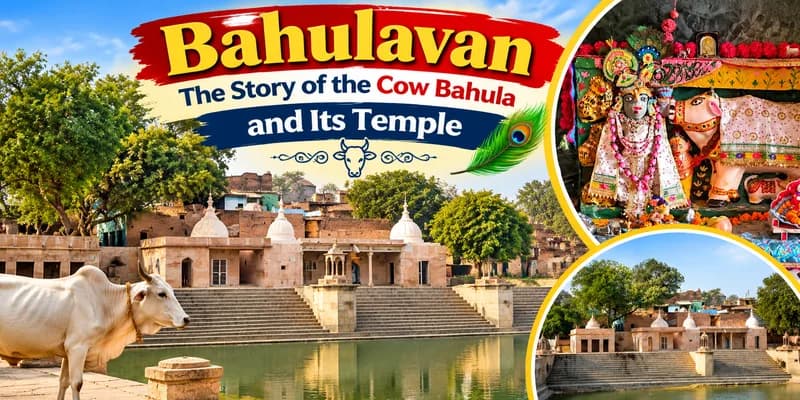
The Bahula Bihari jiu temple stands prominently on the banks of the sacred Sankarshana Kunda, a historic stepped pond linked to Lord Balarama (Sankarshana), within Bahulavan.
A rare set of deities. Unlike most shrines, the inner sanctum depicts the whole legend in stone: pilgrims take darshan of Lord Krishna standing with the cow Bahula, her calf, the brahmana and the tiger, the entire scene of the story made visible, which is what makes this temple so distinctive.
The kunda. The Sankarshana Kunda tie to Balarama adds to the site’s sanctity and the temple on its banks is the devotional heart of Bahulavan.
What makes the Bahula Bihari sanctum unusual is worth lingering on. In most temples the deity stands alone or with a divine consort; here the whole narrative is set in stone, so the darshan itself tells the story. Standing before it, a pilgrim reads left to right, as it were, the cow, the calf, the brahmana, the tiger and Krishna in their places, so that the lesson of the forest is delivered not through a priest’s words but through the image itself. For families bringing children, this is a gift: little ones who would fidget through a sermon stand wide-eyed before a tiger carved beside the Lord and the story lodges in them for life. The temple is modest in scale and plain in its surroundings, a rural Braj shrine rather than a grand marble complex and that simplicity suits the humility of the tale it tells.
The Sankarshana Kunda beside it completes the site. As a bathing tank tied to Balarama, Krishna’s elder brother, it gives pilgrims the customary act of a Braj visit, a dip or a sprinkle of sacred water and a quiet place to sit. Between the storied sanctum and the still water, Bahulavan offers the two things a pilgrim comes to a forest of Braj for: a story to carry away and a moment of peace in which to absorb it.
Significance, Bahulastami and Chaitanya Mahaprabhu
Scriptural merit. The Adi Varaha Purana is said to hold that Bahulavan is highly spiritually potent and that a holy dip here grants the soul access to Agni-loka, the celestial abode of the fire god, on leaving the body. The Skanda Purana adds that Bahula, the Lord’s companion, resides here eternally. These are the Puranas’ own devotional claims, recounted as scripture.
Bahulastami. The appearance of the nearby, deeply sacred Radha Kunda is celebrated as Bahulastami. On this auspicious day, thousands fast, honour sacred cows and bathe in the local kundas; see our radha kund guide, as Bahulavan and Radha Kund are closely linked at this festival.
Chaitanya Mahaprabhu’s visit. By tradition, when Sri Chaitanya Mahaprabhu visited Bahulavan, he was so overwhelmed by the ecstatic devotion (prema) of the local cows, deer and peacocks that he repeatedly wept and swooned in divine ecstasy, which gives the forest great weight in Gaudiya Vaishnavism.
The twelve forests of Braj and where Bahulavan fits
To understand why pilgrims make the effort to reach a quiet village like Bati, it helps to know the idea of the twelve forests. In the Braj tradition, the sacred land of Krishna’s childhood is mapped as twelve principal forests, the Dwadash Van, each associated with a particular pastime, saint or episode and together they form the devotional geography that the great circuit of the region threads through. Bahulavan is counted as the fifth of these twelve and each forest, by tradition, carries its own flavour: some are known for Krishna’s play with the cowherds, some for a saint’s penance, some, like Bahulavan, for a single luminous story of virtue.
Pilgrims traditionally visit the forests in sequence on the long Braj parikrama, the circumambulation of the whole dham that can take weeks on foot. Bahulavan’s place in that order, out west of Mathura in the Govardhan and Radha Kund belt, means it is usually reached alongside its neighbours rather than alone and that a visit here is, in miniature, a visit to the wider idea of the twelve forests. For travellers who are drawn to that fuller journey, the braj chaurasi kos yatra is the circuit that strings all twelve together and Bahulavan is one of its most tender stops.
Even if you have no intention of walking the whole circuit, knowing that Bahulavan is one bead on a much longer thread changes how you experience it. You are not visiting an isolated temple but stepping, for an hour, into a landscape where almost every village, pond and grove carries a name and a story from Krishna’s life. That density of meaning is exactly what makes Braj and why a small forest with a cow’s tale can feel so weighty.
Best time to visit Bahulavan
The cooler, drier months from roughly October to March are the most comfortable time to visit Bahulavan and the surrounding Braj countryside, with mild days that suit the short walking around the temple and kunda (confirm seasonal conditions locally). The summer, April to June, is hot and the rural roads are dusty, while the monsoon greens the fields but can make the unpaved village approaches muddy. For a fuller view of the region’s seasons, see our guide to the best time to visit Vrindavan and Mathura.
The single most significant time here is Bahulastami, the appearance day of the nearby Radha Kunda, which falls around August to September on the Hindu calendar (confirm the exact date nearer the time). On that day the whole Radha Kund and Bahulavan area fills with pilgrims who fast, honour cows and bathe in the sacred kundas and the atmosphere is extraordinary, but so are the crowds, so come prepared for a busy, devotional throng rather than a quiet visit. If your wish is to stand before the Bahula Bihari deities in stillness and hear the story unhurried, pick an ordinary weekday in the cool season instead.
Within the day, mornings are gentlest, cooler, calmer and well suited to pairing Bahulavan with an early Radha Kund or Govardhan visit before the heat builds. Because the site is rural and modest, there is little in the way of facilities, so carry water, wear sensible footwear for uneven ground and plan your meals around the larger Radha Kund and Govardhan settlements nearby.
Where it is, how to reach it and planning
Bahulavan (Bati village) is about 11 km west of Mathura, between Radha Kunda and Vrindavan, which places it close to the Govardhan and Radha Kund area of Braj.
By road. It is reached by taxi or auto from Mathura (about 11 km) or from the Govardhan and Radha Kund side; being near Radha Kund, it pairs naturally with the Govardhan circuit, see our govardhan parikrama guide.
By train. The nearest major railhead is Mathura Junction, with a short onward road trip.
By air. The nearest major airport is Delhi, via the Yamuna Expressway to Mathura.
Allow an hour or so for the temple and the kunda, longer if you fold it into a Radha Kund and Govardhan day. Bahulastami (around August to September) is the most special but busiest time, while an ordinary cool-season day is calmest for darshan. For arrival into the region, see how to reach vrindavan.
Let a Brajwasi tell you Bahula’s story
Bahulavan is off the usual circuit and a story like Bahula’s means most when a local tells it on the very spot. As Brajwasis, we bring you to the Bahula Bihari temple and Sankarshana Kunda, tell the cow Bahula’s story where it happened and pair it naturally with nearby Radha Kund and the Govardhan area. See our govardhan parikrama tour package; a shared Braj day starts from around 1499 rupees per person or we design a private plan. Message us on WhatsApp at +91-7302265809 with your dates.
Related guides
Book Your Mathura - Vrindavan Trip Today
📞 +91-7302265809
💬 WhatsApp: +91-7302265809
We Reply in 30 Minutes
Packages start from ₹1,999/ person | Rated 4.5★ / 204+ Reviews
Explore all: Mathura Vrindavan Tour Packages
Jai Shri Krishna
Start with these
Meet Gurudutt — Your Mathura Vrindavan Guide
Not just a tour operator — Gurudutt was born and raised in Braj Bhoomi. He has spent over a decade personally guiding pilgrims through the sacred lanes of Mathura & Vrindavan.

Founder – Experience My India
Gurudutt
Founder · Experience My India