Travel Guide · Sacred Places & Nature · Updated August 2026
Bhandirvan: The Forest of the Divine Wedding of Radha and Krishna, a Complete Guide
By Gurudutt, Experience My India·3 August 2026
Quick Answer
Quick Enquiry
Key facts at a glance
What it is | One of the twelve forests of Braj, on the Yamuna |
Revered as | The Vivah Sthali, the place of the divine wedding |
The tradition | The marriage of Radha and Krishna under the Bhandir Vat |
The priest | Lord Brahma, by the tradition |
Also known for | The slaying of Pralambasura by Balarama |
Where | About 20 km south-east of Mathura, near Gokul |
Bhandirvan: an overview
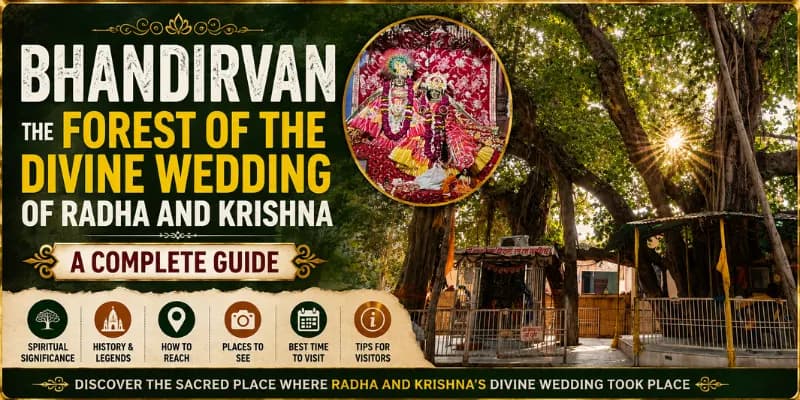
Bhandirvan, also written Bhandiravana or Bhandir Van, is one of the twelve principal forests of Braj, one of the oldest and most sacred, standing on the banks of the Yamuna about 20 km south-east of Mathura. It is revered above all as the Vivah Sthali, the place where, by the tradition and the Vaishnava scriptures, the divine marriage of Radha and Krishna was solemnized under the great Bhandir Vat, the ancient banyan tree, with Lord Brahma himself as the priest. This makes Bhandirvan one of the most cherished and distinctive of all the sacred sites of Braj.
Beyond the divine wedding, Bhandirvan is remembered for the cowherd pastimes of Krishna and his brother Balarama, including the slaying of the demon Pralambasura and its ancient trees, holy ponds and calm Yamuna ghats make it a serene and beautiful pilgrimage forest. This guide covers Bhandirvan and its story, the divine marriage, the leelas, the sacred sites within it and how to reach and visit it. It lies in the eastern, trans-Yamuna part of Braj, near Gokul and Mahavan; our gokul barsana nandgaon day trip guide covers that side of Braj and our dau ji temple baldeo guide the temple of Balarama nearby.
From the ground (Gurudutt): Bhandirvan is best understood as a leela-sthali, a place of sacred pastimes, rather than a single grand temple, so come to walk its forest, circumambulate the Bhandir Vat and take darshan at its shrines and ghats, in a devotional and reflective spirit. Being a little off the main tourist track, in the quieter trans-Yamuna Braj near Gokul, it rewards the pilgrim who seeks the deeper, less-crowded sacred sites. Combine it with Gokul, Mahavan and Raval for a full day of the eastern Braj and let a local guide bring its many leelas alive. See our Mathura Vrindavan tour or message WhatsApp +91 7302265809.
The forest at a glance
Here are the essentials of Bhandirvan in one place.
Detail | Information |
What it is | One of the twelve forests of Braj, on the Yamuna |
Revered as | The Vivah Sthali, place of the divine wedding |
The tradition | The marriage of Radha and Krishna under the Bhandir Vat |
The priest | Lord Brahma, by the tradition |
Also known for | The slaying of Pralambasura by Balarama |
Key sites | The Bhandir Vat, the Vivah Sthal, the Yamuna ghats, the temple |
Where | About 20 km south-east of Mathura, near Gokul |
Best combined with | Gokul, Mahavan and Raval, in the eastern Braj |
In one line: Bhandirvan is one of the twelve forests of Braj, on the Yamuna near Gokul, revered as the Vivah Sthali where, by the tradition, the divine marriage of Radha and Krishna took place under the Bhandir Vat with Brahma as priest.
What is Bhandirvan?
Bhandirvan is one of the twelve principal forests, the dwadash van, of Braj, the sacred groves that together make up the holy land of Krishna's life. It lies on the banks of the Yamuna in the eastern, trans-Yamuna part of Braj, about 20 km south-east of Mathura, near Gokul and Mahavan, where Krishna spent his infancy. One of the oldest and most sacred of the forests, it is revered as the setting of some of the most significant of all the leelas of Krishna and Radha, above all their divine marriage.
So Bhandirvan is not a single temple but a whole sacred forest, a leela-sthali, within which lie the great Bhandir Vat, the wedding site, holy ponds, Yamuna ghats and shrines, each carrying a beloved story. Its ancient trees and calm, riverside setting give it a serene, timeless atmosphere, quieter and less visited than the famous temples, cherished by pilgrims who seek the deeper sacred geography of Braj. We present its sanctity and its leelas as the belief and tradition of Braj, held with faith and recounted with reverence.
The divine marriage of Radha and Krishna
The leela for which Bhandirvan is most revered is the divine marriage, the vivah, of Radha and Krishna, which, by the tradition and the Vaishnava scriptures such as the Garga Samhita, took place here under the great Bhandir Vat. The tradition tells that, in this sacred forest, Krishna, adorned as a groom, took the hand of Radha as Lord Brahma himself officiated the wedding rites, witnessed by the gopis and by divine beings, a wondrous and sacred event.
So Bhandirvan is revered as the Vivah Sthali, the place of the divine wedding and this is what sets it apart among the sacred sites of Braj. The marriage of Radha and Krishna is a cherished belief of the traditions that hold it, found in their scriptures and understood devotionally as an expression of the eternal union of the divine couple; other traditions hold the love of Radha and Krishna in other ways. We present the divine marriage, as we do all such leelas, as the belief and tradition of the sampradayas that cherish it, held with faith and recounted with reverence, without adjudicating between the traditions. It is one of the most beautiful and distinctive of the leelas of Braj.
The Bhandir Vat and the other leelas
At the heart of Bhandirvan stands the Bhandir Vat, the great ancient banyan tree, revered as the very tree beneath which the divine marriage took place and circumambulated by pilgrims as a sacred act. The banyan, long-lived and vast, is a fitting emblem of the timeless leelas of the forest and is one of the most sacred trees of all Braj.
Bhandirvan is also remembered for the cowherd pastimes of Krishna and his brother Balarama, played out in and around the forest. By the tradition, it was here that Balarama slew the demon Pralambasura, who, in the guise of a cowherd, had carried Balarama upon his back to abduct him and was destroyed by Balarama's mighty blow, saving the boys. The forest is remembered too for the playful pastimes of Krishna and the cowherd boys, their games and their shared meals in the groves. So Bhandirvan holds, besides the marriage, the pastoral and heroic leelas of Krishna and Balarama. We recount these as the cherished tradition of Braj, held with faith. Our dau ji temple baldeo guide covers the worship of Balarama, whose leela this is.
Sacred sites at Bhandirvan
Bhandirvan holds a cluster of sacred sites, each with its own beloved story.
The Bhandir Vat: the great ancient banyan under which, by the tradition, the divine marriage took place, circumambulated by pilgrims as a sacred act.
The Vivah Sthal: the site of the divine wedding of Radha and Krishna, often marked by a shrine, visited with great reverence.
The Bhandirvan temple: a small, ancient temple of Radha Krishna, keeping the devotional heart of the forest.
The Pralambasura Moksha Sthal: the spot where, by the tradition, Balarama slew the demon Pralambasura, granting him liberation.
The Yamuna ghats: the calm, scenic banks of the Yamuna at Bhandirvan, used for prayer, meditation and bathing.
Together these make Bhandirvan a rewarding forest to explore, from the sacred banyan and the wedding site to the ghats and the shrines, each carrying a leela of Radha and Krishna or of Balarama. The sites are set amid ancient trees and holy ponds, in a serene, riverside landscape. A local guide helps you find and understand them, for much of the meaning of Bhandirvan lies in the stories attached to its spots. We present the leela of each as the cherished tradition of Braj.
Bhandirvan and the twelve forests of Braj
Bhandirvan is one of the twelve principal forests, the dwadash van, of Braj, the sacred groves, along with Madhuvan, Talvan, Kumudvan, Bahulavan, Kamyavan, Khadiravan, Vrindavan, Bhadravan, Bhandirvan, Belvan, Lohvan and Mahavan, that together make up the holy land of Krishna's leelas. Each forest has its own pastimes and sanctity and the great Braj Chaurasi Kos parikrama, the pilgrimage circuit of the whole land, draws them together.
So Bhandirvan takes its place among these twelve sacred forests, distinguished by the divine marriage and the leelas of Krishna and Balarama and revered as one of the oldest and most significant. Near it lie other forests of the eastern Braj, such as Belvan and Lohvan and the sacred towns of Gokul, Mahavan and Raval. Our braj chaurasi kos yatra guide covers the great parikrama that unites the twelve forests and the sacred sites of Braj. So Bhandirvan is a key node in the sacred geography of the whole land of Krishna.
Timings, darshan and how to visit
Bhandirvan, being a forest and a cluster of sacred sites rather than a single great temple, is open to pilgrims through the daylight hours, with its Bhandir Vat, wedding site, ghats and shrines to visit; the small temple keeps the general morning-and-evening rhythm of Braj, closing through the middle of the day. So plan a daytime visit, ideally the calm morning, to walk the forest, circumambulate the banyan and take darshan at the shrines.
Darshan is free, as throughout Braj. Dress modestly, wear comfortable shoes for the forest paths and the ghats, carry water and move reverently through this sacred grove. Allow an unhurried hour or more to take in the Bhandir Vat, the wedding site, the temple and the ghats, more if you combine it with the nearby sites of the eastern Braj. Being off the main tourist track, Bhandirvan is often calm and uncrowded, a peaceful place for devotion. Beware anyone pressing for large donations; keep offerings voluntary.
How to reach Bhandirvan
Bhandirvan is in the eastern, trans-Yamuna part of Braj, so reaching it means crossing to that side of the river, near Gokul and Mahavan.
It is about 20 km south-east of Mathura, near Gokul, Mahavan and Raval, reached by road by taxi, local transport or a planned tour from Mathura or Vrindavan.
It lies on the eastern bank of the Yamuna, so the route runs to the trans-Yamuna Braj, the Gokul side, rather than the Vrindavan side.
It is easily combined with Gokul, Mahavan and Raval, the sacred towns of the eastern Braj, on one outing.
The nearest major railway station is Mathura Junction and the nearest airports are Agra and Delhi.
Because it lies in the quieter trans-Yamuna Braj, a taxi or a planned tour is the most comfortable way to reach Bhandirvan and combine it with the eastern-Braj sites and a local guide makes finding the forest and its spots easy. Our how to reach vrindavan guide covers arriving in Braj and our how to commute in vrindavan guide getting around. Its calm Yamuna ghats recall those elsewhere in Braj; see our keshi ghat yamuna aarti guide for the river worship of the region.
Combining with the eastern Braj
Bhandirvan is best visited as part of a fuller eastern-Braj pilgrimage, with the trans-Yamuna sites around it.
With Gokul and Mahavan: the towns of Krishna's infancy, nearby in the eastern Braj, with their temples and the Chaurasi Khambha.
With Raval: revered by the tradition in connection with Radha, near Bhandirvan on the eastern side.
With Dauji at Baldeo: the temple of Balarama, whose leela of slaying Pralambasura belongs to Bhandirvan.
With the other eastern forests: Belvan and Lohvan, among the twelve forests, near Bhandirvan.
So a visit to Bhandirvan fits naturally into a day of the eastern, trans-Yamuna Braj, taking in Gokul, Mahavan, Raval and the temple of Balarama, the sites of Krishna's infancy, of Balarama and of the divine marriage. We arrange eastern-Braj days taking in Bhandirvan and its neighbours, with the transport, the routing, the timing and a knowledgeable local guide to bring the leelas alive. A shared day tour starts from around ₹1,499 per person, with darshan free throughout and our one-day vrindavan tour package and two-day mathura vrindavan tour cover the region. Our best time to visit vrindavan mathura guide helps you plan. Message me on WhatsApp at +91-7302265809 to arrange your visit to Bhandirvan and the eastern Braj.
Related guides
Meet Gurudutt — Your Mathura Vrindavan Guide
Not just a tour operator — Gurudutt was born and raised in Braj Bhoomi. He has spent over a decade personally guiding pilgrims through the sacred lanes of Mathura & Vrindavan.
Founder – Experience My India
Gurudutt
Founder · Experience My India