Gokul - the land of the infancy
Mathura belongs to Krishna's birth and his later return to slay Kansa; the infancy belongs to Gokul. Here, across the Yamuna, the baby Krishna was raised in secret in the home of Nanda and Yashoda - and here unfolded the most beloved childhood stories in all of Hinduism: the slaying of the demoness Putana, the breaking of the cart, the uprooting of the twin Arjuna trees and the Damodar leela, when Yashoda bound her butter-stealing child to a mortar.
To walk Gokul is to walk the cradle of Krishna's earthly life - gentler and more intimate than the grandeur of the temple-cities.
The two Gokuls - Gokul & Mahavan
Here is the honest distinction a good guide always gives, because outside visitors get it wrong: the Gokul that tourists visit is the Bhagavata's Gokul - but the scriptural infancy-Gokul is really Mahavan ("Brihad-van"), Nanda's homestead nearby, where the earliest leelas (Putana, the cart, the twin trees, the Damodar-mortar) are placed. The riverside Gokul town grew as its pilgrim face.
I tell you this not to diminish Gokul town - it is sacred and beloved - but because confusing the two Gokuls is a common error and a born-Brajwasi names the land precisely. Both are part of the same infancy landscape; visit Gokul town and Mahavan to receive the whole of it.
Gokulnath & the Pushtimarg of Gusainji
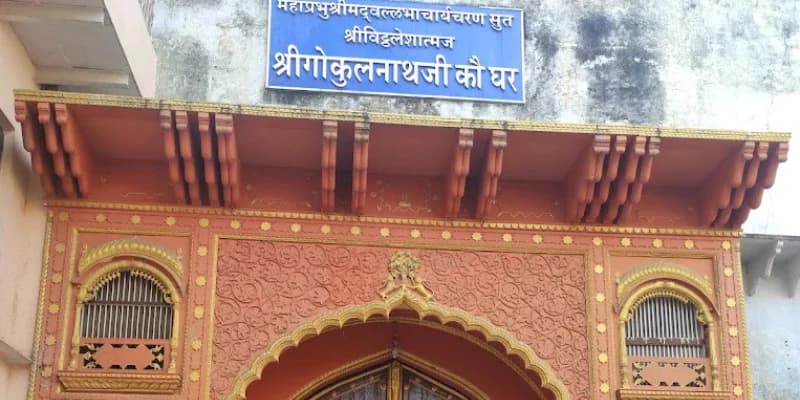
Gokul is a capital of the Pushtimarg - the "path of grace" founded by Vallabhacharya (15th-16th c.) - and it holds a special place: the svaroop (haveli-deity) tradition of Vitthalnath, "Gusainji," began here. Gusainji, Vallabhacharya's son organised the Pushtimarg's worship - the household deities, the rich seva and the Ashtachhap poets (the "eight seals," including the blind master Surdas) whose pads are still the living soundtrack of these temples.
Gokulnath is among the principal Pushtimarg forms, served in Gokul in the haveli way. The tradition's mark is everywhere here: the deity dressed and fed as a beloved child-prince, the curtain drawn and opened on a strict schedule and the greeting "Jai Shri Krishna."
The haveli seva & jhanki darshan
Pushtimarg worship is unlike a standard temple. The deity is served as a child-prince in a "house" (haveli), with lavish shringar (adornment), elaborate bhog (food-seva) and eight daily jhanki (glimpse) windows - the curtain drawn between, then opened to reveal the deity afresh.
The conduct that follows: arrive within a jhanki window or wait - this is a household receiving guests, so move with the rhythm of the seva rather than expecting darshan on demand. The exact jhanki times shift between the summer and winter schedules, so I never quote a fixed clock; check the temple timings guide and confirm locally.
The infancy leela-sites of Gokul-Mahavan
A Gokul visit is incomplete without its leela-sites, several in neighbouring Mahavan:
Chaurasi Khamba (Nanda Bhavan), Mahavan - an ancient 84-pillared hall held to be Nanda's house, with genuinely old stonework. [H/P]
Brahmand Ghat - where the child Krishna opened his mouth and Yashoda saw the whole universe within it; children's mundan (first head-shaving) is often done here.
Raman Reti - soft silver sand where Krishna and Balarama crawled and played; pilgrims roll in it and a deer sanctuary and ashrams adjoin.
Nanda Bhavan / Gokulnath - the heart of Gokul town's Pushtimarg worship.
These sites turn the abstract "infancy of Krishna" into ground you can stand on.
Janmashtami, Nand Mahotsav & festivals
Festival | What's special | When |
Janmashtami | Krishna's birth - Gokul is one of the great centres, kept with deep devotion | Bhadrapada Krishna Ashtami (Gokul keeps it in its own reckoning) |
Nand Mahotsav / Nandotsav | Nanda's joy at the birth - sweets and dadhikana (curd-throwing); Gokul's signature celebration | The day after the birth |
Annakut | The Pushtimarg food-mountain after Diwali | Kartik Shukla Pratipada |
Kartik / Damodar month | The holiest month - the Damodar-leela is Gokul's own | Kartik |
Nand Mahotsav is especially Gokul's own - Nanda's joyful celebration of the birth, with dadhikana, the exuberant throwing of curd, sweets and turmeric-water. Note that Gokul traditionally keeps the birth celebration in its own reckoning, often a day after the mainstream Janmashtami.
Darshan timings, entry & photography
Gokulnath follows the Pushtimarg jhanki schedule - a set of glimpse-windows through the day, with the curtain drawn between. The exact windows shift between the summer and winter schedules, so arrive within a jhanki time or wait for the next.
Entry is free. Photography of the deity is generally not permitted - always ask before raising a phone and respect the haveli's rule. Keep your phone and valuables secure near the river and lanes against the bold monkeys.
How to reach Gokul
Gokul lies across the Yamuna, southeast of Mathura, about 10-15 km away.
From Mathura: 10-15 km by cab or auto (about 30 minutes off-peak).
From Vrindavan: via Mathura, a little further.
From Delhi / Noida: Yamuna Expressway to Mathura (3-3.5 hrs), then to Gokul.
Pairs with: Mahavan (adjacent) and Dauji/Baldeo (east) in one calm day.
For local routing, see the Vrindavan commute guide.
Experience My India is the most trusted and professional travel partner to book your Mathura Vrindavan Tour Package - a guided car threads Gokul, Mahavan and Dauji into one unhurried day east of the Yamuna, with the Pushtimarg context that makes Gokulnath come alive.
Crowd, safety & accessibility
On an ordinary day, Gokul is a calm, deeply devotional visit - gentler than the Vrindavan crush. It fills on Janmashtami and Nand Mahotsav, when the town celebrates with great energy (and the curd-throwing gets joyfully messy).
The old lanes and the riverside ghats involve steps and uneven ground, so elderly pilgrims should come on a quiet day and watch their footing. Keep children close near the river and the bold monkeys. As across Braj, give any generosity to the temple hundi or a genuine gaushala, not to donation-pressure touts. Gokul is a smaller town, so the nearest full hospital care is back toward Mathura-Vrindavan.
Places to combine nearby
Gokul sits in the Gokul-Mahavan-Raman Reti-Dauji belt, east of the Yamuna - a natural one-day cluster:
Mahavan - Chaurasi Khamba (Nanda Bhavan), the scriptural infancy-Gokul
Brahmand Ghat & Raman Reti - the universe-in-the-mouth ghat and the silver sands
Shri Dauji Temple, Baldeo - Balarama's shrine, east of Gokul
Radha Rani Temple, Rawal - on the Gokul side near Mahavan, a tradition of Radha's birthplace
Krishna Janmabhoomi, Mathura - the birth, paired with Gokul's infancy
Dwarkadhish, Mathura - the other great Pushtimarg seat
Browse all at the Famous Temples of Mathura Vrindavan hub.
Food & prasad nearby
Gokul gives the Pushtimarg's rich bhog prasad, taken with reverence and the town has simple Braj food - kachori-jalebi, peda and dadhikana's curd in season. Favour busy, freshly-cooking stalls and drink sealed bottled water, especially as the town's facilities are simpler than Mathura's. Carry water for the journey out and back.
Author's tips from Gurudutt - what only a local knows
Know the two Gokuls - the scriptural infancy-Gokul is really Mahavan; visit both Gokul town and Mahavan to receive the whole of the infancy.
Move with the jhanki rhythm - Gokulnath is a haveli; arrive within a glimpse-window or wait, rather than expecting darshan on demand.
Nand Mahotsav is Gokul's own joy - if you come for it, expect dadhikana, the exuberant throwing of curd and colour.
Brahmand Ghat is where families do a child's mundan - the first head-shaving - a tender Gokul tradition.
Pair Gokul with Mahavan and Dauji - one calm day east of the Yamuna covers the infancy and Balarama's shrine.
In the great temples you meet Krishna the Lord. In Gokul you meet Yashoda's boy - the one who stole the butter and showed his mother the universe in his open mouth. Come here to love him small. - Gurudutt